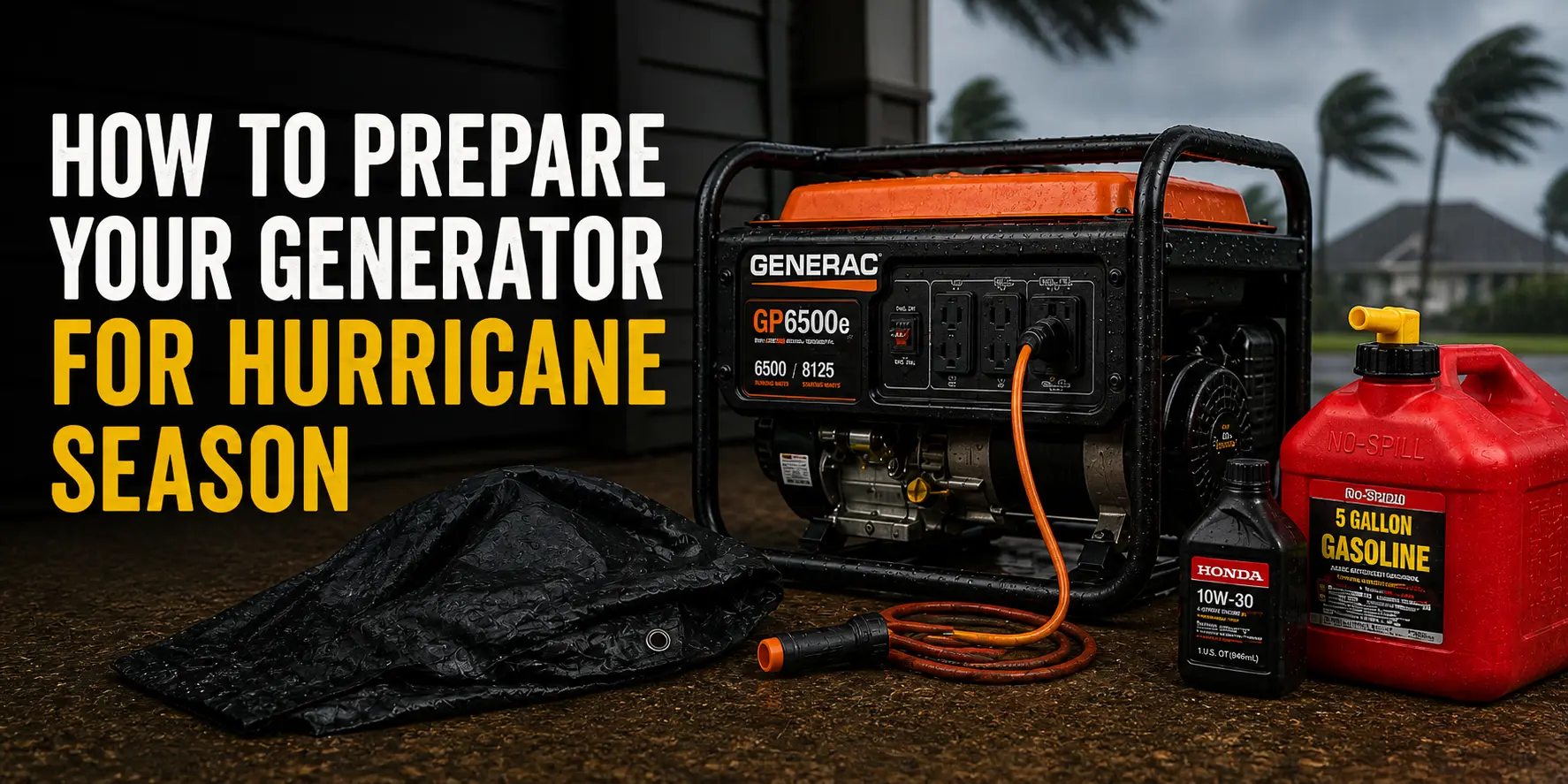
How to Prepare Your Generator for Hurricane Season
Hurricane season runs June 1 through November 30 in the Atlantic. Pacific season starts in mid-May. By the time the first named storm forms, every repair shop within 200 miles of the coast is booked solid for two weeks. The cheapest, fastest, least stressful generator service is the one you do before the season starts.
This is a checklist, not a deep technical dive. Most of it takes about an hour. Some items only apply to certain generator types — skip what doesn't fit yours. The order below moves from "everyone should do this" to "do this if you have time."
If you've never run your generator since you bought it, start with the manual. The first run-in routine for a new unit is different from annual maintenance.
Seasonal backup power boxes
1. Run the engine for 20 minutes under load
This is the single most important thing on this list. Generators that sit idle for months develop fuel system problems, battery drain, and seal stiffness — running the engine under actual electrical load is the fastest way to catch all of it before a storm.
What to do:
Pull the generator outside (never run a generator indoors or in a garage, even with the door open). Fill the tank with fresh fuel. Start the engine and let it warm up for 2-3 minutes at idle.
Then plug in a load. A space heater on high, a hair dryer, a window AC unit, or a small power tool — anything pulling 1,000+ watts. Run the generator under this load for at least 20 minutes. The engine should hold steady RPM, the load should run normally, and there should be no smoke, sputtering, or unusual noises.
If the engine surges (see the generator surging guide for diagnosis), dies under load, or won't hold the rated voltage, you've identified a problem with weeks of buffer to fix it. That's the entire point of this exercise.
2. Drain old fuel and refill with fresh
Fuel that's been sitting in the tank since last hurricane season is the leading cause of no-starts. Don't skip this even if the generator started fine in step 1 — old fuel can run a generator one day and seize the carburetor the next.
Drain the tank completely using the fuel valve drain or a siphon. Dispose of the old fuel responsibly (most auto parts stores accept it, or check your local hazardous waste guidelines). Refill with fresh gasoline.
If your area sells ethanol-free gas, use it — it stores significantly longer. If only standard 87 octane with up to 10% ethanol is available, that's fine, but plan to cycle the fuel more frequently.
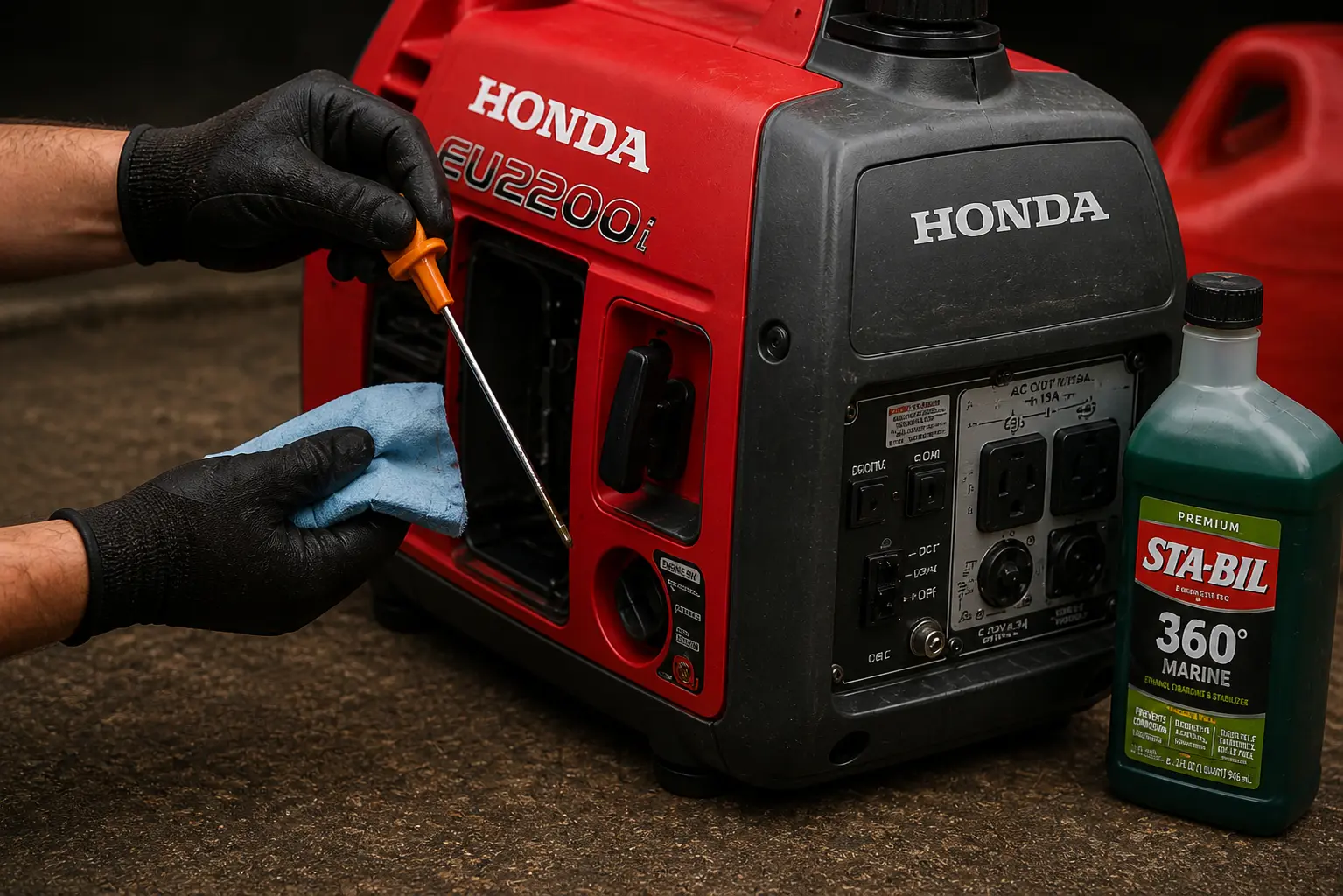
Add fuel stabilizer at the dose listed on the bottle. Sta-Bil, Sea Foam, Star Tron, or any equivalent works. This buys 6-12 months of stable fuel life. Run the generator for 5 minutes after adding stabilizer so it circulates through the carburetor.
3. Change the oil
Generator manuals typically recommend an oil change every 50-100 hours of run time. Most homeowners never hit that threshold because their generator runs maybe 30 hours a year. The bigger issue isn't run time — it's age. Oil oxidizes and loses lubricating properties over time, even when the engine isn't running.
If you haven't changed the oil in over a year, change it now.
What to do:
Run the engine for 5 minutes to warm the oil (warm oil drains cleaner). Shut off the engine. Remove the drain plug — most generators have it on the bottom or side of the engine block. Drain the oil into a pan. Replace the drain plug.
Refill with the oil grade specified in the manual — for most generators that's SAE 30 in summer, 10W-30 for variable temperatures, or 5W-30 for cold-weather use. Generators are typically run during summer storm conditions, so SAE 30 is usually correct unless the manual says otherwise. Don't overfill — check the dipstick after refilling.
Used oil goes to the same places as old fuel. Don't pour it down the drain.
4. Replace the spark plug
Spark plugs are $4-8 and take five minutes to replace — the NGK BPR5ES fits most Briggs, Generac, and Honda consumer generator engines (verify against your manual). There's no good reason to keep an old plug in a generator that needs to start reliably during an emergency.
Pull the existing plug with a plug socket. Note the gap if the new plug isn't pre-gapped. Most generator plugs are pre-gapped from the factory — check the box. Install the new plug hand-tight first, then torque it to the spec on the plug box (usually 15-20 ft-lbs for a 14mm plug).
If the old plug came out wet with fuel, your engine was running over-rich, which suggests a carburetor adjustment is needed. If it came out covered in oil, you have an oil leak past the rings or valve seals — that's a shop visit.

5. Check and clean the air filter
Pop the air filter cover. If the element is dusty but otherwise intact, you can usually tap it out and reinstall. If it's clogged enough to block light, replace it.
Foam pre-filters can be washed in soapy water, dried completely (this takes hours, do it the day before), and lightly oiled with clean engine oil. Squeeze excess oil out before reinstalling.
Paper elements get replaced, not cleaned. They're typically $5-15 and take 60 seconds to swap.
6. Check the battery (electric-start models)
If your generator has electric start, the battery is one of the most common failure points. Lead-acid batteries lose charge sitting idle and can drop below the voltage needed to crank the engine within 6 months of disuse.
What to check:
Look at the battery terminals. White or green corrosion means the terminals need cleaning — disconnect the cables (negative first), wire-brush the terminals, reattach (positive first), and apply a thin layer of dielectric grease.
Check voltage with a multimeter if you have one. A healthy 12V lead-acid battery reads 12.6-12.8V at rest. Below 12.4V means it needs charging. Below 12.0V usually means the battery is failing and should be replaced before the season.
If you don't have a multimeter, just try electric start. If it cranks slowly or clicks without spinning, charge the battery overnight with a trickle charger. If it still won't crank after charging, the battery is done.
For standby generators (Generac, Kohler home standby units), the battery should be tested annually by an authorized service tech as part of regular maintenance — many of these units have battery monitoring that triggers warnings on the controller.
7. Verify the transfer switch (standby generators only)
If you have a standby generator with an automatic transfer switch, test the actual power transfer at least once before the season. Most ATS systems have a test mode in the control panel. Run it and confirm:
- The generator starts and reaches steady RPM
- The transfer switch actually switches load from utility to generator
- The home circuits you expect to power up actually do
- The generator runs the load steadily for at least 15 minutes
- The system transfers cleanly back to utility when the test ends
If anything in this sequence is wrong — failed transfer, half the circuits don't power, controller throws a fault code — call your installer or a licensed electrician. Don't wait until the storm.
8. Check fuel storage and capacity
Most portable generators run 8-12 hours on a tank of fuel under typical load. After a hurricane, gas stations may be without power for days, and the ones that have power will have lines stretching for miles.
Calculate what you need:
Plan for at least 72 hours of generator runtime. If your generator burns 1 gallon per hour at typical load (most 5,000-7,000W portables do), that's 72 gallons of stored fuel. Most homeowners store 10-25 gallons, which gets you through about a day.
Stored fuel rotates. Even with stabilizer, gasoline degrades after 12 months. Plan to use stored fuel in your vehicles before hurricane season starts and refill with fresh gas + stabilizer. Don't store fuel for more than a year.
Fuel containers should be ANSI/CARB compliant, kept in a cool place out of direct sunlight, and away from any ignition source. Don't store gasoline in your house or attached garage. A detached shed or outdoor cabinet rated for fuel storage is the right setup.
For propane and natural gas standby generators, this isn't an issue — the supply is continuous. But verify the propane tank gauge if you're on stored propane.
If your generator is down and you still need a short-term backup plan for lights, phones, medical devices, or a refrigerator, a battery station from EcoFlow or BLUETTI US can cover the gap while you wait on parts or a shop appointment. Keep that use case narrow: it is a bridge, not a replacement for a full-size generator on a storm-prone property.
9. Make sure you can actually move it
Sounds obvious, but portable generators get heavy fast. A 7,000-watt unit weighs 200+ pounds with a full tank. Make sure the wheels turn freely, the handle isn't seized, and you can actually pull it from storage to operating position without throwing your back out.
If you've moved since last storm season, walk the route the generator needs to take. Make sure no doors are too narrow, no thresholds are too tall, and no extension cords need to run somewhere they didn't last year.
10. Test your extension cords and inlet box
This is the most common day-of-storm screw-up: the generator works fine, but you can't actually get power into the house because of a cord problem.
What to check:
If you use heavy-duty extension cords, plug them in to the generator and test each one with a known load. Worn cords with damaged insulation are a fire and shock hazard — replace anything sketchy.
If you have an installed transfer switch or generator inlet box, test the connection. The generator-to-inlet cord should plug in cleanly without forcing it. The breakers in the transfer switch should move freely.
If you don't have an inlet box and you're running cords through windows or doors, mark which appliances will get powered and label your cord runs so you don't have to figure it out at 2 AM in 50 mph winds.
When to call a shop
Most of the items above are DIY-friendly with basic mechanical skills. Bring your generator to a shop if:
- The engine surged or wouldn't hold load during step 1 — likely a governor or carburetor issue
- The engine produced significant smoke during the run-in test
- You see fuel or oil leaking from any seal or gasket
- The electric starter clicks but won't crank even with a fresh battery
- Your standby generator's controller is showing fault codes you can't clear
Most independent generator shops can complete a full pre-season service — oil, plug, filter, fuel system clean, load test — in 1-2 hours for $150-250 depending on engine size. For a full cost breakdown before authorizing work, see how much does generator repair cost. Booking before May 1 usually gets you a slot. After June 1, expect 2-3 week waits.
If you can't tell what's wrong but the generator isn't running right, find a verified small engine repair shop near you below. Most can give a phone diagnosis and quote before you bring the unit in.
This guide covers gas, propane, and natural gas generators including portable and standby units (Generac, Honda, Champion, Briggs & Stratton, Kohler, and similar). Diesel generators have different maintenance schedules and aren't covered here. Always follow the maintenance schedule in your specific generator's manual — these are general guidelines and your model may have specific requirements.