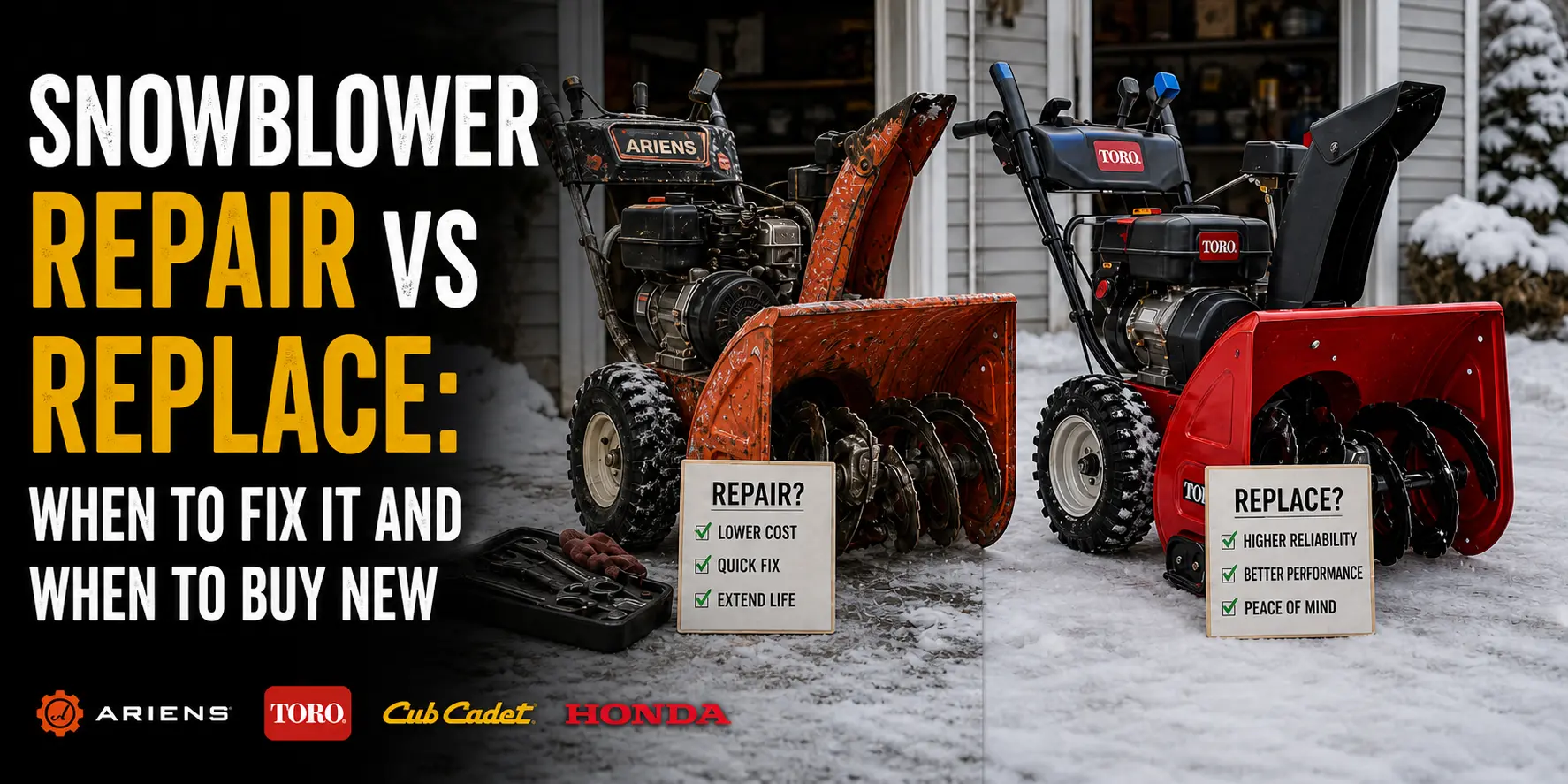
Snowblower Repair vs Replace: When to Fix It and When to Buy New
The decision between repairing an aging snowblower and replacing it usually comes down to one calculation: what's the repair cost as a percentage of replacement value?
The general rule across small engine equipment: if a single repair exceeds 50% of replacement cost, replacement is usually the better call. If the snowblower has multiple accumulating issues that would each cost 25-40% of replacement value, it's also time to replace.
But that rule is too crude on its own. Snowblower replace-or-repair decisions also depend on the snowblower's age, parts availability, the specific failure type, and whether you can survive a season with it out of commission. This guide gives you a clearer framework.
Cost thresholds by snowblower type
The decision is mostly about replacement value. Here are realistic numbers for 2026:
Single-stage snowblowers (Ariens Path-Pro, Toro Power Clear, Honda HS720, similar)
- Typical replacement cost: $400-700
- Repair budget cap: 50% of replacement value = $200-350
- Above the cap: Replace. Below: Repair makes sense.
Two-stage snowblowers, residential (Ariens Deluxe, Toro Power Max, Cub Cadet 2X)
- Typical replacement cost: $800-1,400
- Repair budget cap: $400-700
- Above the cap: Strongly consider replacement, especially if the snowblower is over 10 years old.
Two-stage snowblowers, premium (Ariens Platinum, Toro Power Max HD)
- Typical replacement cost: $1,400-2,200
- Repair budget cap: $700-1,100
- These are designed to last 20+ years; major repairs are often worthwhile.
Three-stage and tracked snowblowers (Cub Cadet 3X, Honda HSS series, Ariens Pro)
- Typical replacement cost: $1,500-3,500
- Repair budget cap: $750-1,750
- Almost always worth repairing unless the engine block is cracked or the auger gearbox is destroyed.
Honda commercial-grade (HSS724, HSS928, HSS1332)
- Typical replacement cost: $2,500-4,500
- Repair budget cap: $1,250-2,250
- These are built like industrial equipment. Major rebuilds are routine and worthwhile.
Age matters more than people think
A 5-year-old snowblower with a $300 carburetor problem is probably worth fixing. The same $300 carburetor problem on a 15-year-old snowblower is a harder call.
Here's why: snowblowers don't fail in isolation. When a 15-year-old machine has a major repair need, it usually has 2-3 other issues lurking that will surface within a season or two. You fix the carb today, the belts go next month, the auger gearbox starts grinding next year. By the time you're done, you've spent $700 on an $800 machine.
Age guidelines:
- 0-5 years old: Repair almost always makes sense unless the repair exceeds 60-70% of replacement.
- 5-10 years old: Standard 50% rule applies.
- 10-15 years old: Be conservative — 35-40% of replacement is the practical cap.
- 15+ years old: Major repairs (engine internals, auger gearbox, transmission) usually mean it's time to replace, even if the math is close.
There's an exception: older Honda snowblowers and high-end Ariens are worth repairing past these age cutoffs. A 15-year-old Honda HS828 in good cosmetic condition is often worth $400-600 used and is built to last another 10-15 years with proper service. An old Cub Cadet 1024 of the same age is worth $100-150 and has another 3-5 years if you're lucky. For brand-specific longevity data and parts availability that affect this decision, see Ariens vs Toro snowblowers compared.
Repairs that almost never make economic sense
Some specific repairs are usually deal-breakers regardless of age:
Engine block replacement on a consumer-grade snowblower. A new short-block runs $300-500 plus labor. On a $600 snowblower, that's the entire replacement value gone for one repair. Replace the snowblower instead.
Transmission failure on a self-propelled two-stage. Transmissions are expensive ($200-500 in parts) and labor-intensive (3-5 hours). On older snowblowers, you're often better off replacing.
Auger gearbox grenading. Auger gearboxes contain hardened steel gears in oil bath. When they fail catastrophically (chunks of metal in the oil, grinding sounds, refuses to spin), repair often costs $300-600. On consumer snowblowers, this is usually the death knell.
Cracked auger housing. The metal scoop assembly that contains the augers. Welding repairs are sometimes possible but rarely durable. Replacement housings cost more than most consumer snowblowers are worth.
Multiple electronic faults on premium models with control boards. Premium snowblowers with electric start, heated handles, and electronic chute control have proprietary control boards that cost $200-500. When they fail in combination, the math gets ugly fast.
Repairs that usually make sense regardless of age
These are repairs where the math almost always favors fixing:
Carburetor service. Even at $150-200, a carb service is the highest-value repair on any snowblower. If the only issue is the carburetor, fix it. The snowblower tune-up cost guide has itemized pricing for what a fair quote looks like.
Spark plug, fuel filter, fuel lines. Total cost under $50 in parts. Always worth doing.
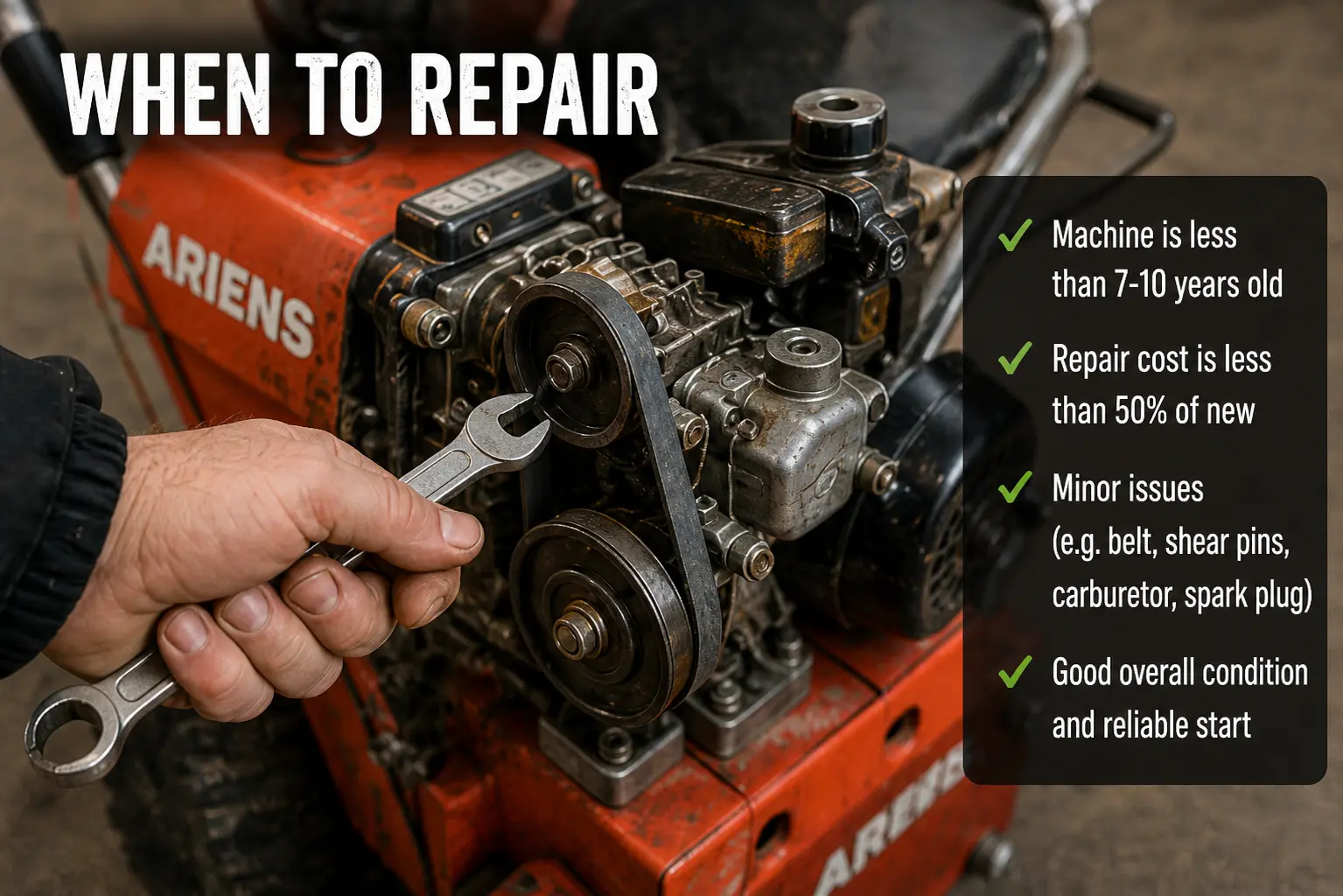
Belt replacement. $40-80 each, including labor. Worth doing as preventive maintenance, not just repair.
Shear pin replacement. $5-15 each. These are designed to break — replacing them is expected maintenance, not real repair.
Skid shoe and scraper bar replacement. $30-60 in parts. Worth doing because worn skid shoes accelerate damage to the auger housing.
Recoil starter assembly. $50-100. Cheap fix, cheap part, worth doing.
How to estimate before authorizing repair
The right approach when faced with a major repair quote:
1. Get a written diagnosis with itemized costs. Don't authorize work based on a verbal "it's going to need..." Reputable shops put proposed work in writing.
2. Look up replacement cost honestly. Check current pricing at Home Depot, Lowe's, or local equipment dealers. Used market on Facebook Marketplace or Craigslist tells you what the snowblower is realistically worth as-is.
3. Apply the percentage rule. Repair cost ÷ replacement cost = decision percentage. Above 50% generally means replacement; below 35% generally means repair; 35-50% depends on age and other factors.
4. Ask the shop for their honest take. Most reputable shops will tell you when a repair isn't worth it. That honest assessment is one of the most valuable things a good local repair shop offers. If the shop is pushing repair on a clearly uneconomic case, get a second opinion.
5. Consider the season. Mid-storm season, replacement isn't always immediately available — supply chain delays and seasonal demand can mean 2-4 week waits for a new snowblower. Sometimes the right call is to repair the existing machine to make it through this winter and replace next fall.
The "repair to last one more season" approach
A common scenario: 12-year-old snowblower with $400 in needed repairs, replacement value $700, you're on the fence. The compromise approach:
Authorize the minimum repairs needed to get through the season. Carburetor service, spark plug, belt replacement — the basics that get the snowblower running reliably. Skip the optional preventive work (auger gearbox flush, deep tune-up, cosmetic repairs).
This usually cuts the repair bill 30-50%. Then plan to replace next fall when shop pricing is best and you have time to research the right new unit.
The risk: a major failure mid-season that wasn't caught during the minimal repair. The math: a second repair on top of the first usually means total spending exceeds replacement value, which puts you in the worst position.
This compromise works best when the snowblower is in mostly good cosmetic condition (suggesting careful ownership), the failure is fuel-system-related (which is fixable), and you're certain about replacing in 6-12 months anyway.
When replacement is clearly the right call
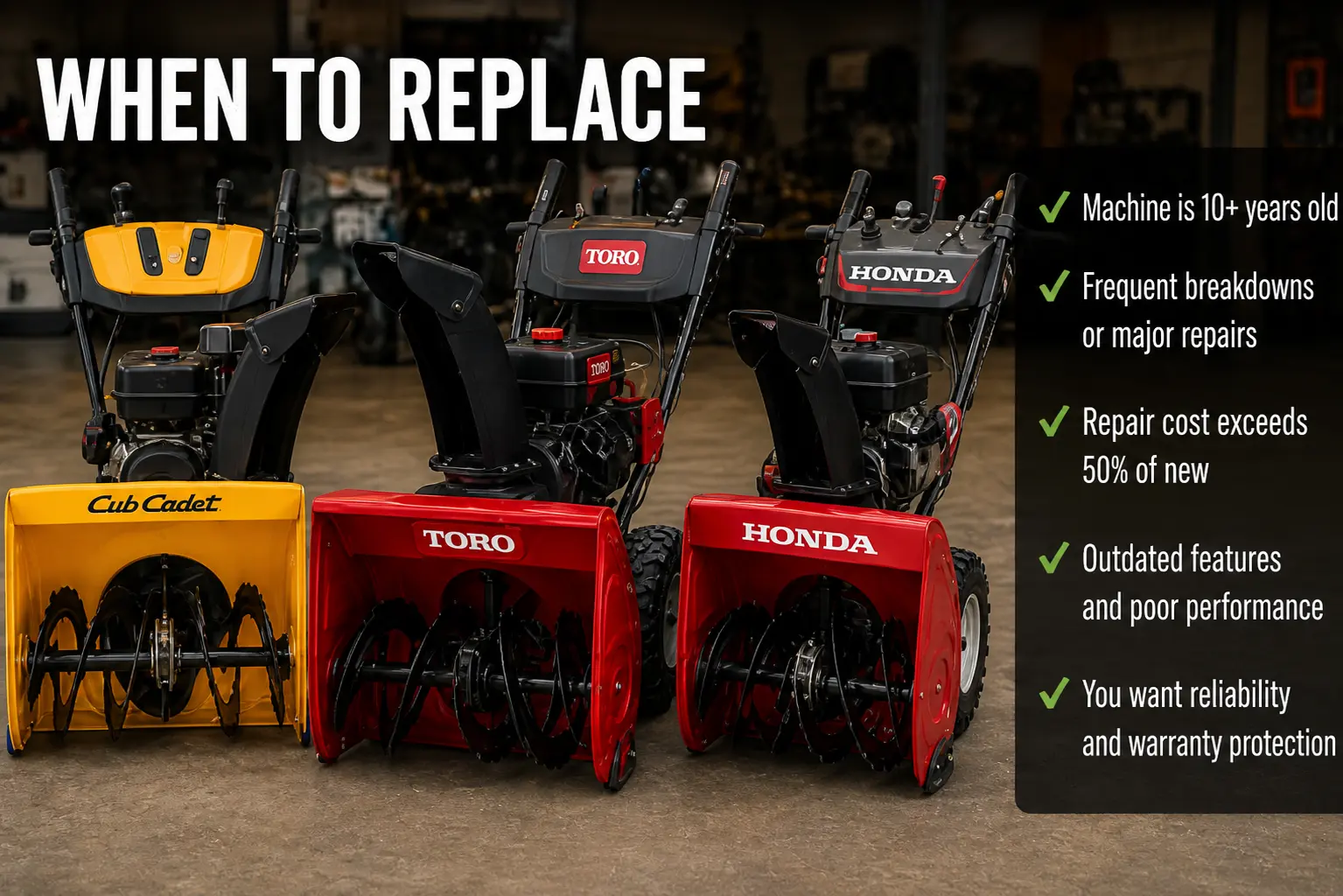
You're better off replacing without much agonizing when:
- Engine internal repair quoted (compression loss, ring replacement, valve work) on a consumer snowblower
- Auger gearbox needs full rebuild on anything under premium-tier
- Multiple unrelated repairs needed simultaneously (carb + transmission + belt + housing)
- The snowblower is 15+ years old and needs anything beyond routine maintenance
- Parts availability is becoming a problem (older models with discontinued parts)
- The frame, housing, or bucket has structural damage from impact or rust
In these cases, the math will rarely favor repair, and the next major failure is likely close behind.
What to do with the old snowblower
If you decide to replace, the old snowblower has options:
Sell it as-is on local marketplace. Facebook Marketplace and Craigslist accept "needs work" listings. Disclose the issues honestly. A non-running snowblower with documented problems is typically worth $50-150 to someone who wants a parts source or DIY project.
Trade-in at a dealer. Some snowblower dealers offer trade-in credit toward new purchases. Usually less than private sale value, but easier and the dealer handles disposal.
Donate to a vocational program. Local technical schools and community college small engine programs often accept non-running equipment for student practice. Tax-deductible in most cases.
Scrap. Final option — most metal recyclers accept snowblowers. You'll get $20-40 for scrap value depending on size.
If you're not sure where to start with the repair-vs-replace decision, find a verified small engine repair shop near you below. Most will give an honest assessment for the cost of a diagnostic fee — money well spent before authorizing a $400-700 repair.
This guide covers gas-powered single-stage, two-stage, and three-stage snowblowers (Ariens, Toro, Cub Cadet, Craftsman, Husqvarna, Honda, and similar consumer/prosumer brands). Battery-powered electric snowblowers have different replacement economics (battery costs are usually the deciding factor) and aren't covered here. Pricing and replacement value estimates are based on 2026 U.S. market conditions.