
Why Won't My Snowblower Start? 8 Common Causes (And What To Try)
It's the morning after a storm. Eight inches of heavy wet snow on the driveway. The snowblower that worked fine last March is sitting in the garage refusing to start. Pull cord, nothing. Pull again, nothing. Your back is starting to complain just thinking about shoveling.
Snowblowers are particularly punishing on neglected maintenance. They sit unused for 7-9 months a year, then get asked to perform reliably in subzero temperatures with old fuel and cold-stiffened seals. Most no-start issues trace back to fuel system problems caused by long off-season storage — and most are fixable in an afternoon with basic tools and a few cheap parts.
The eight causes below are listed in the order a small engine technician would actually check them. Work through them sequentially.
1. Old fuel from last season (the #1 cause)
If your snowblower sat from March to December with fuel in the tank, that fuel is the problem. Gasoline mixed with the standard 10% ethanol in U.S. pump gas starts degrading within 30 days and is essentially varnish by 9 months later.
Snowblowers are uniquely vulnerable because of their long storage period. A generator that sits 6 months might still start; a snowblower that sits 9 months almost never will without intervention.
What to try first:
Drain the tank completely. The fuel valve below the tank usually has a drain screw, or you can siphon it out into a separate container. Don't put the old fuel back in your gas can with fresh fuel — it'll contaminate the whole batch.
Refill with fresh ethanol-free gasoline if available, or fresh 10% ethanol pump gas if that's all you can get. Add a fuel stabilizer like STA-BIL (Sea Foam, Star Tron — all work) at the dose listed on the bottle.
Try starting again with the choke fully on and primer pumped 3-5 times. If the engine fires briefly and dies, the carburetor is fouled too (see #2).
2. Carburetor gummed up from old fuel
The carburetor on a snowblower is small and the fuel passages inside are smaller. When fuel evaporates inside it, the residue blocks the jets and metering passages. Even with fresh fuel in the tank, a gummed carburetor won't deliver fuel to the cylinder correctly.
Symptoms: engine fires for 1-2 seconds and dies, runs only with the choke fully on, won't idle, or won't start at all even with fresh fuel.
What to try first:
Spray carburetor cleaner directly into the air intake while pulling the starter cord. If the engine fires for a few seconds, the carburetor is the issue.
A full clean involves removing the carburetor, soaking the components, replacing the diaphragm and gaskets, and clearing the jets. Carburetor rebuild kits are typically $10-25 for most snowblower models (Ariens, Toro, Cub Cadet, Craftsman, Husqvarna). DIY is doable for someone comfortable with small parts; many people prefer to bring it to a shop given how small the components are.
A shop carb service typically runs $80-150 plus parts on a snowblower. For what's typically included in a full pre-season service and how to evaluate a quote, see the snowblower tune-up cost guide.
3. Fouled spark plug
Snowblowers run rich (more fuel, less air) for cold-weather starting, which fouls plugs faster than warmer-weather equipment. After 50-100 hours of run time, or 2-3 winters of regular use, the plug stops firing reliably.
What to try:
Pull the spark plug with a plug socket. If it's wet with fuel, you flooded the engine — pull the cord 10-15 times with the choke open and plug out, dry the plug, then reinstall and try again. If the plug is black and crusty or covered in oily deposits, replace it.
Plugs are $4-8 and most snowblowers use a common Champion or NGK plug. The owner's manual or a quick search by snowblower model will give you the part number.
While the plug is out, ground the metal body of the plug against the engine block (using the wire boot, not your bare hand) and pull the starter. You should see a clean blue spark jump the gap. No spark or weak orange spark means an ignition coil issue, which is shop work.
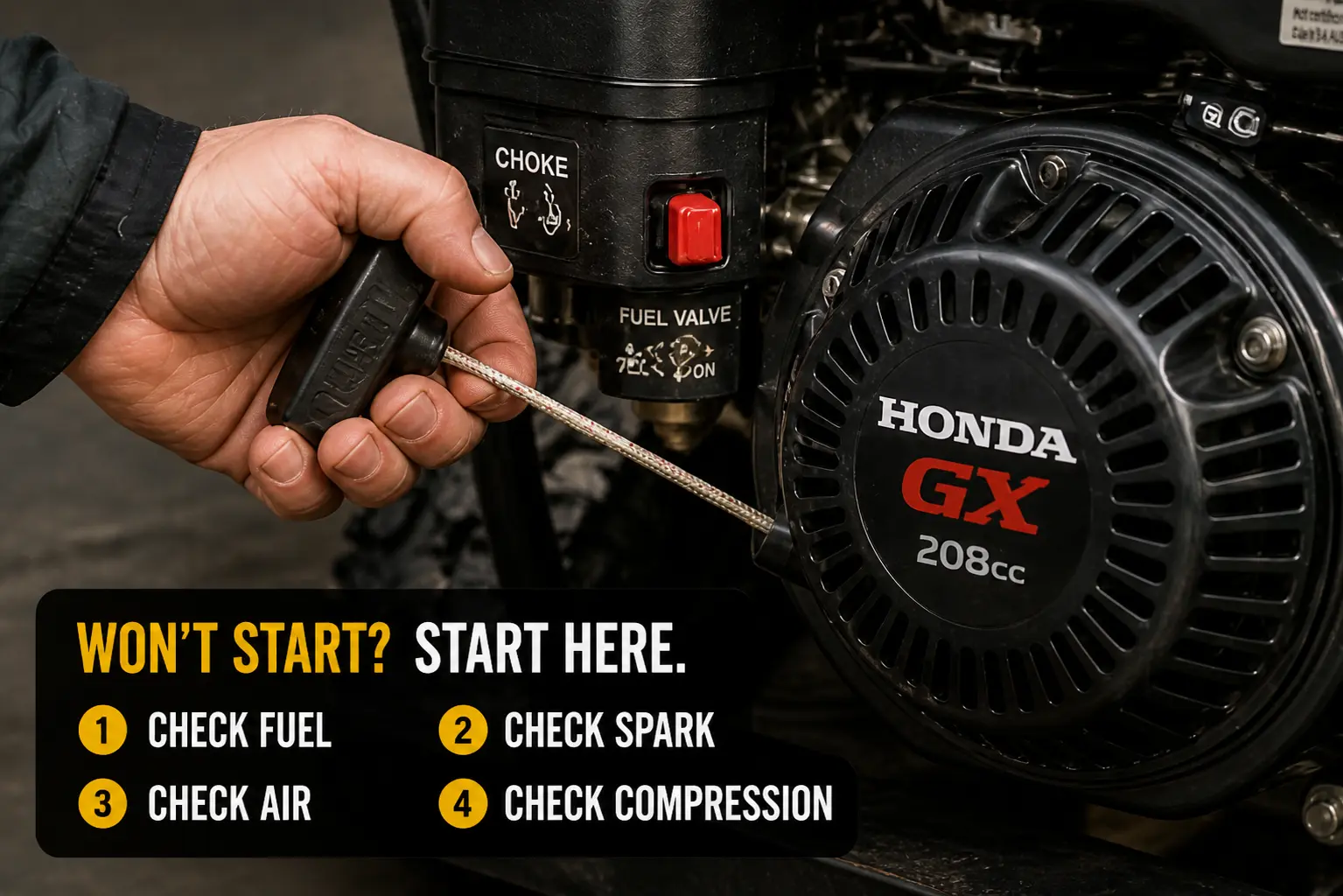
4. Primer bulb cracked or fuel line clogged
The primer bulb on a snowblower pre-fills the carburetor with fuel for cold starting. When it's cracked, hardened, or has a torn membrane, it can't pull fuel through, and the engine won't get enough fuel to fire on a cold pull.
What to check:
Press the primer bulb 3-5 times. It should feel firm and you should see fuel visibly filling the bulb. If the bulb stays soft, doesn't fill, or has visible cracks, replace it.
A primer bulb replacement kit is $5-10 and usually includes the connecting fuel lines. On most snowblowers, replacement is a 15-30 minute job — pop off the primer assembly, swap in the new one, reconnect the fuel line.
If the bulb is fine but no fuel reaches the carb, the fuel line itself may be cracked or the inline filter clogged. Inspect the fuel line from tank to carb for cracks, especially at the fittings. Replace if it looks brittle or has visible damage. Fuel line is $1-2 per foot at any small engine shop.
5. Choke not engaging properly
A cold snowblower engine needs a richer fuel mix to start in below-freezing temperatures. The choke restricts airflow to make this happen. If the choke linkage is sticky from age, frozen with ice, or just out of adjustment, the engine won't get enough fuel during cranking.
What to check:
Operate the choke lever and watch the choke butterfly inside the air intake. It should fully close in the "choke" or "start" position and fully open in the "run" position. If it's sticking partway, work it back and forth and add a drop of light oil to the pivot.
In cold weather, a wet or frozen choke linkage is common. Bring the snowblower into a heated garage for 15-30 minutes if you suspect ice is locking the choke. After thawing, work the linkage manually and oil the pivot to prevent it freezing again.
For older or worn choke cables, replacement is straightforward — usually 30 minutes and $15-30 in parts.
6. Carburetor float stuck
Many snowblower carburetors have a float that opens and closes a needle valve to regulate fuel flow. When the snowblower sits with old fuel, the float can stick — either holding the valve closed (no fuel flow) or open (flooding the engine).
Symptoms:
- Stuck closed: engine cranks but won't fire, no fuel reaches the cylinder even with priming
- Stuck open: fuel floods the carburetor and engine, plug comes out wet repeatedly
The fix:
For a stuck-closed float, sometimes a sharp tap on the carburetor bowl with a screwdriver handle frees it temporarily. This is a diagnostic, not a permanent fix — if the float is stuck once, it'll stick again.
The proper fix is removing the carburetor bowl, cleaning the float and needle assembly, and replacing the small rubber tip on the float needle if it's hardened. Often this is bundled with a full carburetor service since you've already got the carb apart.
7. Auger or wheel drive belt seized
This isn't actually a no-start issue, but it's the most common reason owners think their snowblower is "broken" when it actually starts fine. After a snowblower sits all summer, the rubber drive belts can stick to the pulleys, especially in damp basements or unheated sheds.
Symptoms:
- Engine starts and runs fine
- Engaging the auger or drive lever causes the engine to stall immediately or smoke from the belt area
- Belt visibly pulled out of place when you look under the housing
The fix:
Inspect the belts. If they're glazed, stretched, or have visible cracks, replace them. Snowblower belts are $15-40 each depending on model. Replacement is typically 30-60 minutes of labor — fairly DIY-friendly with the right service manual.
If the belts look fine but stuck, sometimes manually freeing them with the engine off and lubricating the pulleys with belt dressing solves it. But a belt that's been stuck once will likely stick again next year, so plan to replace it before next season.
8. Engine flooded from too much priming
Snowblowers have primer bulbs because they need fuel pre-filled for cold starts. But it's easy to overdo it — pumping the primer 10-15 times "just to make sure" floods the cylinder with raw fuel, which won't ignite on a cold pull.
Symptoms:
- You've been pulling the cord for a while with no result
- The plug came out soaking wet with fuel
- You smell strong fuel coming from the exhaust
The fix:
Pull the spark plug. Hold the engine's kill switch in the "off" position (or disconnect the plug wire entirely for safety) and pull the cord 10-15 times to clear the cylinder of excess fuel. Dry the plug or replace it. Reinstall, then try starting with only 2-3 primer presses next time, choke fully on for the first pull, and choke off after the engine fires.
For future cold starts: primer bulb 2-3 presses for a slightly cold engine, 3-5 presses for a deeply cold engine (below 20°F). More than that floods.
When to call a shop
Most snowblower no-start issues are DIY-fixable with the eight causes above. Bring it to a shop when:
- No spark after replacing the plug — likely an ignition coil failure ($60-150 repair)
- Engine cranks but never fires after fresh fuel and a clean carb — possible compression issue
- Hydrolocked engine (water in the cylinder, can happen if the snowblower sat outside uncovered)
- Visible oil leaks from the engine
- Auger gearbox makes grinding noises (separate from engine starting issues but often discovered together)
- You're not comfortable with carburetor disassembly and the engine needs that level of service
Independent snowblower shops typically charge $80-120 per hour. A full carburetor service plus tune-up (oil, plug, fuel system clean, belt inspection) usually runs $150-250 at most independent shops.
The best time to schedule shop service is September or October, before the first snow — for the full timing breakdown and why fall service is dramatically cheaper than in-season, see best time to service your snowblower. After the first storm of the season, expect 2-3 week wait times at every shop in the region.
If you're not sure where to start, find a verified small engine repair shop near you below. Most can give a phone diagnosis before you bring the snowblower in.
This guide covers gas-powered single-stage and two-stage snowblowers (Ariens, Toro, Cub Cadet, Craftsman, Husqvarna, Honda, and similar consumer/prosumer brands). Battery-powered electric snowblowers have entirely different failure modes (mostly battery and motor controller issues) and aren't covered here. Always follow the storage and service schedule in your specific snowblower's manual.