Why Won't My Generator Start? 8 Common Causes (And What To Try)
The power's out. The generator that worked fine last hurricane season is sitting in the garage refusing to start. The wind is picking up. This is the worst possible time for this.
Before calling a repair shop, the good news: most generator no-start issues come down to one of three things — fuel, ignition, or air. The bad news: figuring out which one takes a few minutes of methodical checking. The work below covers the eight most common causes in the order a small engine technician would actually check them.
If you can pull the starter cord (or hear the electric starter spin) but the engine doesn't catch, you're in the right place. If you can't even crank the engine, skip to cause #8.
Quick product boxes
1. Old fuel — the #1 cause of generator no-starts
Gasoline goes bad. Specifically, the volatile compounds that make gas ignite easily evaporate within 30-60 days, leaving behind a thicker, varnish-like residue. Generators are particularly vulnerable because they sit unused for months at a time between storms.
If your generator has been sitting since last fall (or longer) with fuel in the tank, the gas in there is almost certainly the problem. The lighter, more flammable components are gone, and what's left in the tank — and worse, gummed up in the carburetor — won't ignite reliably.
What to try first:
Drain the tank completely. The fuel valve below the tank usually has a drain screw, or you can siphon it out. Don't leave a single ounce of old fuel — it'll mix with the new and contaminate it.
Refill with fresh, ethanol-free gasoline if available (regular pump gas with up to 10% ethanol works but degrades faster). Add a fuel stabilizer — Sta-Bil, Sea Foam, or any equivalent — at the dose listed on the bottle. This buys you 6-12 months of usable fuel life.
Try starting again. If the engine fires briefly and dies, the carburetor itself is fouled (see #2).
2. Carburetor gummed up from old fuel
The carburetor is the small assembly that mixes air and fuel before the cylinder. When fuel evaporates inside it, it leaves sticky residue in the tiny passages. Even with fresh fuel in the tank, a gummed-up carburetor won't deliver fuel correctly.
Symptoms: engine fires for 1-2 seconds and dies, runs only with the choke fully on, or won't start at all even with fresh fuel.
What to try first:
Spray carburetor cleaner directly into the air intake while pulling the starter. If the engine fires for a few seconds, the carb is the issue. A full clean involves removing the carburetor, soaking the parts, and clearing the jets — doable for a careful DIYer with basic mechanical experience, but it's also the most common reason people give up and bring the generator to a shop.
If the engine has been sitting with old fuel for more than a year, the float bowl gasket and rubber tip on the float needle may also be hardened beyond repair. Carburetor rebuild kits are inexpensive but require disassembly.
3. Stale fuel in the float bowl
The float bowl is the small reservoir at the bottom of the carburetor. Fuel pools there, and when the engine sits, it's the first place stale gas turns to varnish.
Many small engines have a drain screw on the bottom of the float bowl. Open it briefly with the fuel valve on — if dark, brown, or varnish-smelling fuel comes out, drain until you see clean fresh fuel.
This is a 60-second check that often skips the need for a full carburetor service.
4. Choke not engaging properly
A cold engine needs a richer fuel-air mix to start. The choke restricts airflow to make this happen. If the choke linkage is sticky, broken, or the cable is misadjusted, the engine won't get enough fuel during cranking.
What to check:
Watch the choke butterfly (the flat plate inside the air intake) as you move the choke lever. It should fully close when set to "choke" or "start" position, and fully open when set to "run." If it's sticking partially open, work it back and forth by hand and add a drop of light oil to the pivot.
For pull-start generators, also try the opposite: if it's been hot recently, the choke might be over-rich. Try starting with the choke open.
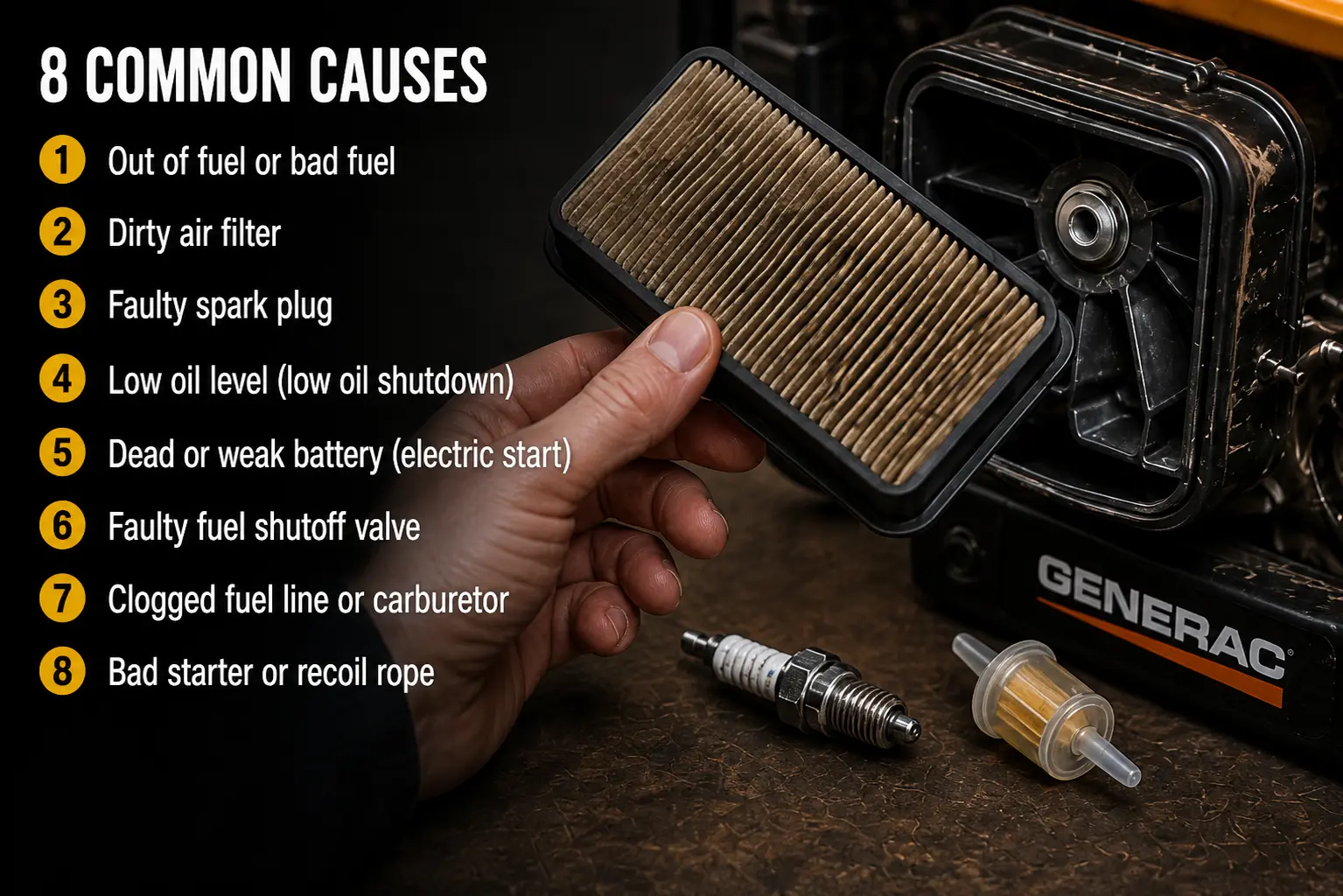
5. Spark plug fouled or worn out
If you're getting fuel but not getting combustion, the spark plug is the likely culprit. Plugs foul from incomplete combustion, oil blow-by, or just age. A plug with thick black deposits, oil residue, or a worn electrode won't reliably ignite the fuel-air mixture.
What to try:
Pull the spark plug with a plug socket. If it's wet with fuel, you flooded the engine — let it sit 10 minutes with the choke open and try again. If it's black and crusty, replace it. Plugs are $4-8 and most generators use a common automotive plug — the NGK BPR5ES (a common fit) works on many Generac, Honda, Champion, and Briggs & Stratton engines. The owner's manual or a quick search by model will confirm the exact part number for yours.
While the plug is out, ground the metal body of the plug against the engine block (use the wire boot, not your bare hand) and pull the starter. You should see a clean blue spark jump the gap. No spark or weak orange spark = ignition system issue, and you'll likely need a shop for the diagnosis.
6. Low oil shutdown sensor triggered
Most generators sold in the last 15 years have a low-oil sensor that prevents the engine from starting if oil level is below a safe threshold. This is a feature, not a bug — running with low oil destroys the engine in minutes.
What to check:
Pull the dipstick. Wipe it clean. Reinsert fully and pull again. The level should be at or near the upper mark on the dipstick. If it's below the lower mark, top off with the correct oil grade (usually 10W-30 or SAE 30 — check the manual).
A common gotcha: if the generator is on uneven ground, the dipstick reading is wrong and the sensor may falsely trigger. Move it to a level surface before checking.
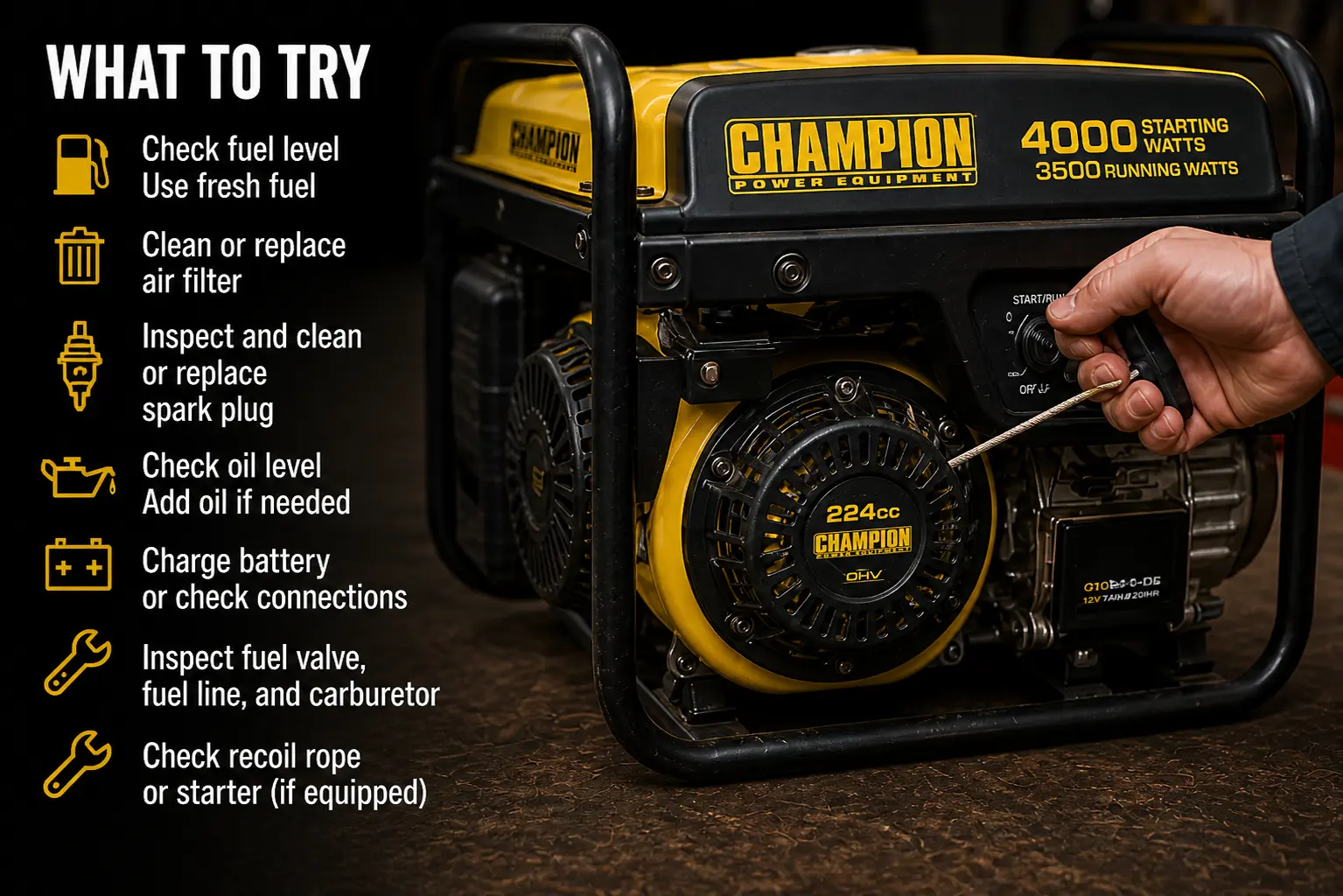
7. Air filter completely clogged
A severely clogged air filter starves the engine of air, throwing the fuel-air mix way too rich and preventing combustion. This is rare on a modern generator unless it's been stored in a dusty environment or hasn't had the filter cleaned in years.
What to check:
Pop the air filter cover (usually one or two screws or clips). The filter element is paper, foam, or both. If you can hold it up to a light and see almost no light through it, replace it. Foam elements can sometimes be washed in soapy water, dried thoroughly, and lightly oiled — paper elements should be replaced.
Try starting with the filter removed entirely. If the engine fires up, you've confirmed the filter is the issue. Don't run the generator without a filter for more than a minute or two — dirt destroys the cylinder over time.
8. Starter not turning the engine
If the engine doesn't crank when you pull the cord (or the electric start makes a click but no spin), the issue is mechanical or electrical, not fuel-related.
Pull-start generators:
The recoil mechanism may be broken. Pull the cord slowly — if it just keeps coming out without resistance, the spring or pawls inside the recoil housing have failed. This is usually a 30-minute repair with a replacement recoil assembly.
If the cord pulls with normal resistance but the engine doesn't turn, the engine itself may be hydrolocked (water in the cylinder, which can happen if the generator was tipped or stored in a flood) or the engine may have seized. Both warrant a shop visit.
Electric start generators:
Check the starter battery first. If the battery is dead, charge it or jump it from a car battery. Most generator starter batteries are small and lose charge after 6-12 months of sitting. If the battery is good but the starter clicks without spinning, the starter motor itself may have failed.
When to call a repair shop
If you've tried the fuel-system fixes above and the engine still won't start, the issue is likely beyond a quick DIY fix. Specifically:
- No spark after replacing the plug — you may have an ignition coil failure
- Engine cranks freely but never fires — likely a compression issue or major carburetor blockage
- Hydrolocked engine — water needs to be flushed before any restart attempt to avoid bending a connecting rod
- Visible smoke from the engine when cranking — could be oil leakage into the cylinder, head gasket failure, or worse
Generator repair shops typically charge $80-120 per hour of labor plus parts. A full carburetor service runs $150-250 at most independent shops — for a full cost breakdown before authorizing work, see how much does generator repair cost. For storms, many shops will move emergency repairs to the front of the queue if you call ahead. To avoid being in this position entirely, see how to prepare your generator for hurricane season for the pre-season checklist.
If you're not sure where to start, find a verified small engine repair shop near you below — most can give a same-day or next-day estimate over the phone before you bring the unit in.
This guide covers common no-start causes for portable and standby gas generators (Generac, Honda, Champion, Briggs & Stratton, Kohler, and similar brands). Diesel generators have different failure modes and aren't covered here. If your generator is under warranty, check the manufacturer's authorized service requirements before attempting any fixes — DIY work may void coverage.