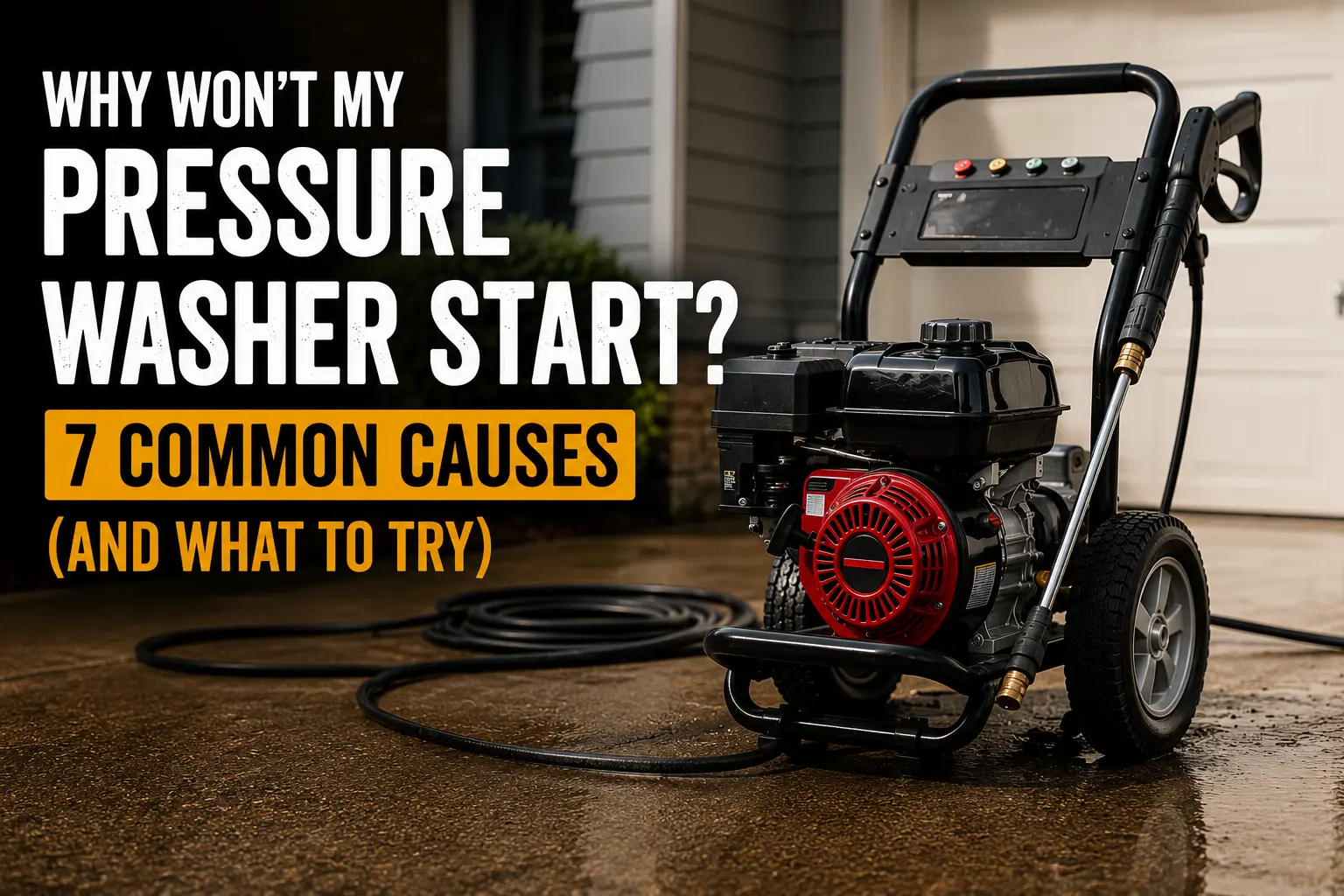
Why Won't My Pressure Washer Start? 7 Common Causes (And What to Try)
The driveway is filthy, the deck needs cleaning before guests arrive, and the pressure washer that worked fine last summer is sitting on the patio refusing to start. You pull the cord, nothing. Pull again, nothing.
Pressure washers are uniquely punishing on neglected maintenance. They often sit unused for 6-12 months between projects, then get asked to perform on demand. Most no-start issues trace back to fuel system problems caused by long off-season storage, and most are fixable in an afternoon with basic tools and a few cheap parts.
The seven causes below are listed in the order a small engine technician would actually check them. Work through them sequentially.
Quick product boxes
A quick diagnostic rule
Before opening anything, note which scenario fits:
- Engine won't turn over at all (no cord resistance, or cord pulls easily with no engine response) — mechanical issue, jump to cause #7
- Engine cranks but won't fire — fuel, ignition, or air issue. Causes 1-6 cover this.
- Engine fires briefly and dies — fuel system. Cause 1, 2, or 3.
- Engine starts but dies when you squeeze the spray gun trigger — water/pump issue, not engine. See the end of the guide.
1. Old fuel from last season (the #1 cause)
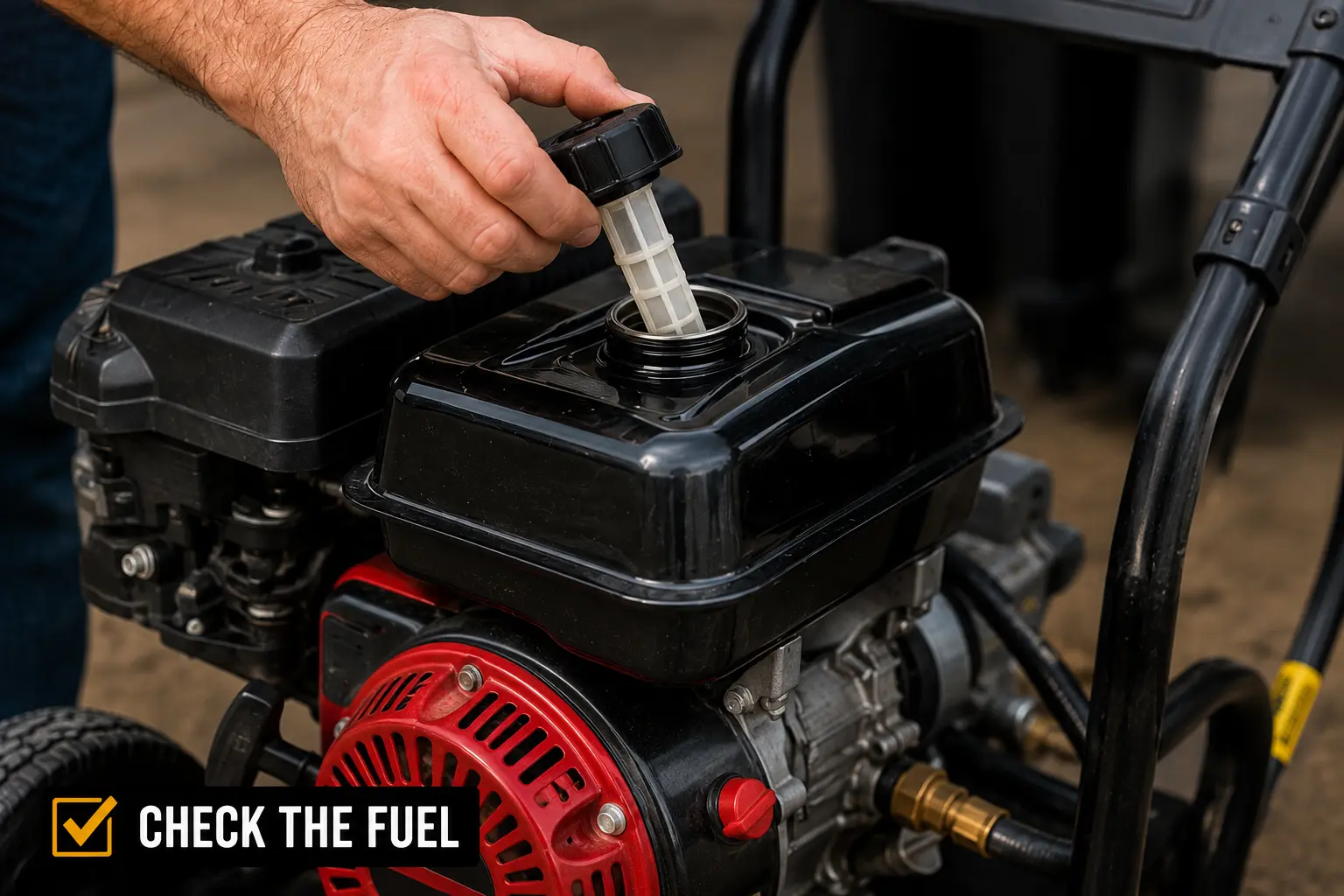
If your pressure washer sat for 6+ months with fuel in the tank, that fuel is almost certainly the problem. Gasoline mixed with the standard 10% ethanol in U.S. pump gas starts degrading within 30 days, and is essentially varnish by 6 months later. Pressure washers are uniquely vulnerable because their off-season storage is often longer than other small engines — most homeowners use a pressure washer 2-4 times a year, with months between uses.
What to try first:
Drain the tank completely. Most pressure washers have a fuel valve at the bottom of the tank — open it and drain into a separate container. Don't put the old fuel back in your gas can with fresh fuel; it'll contaminate the whole batch.
Refill with fresh ethanol-free gasoline if available, or fresh 10% ethanol pump gas if that's all you can get. Add a fuel stabilizer like STA-BIL at the dose listed on the bottle. This extends fuel shelf life to 6-12 months.
Try starting again. If the engine fires briefly and dies, the carburetor is fouled too (see cause #2).
2. Carburetor gummed up from old fuel
The carburetor on a pressure washer is small, and the fuel passages inside are smaller. When fuel evaporates inside it, the residue blocks the jets and metering passages. Even with fresh fuel in the tank, a gummed carburetor won't deliver fuel correctly.
Symptoms:
- Engine fires for 1-2 seconds and dies
- Runs only with the choke fully on
- Won't idle, won't start at all even with fresh fuel
What to try first:
Spray carburetor cleaner directly into the air intake while pulling the starter cord. If the engine fires for a few seconds, the carburetor is the issue.
A full clean involves removing the carburetor, soaking it in cleaner, replacing gaskets and the float bowl O-ring, and clearing the jets with the fine wires that come in most carb rebuild kits. Rebuild kits are typically $10-25 for most pressure washer engines (Honda GC160/190, Briggs & Stratton 875EXi, etc.) and include the parts a typical service needs.
DIY is reasonable for someone comfortable with small parts; many people prefer to bring it to a shop. Shop carb service typically runs $80-150 plus parts on a pressure washer.
3. Fouled spark plug
Pressure washer engines run rich (more fuel, less air) during starting, which fouls plugs faster than equipment running at sustained operating temperature. After 50-100 hours of run time, or after 2-3 seasons of light use, the plug stops firing reliably.
What to try:
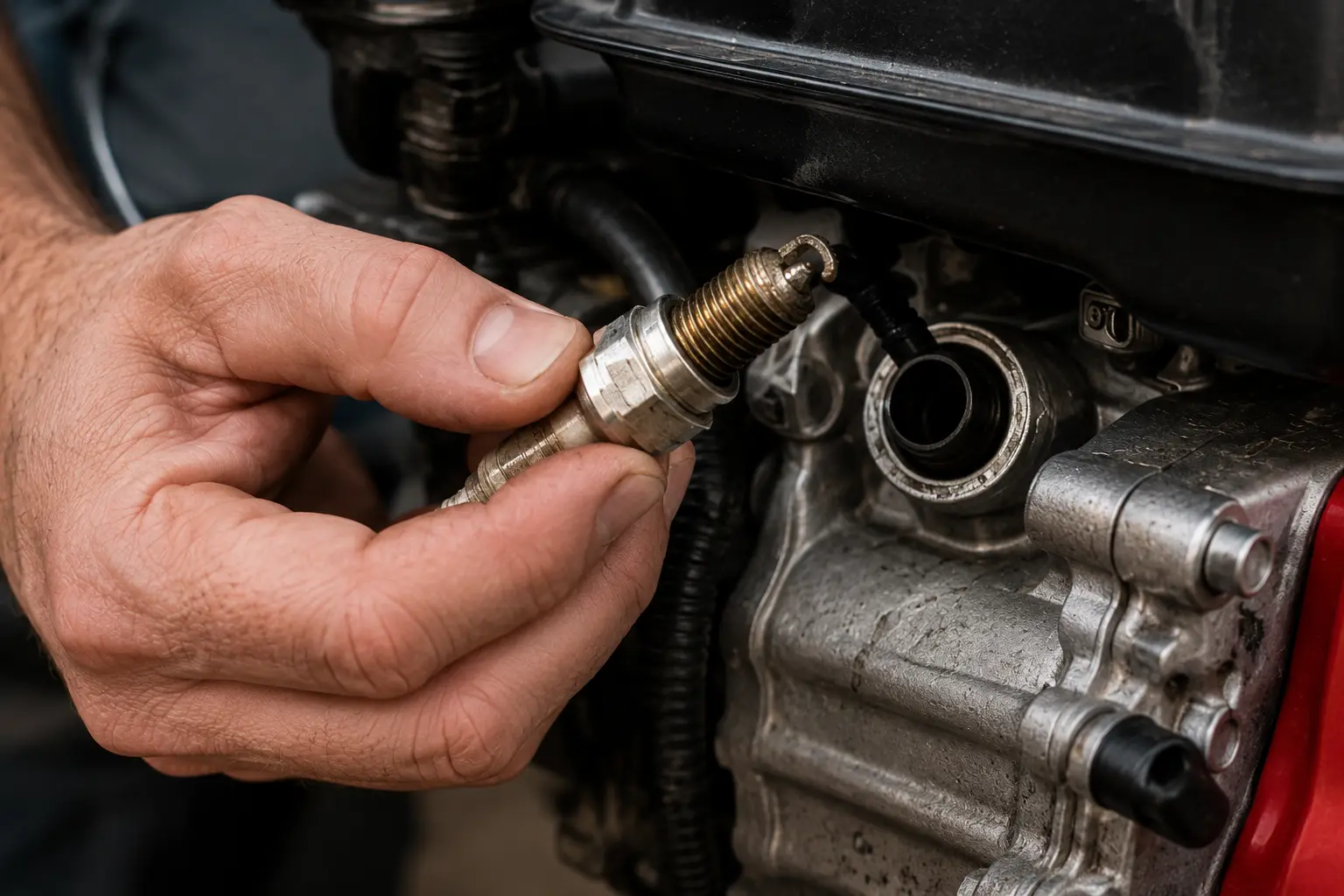
Pull the spark plug with a plug socket. If it's wet with fuel, you flooded the engine — pull the cord 10-15 times with the plug out and choke open to clear the cylinder, dry the plug, then reinstall and try again. If the plug is black and crusty or covered in oily deposits, replace it.
Plugs are $4-8 and most pressure washers use a common NGK or Champion plug. Honda GC160/190-powered washers typically use NGK BPR6ES; Briggs & Stratton engines usually use Champion RC12YC. The owner's manual or a quick search by engine model will give you the exact part number.
While the plug is out, ground the metal body of the plug against the engine block (use the wire boot, not your bare hand) and pull the starter. You should see a clean blue spark jump the gap. No spark or weak orange spark means an ignition coil issue, which is shop work.
4. Low oil shutdown sensor triggered
Most pressure washers sold in the last 15 years have a low-oil sensor that prevents the engine from starting if the oil level is below a safe threshold. This is a feature, not a bug — pressure washer engines spin at 3,400+ RPM and running with low oil destroys them in minutes.
What to check:
Pull the dipstick. Wipe it clean. Reinsert fully and pull again. The level should be at or near the upper mark. If it's below the lower mark, top off with the correct grade — usually SAE 10W-30 for most pressure washer engines, sometimes SAE 30 for older units. Check the engine manual or the plastic engine cover for the spec.
A common gotcha: if the pressure washer is on uneven ground, the dipstick reading is wrong and the sensor may falsely trigger. Move it to level ground before checking. Pressure washer engines are particularly sensitive to this because the oil reservoir is small and a tilt of 10-15 degrees can drop the dipstick reading below the trigger threshold.
5. Air filter completely clogged
A severely clogged air filter starves the engine of air, throwing the fuel-air mix way too rich and preventing combustion. Pressure washers operate in dusty environments — driveways, decks, exterior siding — so filters foul faster than equipment used in cleaner conditions.
What to check:
Pop the air filter cover (usually one screw or a snap-clip). The filter element is paper, foam, or both. Hold it up to a light — if you can't see light through it, replace it. Foam pre-filters can sometimes be washed in soapy water, dried completely, and lightly oiled. Paper elements should be replaced. A new pressure washer air filter is $5-15 at most small engine shops.
As a diagnostic, try starting with the filter removed entirely. If the engine fires up, the filter is the issue. Don't run the pressure washer without a filter for more than a minute or two — dust into the cylinder accelerates wear.
6. Choke and fuel valve checks
Pressure washer engines need a richer fuel-air mix for cold starting, which is what the choke provides. If the choke linkage is sticky from age or out of adjustment, the engine won't get enough fuel during cranking.
The fuel shutoff valve on the tank also needs to be in the "on" position. This sounds obvious but is a surprisingly common cause — someone shut the valve off for off-season storage (good practice) and forgot to open it before the next start attempt.
What to check:
Watch the choke butterfly inside the air intake as you move the choke lever. It should fully close in the "choke" or "start" position and fully open in "run." If it's stuck partway, work it back and forth and add a drop of light oil to the pivot.
Confirm the fuel valve below the tank is fully open. On most pressure washers it's a small lever or knob on the line between tank and carburetor. The "open" position is parallel to the fuel line; perpendicular is closed.
For pressure washers stored over winter with fuel in the tank, also check the line itself for ice plugs or visible cracks. Ethanol-blended fuel attracts water, which can freeze inside fuel lines in unheated storage. Drain and warm the unit in a heated space for an hour if you suspect line ice.
7. Pump-related no-start (mechanical resistance)
Pressure washer engines are coupled directly to the pump via a shaft or coupler. If the pump has seized — from sitting unused for years, freezing damage, or internal seal failure — the engine can't turn over.
Symptoms:
- Pull cord barely budges, or feels solid like the engine is locked up
- Engine cranks for one stroke and stops
- You hear a click or feel a hard mechanical stop
What to check:
Disconnect the engine from the pump if your model allows quick separation (some do, some require pulling the engine off the pump frame). Try cranking the engine alone — if it spins freely, the pump is the seized component, not the engine.
Pump seizure usually means pump replacement or rebuild. Pump replacement runs $80-200 in parts for most consumer pressure washers; rebuild kits with seals and O-rings run $30-60 for owners willing to disassemble — see the pressure washer pump rebuild guide for the full process.
A common cause of pump seizure in northern climates: water left in the pump during winter storage. Water expands when it freezes and cracks pump internals. Always blow water out of the pump before winter storage, or run pump antifreeze through the system.
When the engine starts but dies under the trigger
Some pressure washers start and run at idle but die the moment you pull the spray trigger. This isn't an engine no-start — the engine is fine. The problem is usually one of:
- Pump unloader valve stuck closed — the unloader regulates pressure between the pump and spray gun. If it's stuck closed, the engine stalls when the trigger opens because it can't move water against blocked flow. Cleaning or replacing the unloader fixes this — $20-50 in parts.
- Water inlet restriction — kinked hose, clogged inlet screen, or insufficient water supply pressure. Pressure washers need 5+ GPM at the inlet on most consumer units.
- Fuel-starvation under load — if the fuel filter is partially clogged or the float bowl is varnished, the engine gets enough fuel to idle but not enough to power the pump. This usually resolves with full carburetor service per cause #2.
When to call a shop
Most pressure washer no-start issues from the list above are DIY-fixable in an afternoon. Bring it to a shop when:
- No spark after replacing the plug — likely ignition coil failure ($60-150 repair)
- Engine cranks freely but never fires after fresh fuel and a clean carburetor — possible compression issue
- Pump seized and you're not comfortable with mechanical disassembly
- Hydrolocked engine (water in the cylinder, which can happen if the pressure washer was tipped on its side or stored uncovered through a freeze)
- Visible oil leaks from the engine
- Engine smokes heavily when cranking
Independent pressure washer repair shops typically charge $80-120 per hour. A full carburetor service runs $100-180 at most independent shops; pump rebuild or replacement runs $150-350 depending on parts. For a full cost breakdown before authorizing any work, see gas pressure washer repair cost. The cost-benefit calculation gets thin fast on consumer pressure washers under $400 new — shops will tell you honestly when a repair isn't worth it compared to a new unit.
For Honda-, Simpson-, and Generac-branded pressure washers specifically, authorized dealer pricing is generally higher than independent shops, but warranty work has to be done at an authorized location. If your unit is still under warranty, check what's covered before paying anyone.
If you're not sure where to start, find a verified small engine repair shop near you below — most can give a phone diagnosis before you bring the unit in.
This guide covers gas-powered consumer and prosumer pressure washers (Honda, Simpson, Generac, Briggs & Stratton, Ryobi, Craftsman, and similar brands). Electric pressure washers have entirely different failure modes (mostly motor and switch issues) and aren't covered here. Always follow your specific unit's manual for fuel, oil, and seasonal storage requirements.