Best Time to Service Your Snowblower (Before vs After Season)
The short answer: schedule professional service in early fall (September-October), and do basic storage prep yourself in spring (March-April).
The longer answer is about why this matters. Snowblowers fail more from sitting than from running. The 7-9 months a snowblower sits between seasons is where most damage happens — old fuel varnishing the carburetor, rubber components hardening, batteries draining (on electric-start models). The right service at the right time prevents the most expensive failures.
This guide covers what to do at each end of the season and why timing matters more than most owners realize.
Why fall service beats spring service
Fall service (September-October) is the right time for professional shop work for three reasons:
1. Shop pricing is at its lowest. Most independent small engine shops are slow in September because they're between the lawn equipment busy season and the snowblower busy season. Many run pre-season specials, often 10-20% below their standard pricing.
2. Wait times are short. Same-week service is usually available in September. By December, expect 1-3 week waits. After a major storm, expect 2-4 weeks.
3. You have buffer time. If the shop finds something major during service — a cracked carburetor, a worn auger gearbox — you have weeks to deal with it before the first storm. In December, you might have hours.
Spring service is what most homeowners actually do, because that's when they remember the snowblower exists. But by spring, the damage from sitting is already starting. Old fuel left in the tank from January is varnishing the carburetor by August. The "I'll get it serviced before winter" plan turns into a panicked December call to a shop that's booked through January.
What to do in fall (before storage isn't relevant — see "what to do in spring" below)
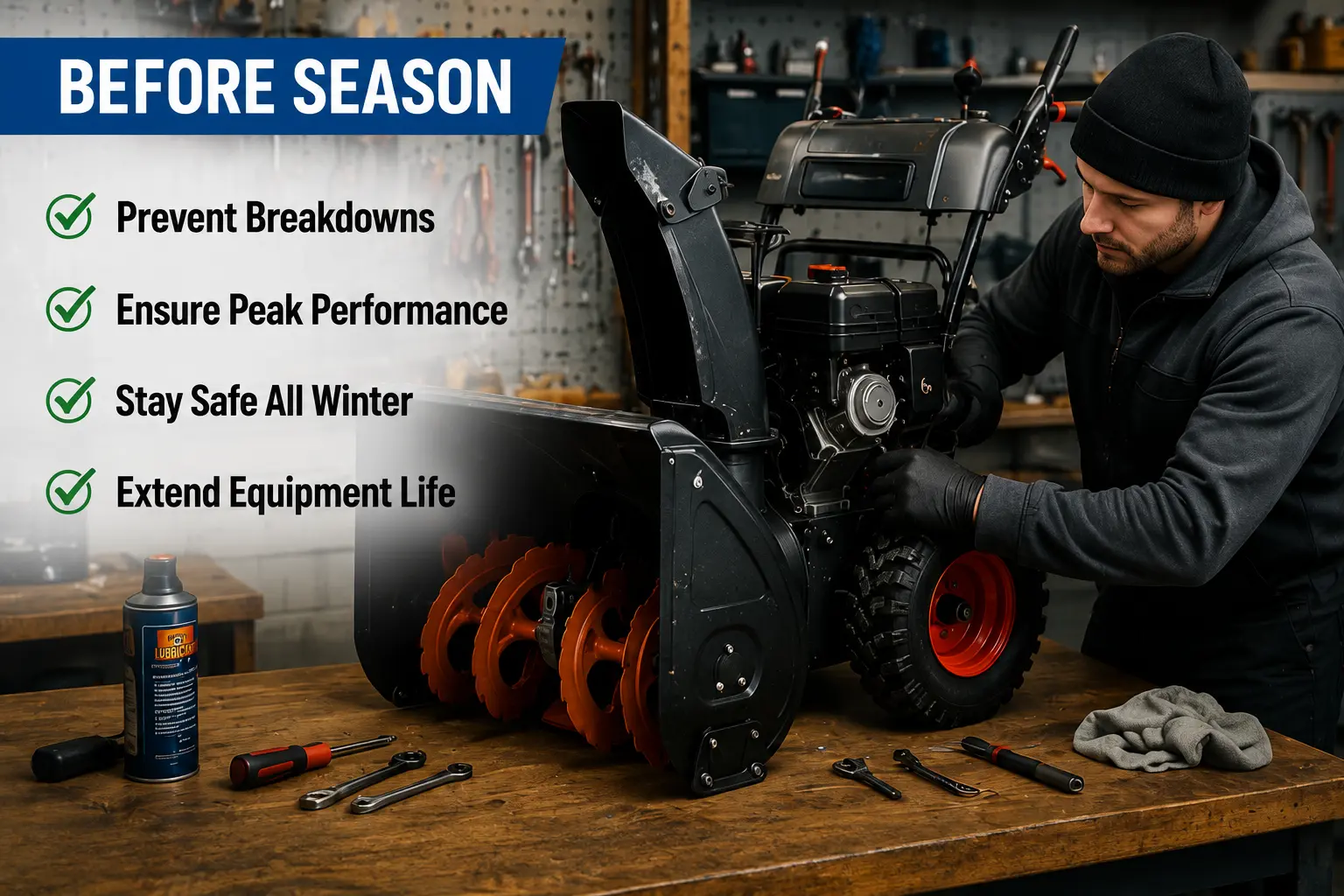
If your snowblower has been sitting since last winter, fall is when you fix the damage. Schedule professional service or do the work yourself by mid-October at the latest.
Full pre-season checklist:
-
Drain old fuel and refill with fresh. Old fuel from last season is the leading cause of no-starts. Drain the tank, dispose of old fuel responsibly, refill with fresh ethanol-free gas (or 10% ethanol with stabilizer added).
-
Change the oil. Even if the snowblower only ran a few hours last winter, oil oxidizes over time. Run the engine 5 minutes to warm the oil (warm oil drains cleaner), drain, refill with fresh SAE 5W-30 synthetic for cold-weather operation.
-
Replace the spark plug. Plugs are $4-8. Replacing annually is cheap insurance against starting issues.
-
Inspect the air filter. Clean foam filters with soapy water, dry completely, lightly oil. Replace paper filters if degraded.
-
Check the auger gearbox oil. Most snowblowers have a small reservoir on the auger gearbox that uses a specific gear oil (check the manual — usually 90W gear oil or proprietary equivalent). Top off or replace if dirty.
-
Inspect belts. Drive belts and auger belts should be free of cracks, glazing, or stretching. Replace if damaged. A broken belt during a storm leaves you stranded.
-
Check shear pins. The sacrificial pins that protect the auger from impact damage. Inspect for cracks. Replacement pins are $5-15.
-
Check skid shoes and scraper bar. The metal pieces that ride along the ground and scrape snow. If worn down, replace before storm season.
-
Test run for 15-20 minutes. Start the engine, let it warm up, engage the auger and drive systems. Verify everything operates smoothly. If anything feels wrong, get it serviced now while shops have availability.
-
Lubricate moving parts. Auger pivot points, drive shaft fittings, control linkages. Use a quality machine oil or grease.
This checklist takes 1.5-3 hours of DIY work or runs $140-220 at most independent shops as a bundled tune-up.
What to do in spring (the part most owners skip)
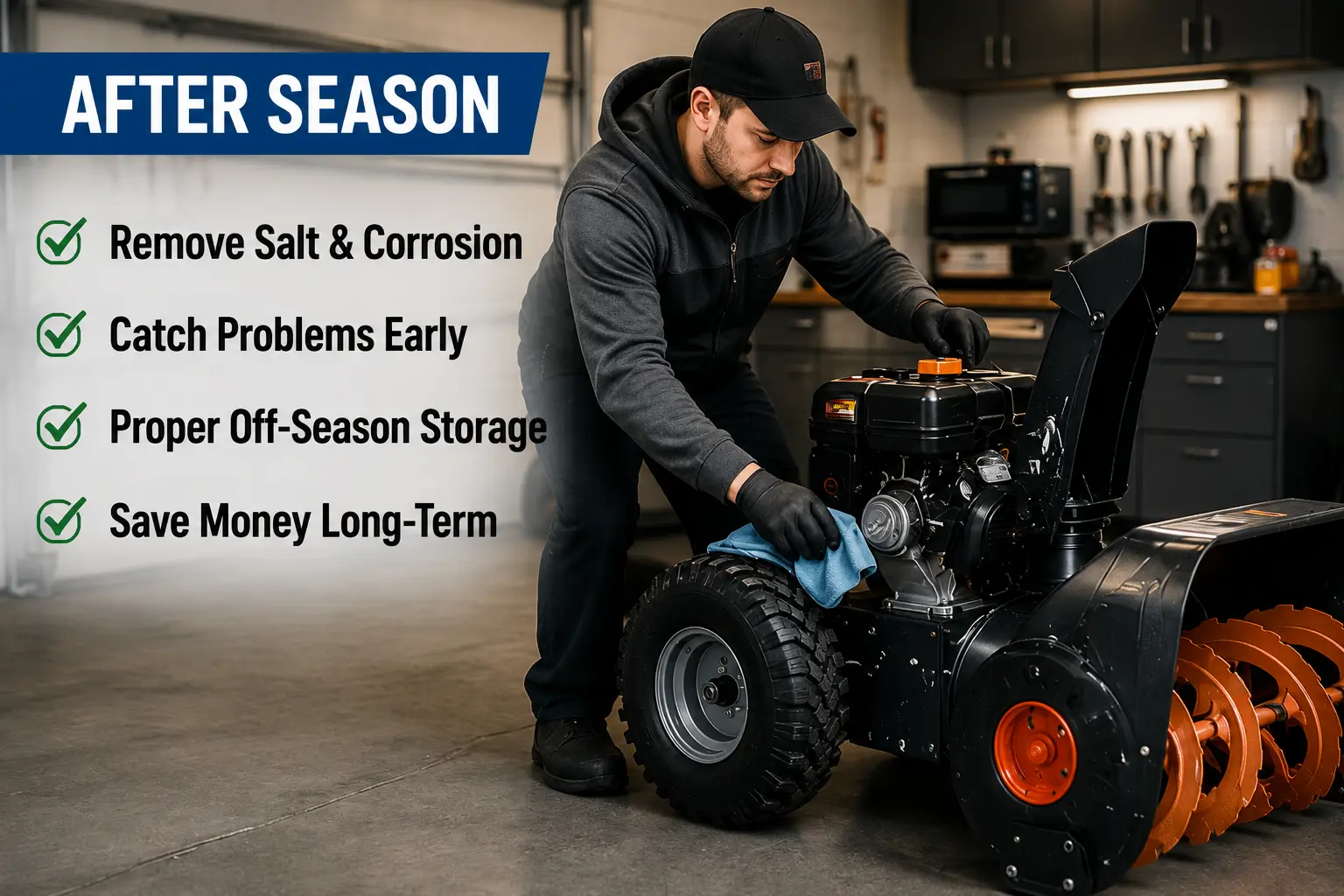
Spring is not when you bring the snowblower to a shop. Spring is when you do basic storage prep yourself to prevent the damage that fall service has to fix.
The single most important spring task: stabilize the fuel or drain it entirely.
Option A: Stabilize the fuel for storage.
- Add fuel stabilizer like Sta-Bil (or Sea Foam, Star Tron) to the tank at the dose listed on the bottle.
- Run the snowblower for 5-10 minutes so the stabilized fuel circulates through the carburetor.
- Top off the tank with fresh stabilized gas — a full tank is better than half full because it leaves less air space for condensation.
- Store the snowblower in a dry location.
This buys 6-12 months of stable fuel life. Done in March, the fuel will still be usable in November.
Option B: Drain the fuel completely.
- Drain the tank using the fuel valve drain or by siphoning.
- Run the engine until it dies (clears the carburetor of remaining fuel).
- Pull the carburetor bowl drain screw if your model has one, drain any remaining fuel.
- Store with the tank empty.
This eliminates fuel-degradation issues entirely but requires you to remember to refuel in fall before first use.
Most owners do neither. They park the snowblower in March with whatever fuel was in the tank, and that fuel turns to varnish over the next 7 months. Fall service then has to fix the resulting carburetor problems — which is why the average fall tune-up runs $140-220.
Other important spring tasks
Beyond fuel, a 30-minute spring storage routine prevents most off-season damage:
Disconnect the spark plug wire. Prevents accidental starts during summer maintenance and reduces moisture in the cylinder during humid months.
Check and top off oil. Don't drain it — just verify level. Old oil sitting is bad, but no oil is worse if you accidentally try to start the unit.
Lightly oil the cylinder. Pull the spark plug, squirt a teaspoon of two-stroke oil or fogging oil into the cylinder, pull the cord 2-3 times to coat the cylinder walls. Reinstall the plug. This prevents rust on the cylinder during storage.
Lubricate moving parts. Same as fall checklist — auger pivots, control linkages, drive components.
Clean the snowblower. Remove caked-on snow, ice, and salt residue from the auger housing and discharge chute. Salt corrosion is the leading cause of structural damage on stored snowblowers.
Cover or store indoors. UV exposure degrades plastic and rubber. A simple tarp prevents this.
Disconnect the battery (electric-start models). Or use a battery tender. Lead-acid batteries lose 1-2% charge per week sitting idle.
This entire spring routine takes 30 minutes if you're being thorough. It saves $80-150 in fall service costs and dramatically reduces the chance of a no-start when you actually need the snowblower.
What if you forgot last spring?
If you didn't do spring storage prep last year and now it's October, the damage is likely already done. Don't try to start the snowblower without addressing the fuel system first.
The right approach for a snowblower that sat with old fuel all summer:
- Don't try repeatedly pulling the cord to start it. You'll just foul the spark plug.
- Drain the old fuel entirely.
- Replace the spark plug (the old one is probably contaminated from your starting attempts).
- Refill with fresh stabilized fuel.
- Try starting with full choke and 3-5 primer presses.
- If it doesn't fire after 5-10 pulls with fresh fuel and a fresh plug, the carburetor is fouled. See snowblower troubleshooting for next steps, or take it to a shop.
A shop carburetor service runs $80-150 plus parts. A new snowblower starts at $400-500 for a basic single-stage and $800-1500 for a typical two-stage. The math usually favors repair unless the snowblower is older than 8-10 years and has other accumulating issues — for a full framework by snowblower type and age, see snowblower repair vs replace.
When to schedule shop service
If you decide professional service is the right call:
- Best time: Mid-September through mid-October
- Acceptable: Late October through mid-November
- Risky: Late November through early December (some shops booked solid)
- Bad: December through February (long waits, premium pricing, you might miss storms)
- Mostly pointless: March through May (some shops don't even accept snowblower service in spring)
Booking in September buys you the cheapest pricing of the year, fastest turnaround, and buffer time if anything unexpected comes up.
If you don't have a snowblower shop you trust, find a verified small engine repair shop near you below. Most will give phone estimates before you bring the unit in — useful for narrowing options before driving across town.
This guide covers gas-powered single-stage, two-stage, and three-stage snowblowers (Ariens, Toro, Cub Cadet, Craftsman, Husqvarna, Honda, and similar consumer/prosumer brands). Battery-powered electric snowblowers have different storage requirements (battery management is the primary concern) and aren't covered here. Always follow the storage and service schedule in your specific snowblower's manual.