Chainsaw Bar and Chain Maintenance: What to Do and When
The bar and chain are the parts of a chainsaw that do the actual work — and they're the parts most owners neglect until something goes wrong. A dull chain makes the saw work harder, produces sawdust instead of chips, and causes premature engine and clutch wear. A neglected bar wears unevenly, creates a tracking problem, and eventually causes a chain that won't run straight.
Neither requires special skills to maintain. What's required is doing it consistently.
How to tell when the chain needs sharpening
A sharp chain cuts aggressively and ejects large chips. A dull chain produces fine sawdust, requires you to push the saw into the cut, and may smoke even with adequate lubrication. You should feel the chain pulling itself into the wood — if you're doing the work, the chain isn't doing its job.
Other signs: the saw drifts to one side during a cut (indicates cutters on one side are sharper than the other), the engine bogs down under light load, or the chain comes off the bar more frequently than usual.
How often to sharpen: Most working chainsaws need sharpening every 2-4 hours of cutting time, or any time the chain contacts dirt or rock. Hitting the ground once is enough to dull a chain noticeably. If you're felling trees and the base of the trunk contacts soil, sharpen before the next cut.
Hand filing: the right way to sharpen a chain
Hand filing is the standard method for field sharpening. It requires a round file in the correct diameter for your chain pitch and a flat file for the depth gauges. Chain manufacturers print the correct file size on the packaging — common sizes are 5/32", 3/16", and 7/32" depending on chain pitch.
The procedure:
- Engage the chain brake to lock the chain. Secure the saw in a vise or brace it on a log.
- Mark the cutter where you start so you know when you've gone around the full chain.
- Hold the file at the correct angle. Most chains require filing at 30 degrees horizontally (across the bar) and 10 degrees downward. A filing guide that attaches to the chain keeps these angles consistent and is worth the $5-10 cost.
- Use smooth, forward strokes — 3-5 strokes per cutter on a mildly dull chain, more on a severely dull one. File each cutter the same number of strokes to keep them even.
- Alternate sides. File all the cutters on one side, then rotate the saw and file the other side.
- After sharpening the cutters, check the depth gauges. These are the rounded rakers in front of each cutter that control how deep the cutter bites. As cutters are filed shorter over multiple sharpenings, the depth gauges become proportionally higher, causing the chain to cut shallower and shallower. Use a depth gauge tool and a flat file to bring them down to the correct specification (usually 0.025").
A properly sharpened chain has consistent cutter lengths, matching angles on both sides, and correct depth gauge settings. Inconsistent sharpening — where one side is filed more than the other — causes the drift problem described above.
Chain tension: how tight is right
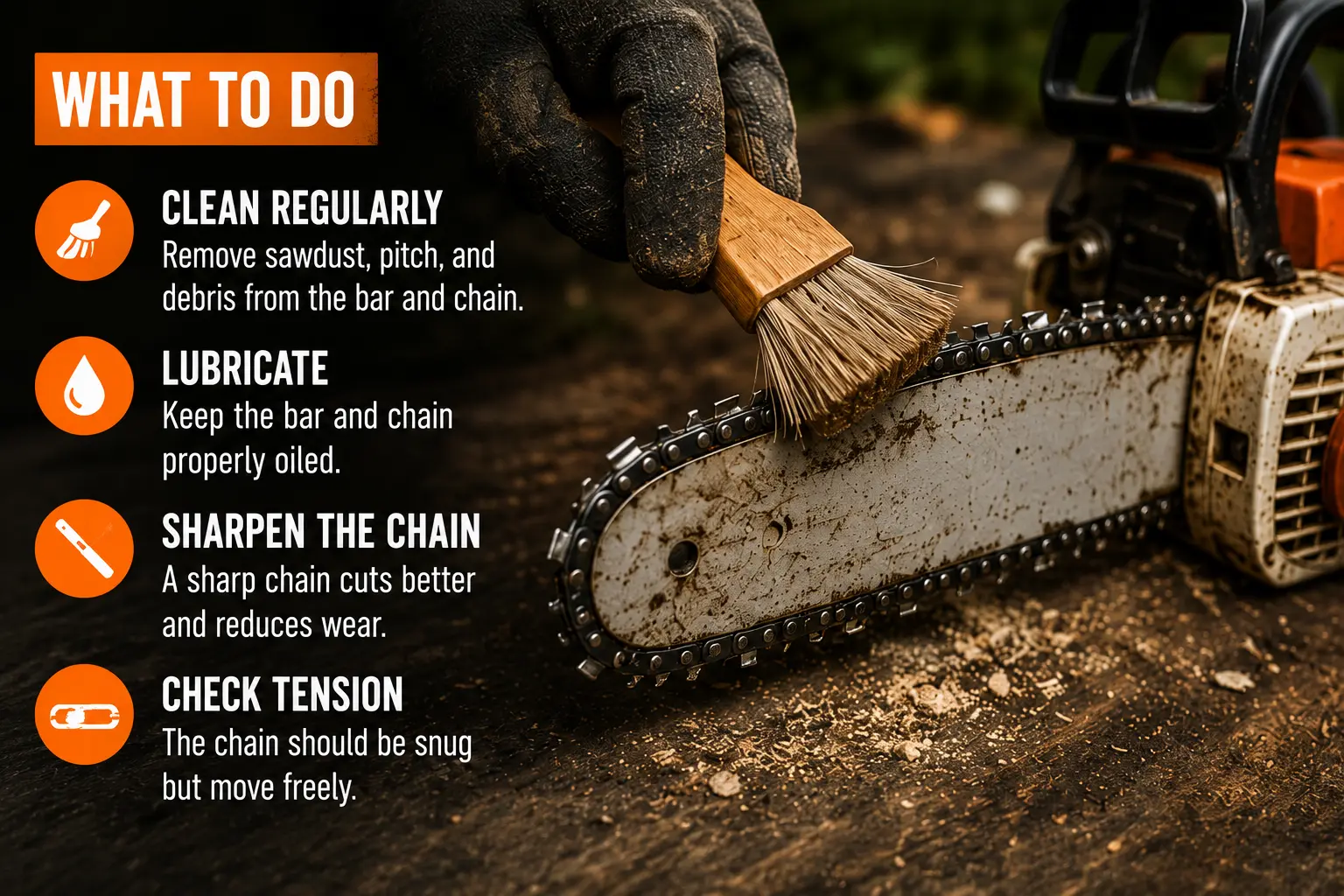
Chain tension is the single most common maintenance item that gets wrong. A chain that's too loose can derail and cause injury. A chain that's too tight creates excessive friction, wears the bar rail, and can seize the saw.
The correct tension: With the saw off and the bar nose supported, the chain should hang slightly below the bar rail on the underside — about 1/8" of droop. You should be able to pull the chain away from the bar by hand and feel light resistance, then watch it snap back against the bar when you release it.
How to adjust:
Most chainsaws have a side-mounted tensioner screw and a bar mounting nut. Loosen the bar mounting nut slightly (enough to let the bar move), turn the tensioner screw clockwise to tighten or counterclockwise to loosen, then retighten the bar mounting nut.
Always check tension when the chain is cold. A chain heats up and expands during cutting, which loosens tension. What feels correct cold may be slightly loose after 20 minutes of cutting — check periodically during long sessions.
New chains stretch significantly during their first few hours of use. Check tension frequently when breaking in a new chain — every 10-15 minutes of cutting for the first two hours.
Bar maintenance: the part most people skip
The bar wears gradually in ways that aren't obvious until they cause problems. Proper bar maintenance extends bar life significantly and keeps the chain running straight.
Flip the bar regularly. Most chainsaw bars can be mounted in two orientations. Flipping the bar every 3-4 hours of cutting time distributes wear evenly across both rail edges instead of concentrating it on one side. Most bars have holes at both the nose end and the drive sprocket end to accommodate this.
Clean the bar groove. The groove that the chain rides in accumulates sawdust, pitch, and debris. A clogged groove restricts chain movement and reduces lubrication flow to the chain. Use a bar groove cleaner (a flat tool designed for this) or the tip of a flat screwdriver to clear the groove. Do this every time you refuel.
Clean the oil inlet hole. There's a small hole in the bar (near the mounting end) where bar oil flows from the saw into the groove. It clogs with debris. Use a nail or thin wire to clear it if oil flow seems reduced.
Check rail wear. Over time, the rails of the bar groove splay outward — the sides of the groove spread apart slightly from chain pressure. A bar with splayed rails allows the chain to rock side to side, causing a rough cut and accelerated cutter wear. Use a bar rail dressing tool to file the rail edges square. If the rails are severely splayed, the bar needs replacement.
Inspect the bar nose sprocket. Most modern bars have a small sprocket at the nose that the chain rides on. This sprocket needs occasional lubrication (through a hole at the tip of the bar, using a grease needle) and eventually wears out. A worn nose sprocket creates a rough, clicking feeling as the chain passes over it.
When to replace the chain
Chains have a finite life. Indicators that a chain is at end of life:
The cutters are filed down to minimal height. Each time you sharpen, the cutters get slightly shorter. Eventually they're too short to cut efficiently regardless of how sharp you make them. Most chains have witness marks (small lines etched into the cutters) that indicate the minimum safe cutter height.
Cracked or broken drive links. Inspect the drive links (the part of the chain that fits into the bar groove) regularly. A cracked drive link is a safety hazard — it can break under load and cause kickback or chain separation.
Stretched beyond adjustment range. A chain that has been repeatedly tensioned and is now at the end of the tensioner's range is overstretched. Even at maximum tension, it will droop and risk derailing.
Consistent tracking problems after bar service. If the chain consistently drifts despite even sharpening and a properly dressed bar, the chain itself may be uneven from inconsistent wear.
A replacement chain for a common consumer saw (Stihl MS 170, Husqvarna 450, etc.) typically costs $20-45 depending on the chain type. Oregon, Stihl, and Husqvarna all make quality replacement chains. Use the chain pitch and gauge specified in your owner's manual — an incorrect chain won't fit the bar properly.
When to replace the bar
Bars last longer than chains under normal use, but they do wear out. Replace the bar when:
- The rails are so worn or splayed that dressing them would remove structural material
- The bar is bent or has visible damage from a pinch or kickback event
- The nose sprocket is worn to the point of rough chain movement and can't be replaced separately
- The bar groove is so worn that the chain rocks noticeably even on a new chain
A quality replacement bar for a consumer saw runs $30-80 depending on length and brand. If you're replacing both the bar and chain at the same time (which makes sense when both are worn), buy them as a matched set or confirm the chain gauge matches the bar groove width.
The maintenance rhythm in practice
For a homeowner using a chainsaw occasionally for firewood and storm cleanup:
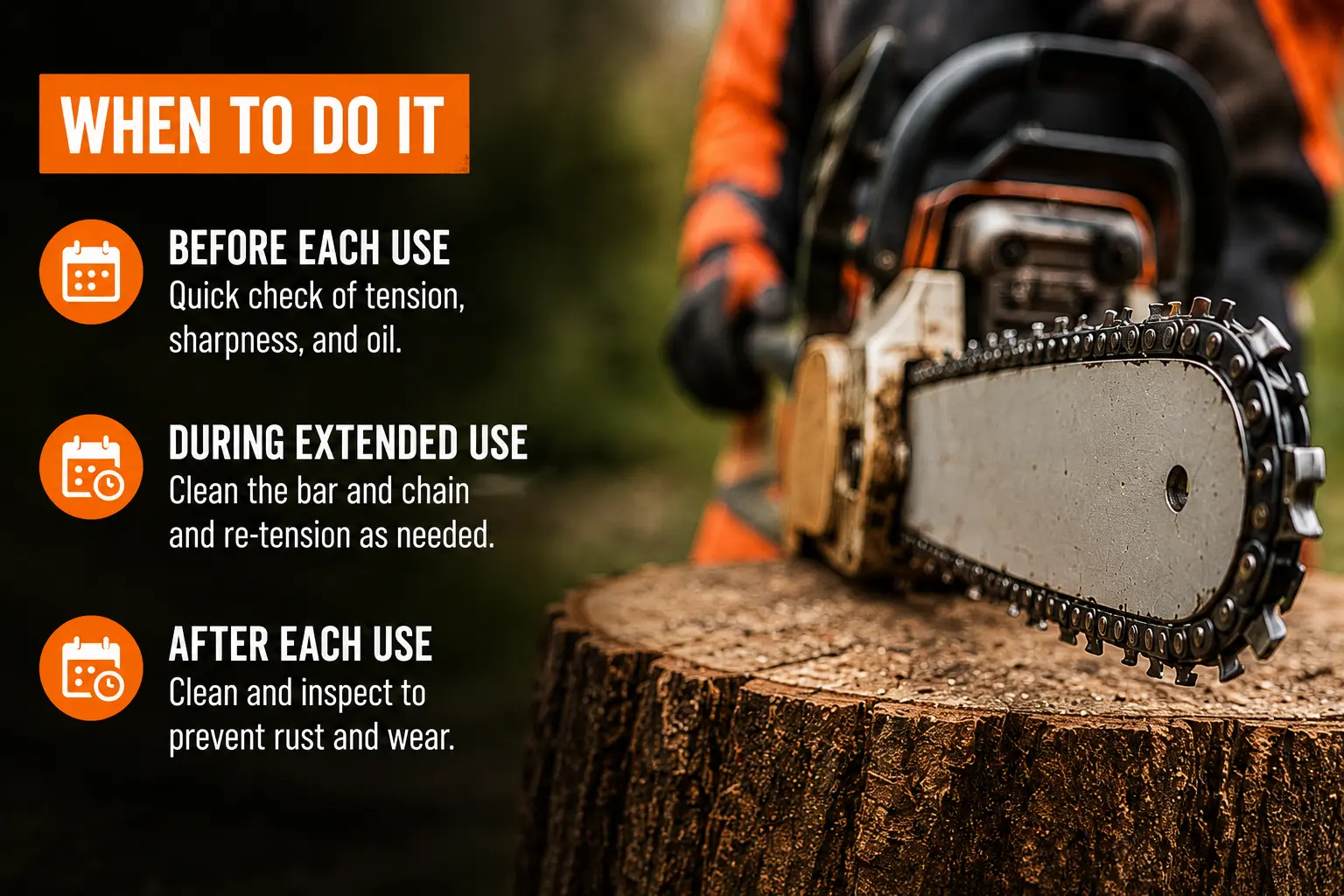
- Every refueling stop: check chain tension, check oil level, clear bar groove
- Every 2-4 hours of cutting: sharpen the chain, flip the bar
- Every 10 hours of cutting: clean the bar oil inlet, inspect drive links, lubricate nose sprocket
- Each season: full inspection of chain, bar, and nose sprocket; replace if worn
For heavier use, compress this schedule proportionally. A professional cutting eight hours a day will sharpen multiple times per day and inspect the bar daily.
This guide covers standard chainsaw chains and solid-nose or sprocket-nose guide bars. Specialty chains (skip-tooth, full-chisel professional chains) follow the same principles but have different filing specifications. Always confirm the file diameter and filing angle for your specific chain before sharpening.