When to Repair vs Replace a Chainsaw
A chainsaw repair quote lands in one of two categories: easy call, or genuinely hard call. If the repair is $40 for a new chain and a carb cleaning, you fix it. If the quote is $280 for a crankshaft seal replacement on a seven-year-old consumer saw, the math gets complicated.
The decision depends on four factors: what's broken, what the saw is worth, how old it is, and how much you actually use it. This guide walks through each one.
First: what's actually broken?
Not all chainsaw problems are equal. Some are cheap, fast fixes with a predictable outcome. Others involve disassembly, machining, or parts that may be unavailable. Knowing which category your problem falls into shapes everything that follows.
Low-cost, high-confidence repairs — fixes that almost always make sense:
- New chain and bar ($25-60 in parts, minimal labor)
- Carburetor clean or rebuild ($40-120)
- Air filter and spark plug replacement ($15-30)
- Fuel line and primer bulb replacement ($20-50)
- Recoil starter assembly ($30-80)
- Chain tensioner replacement ($20-50)
These are the bread-and-butter repairs every small engine shop does routinely. Parts are inexpensive and universally available. Even on an older saw, these are worth doing.
Higher-cost repairs that require more analysis:
- Clutch replacement ($80-150 in parts plus labor)
- Bar studs stripped or housing cracked ($100-200+)
- Ignition coil failure ($60-120 in parts plus labor)
- Oil pump failure ($60-150)
- Chain brake mechanism replacement ($80-200)
These are real repairs that shops do every day — but the cost is high enough relative to the saw's value that you need to think before authorizing.
Repairs that rarely make economic sense on consumer-grade saws:
- Crankshaft seal replacement ($150-300+ in labor alone)
- Piston and cylinder replacement ($200-400+)
- Crankcase damage or catastrophic seizure
- Bent or twisted crankshaft
These repairs involve significant disassembly and machining time, and the labor cost typically exceeds the replacement cost of any non-professional saw.
The 50% rule: a useful starting point
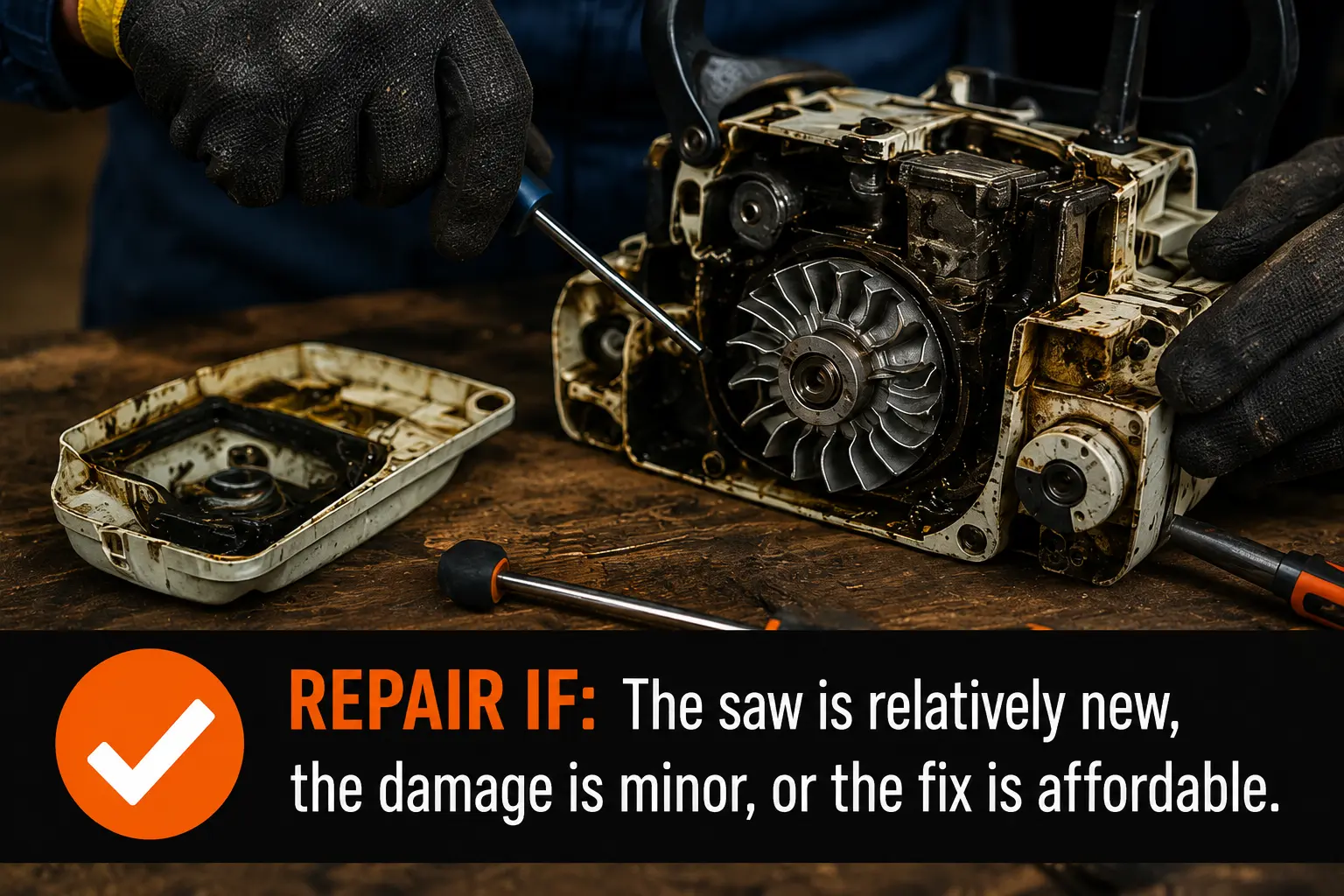
A common rule of thumb in equipment repair: if the repair costs more than 50% of the saw's replacement value, replacement is usually the better financial decision.
The logic is straightforward. If a saw would cost $300 new and the repair quote is $180, you're spending 60% of replacement cost to get a machine that's still whatever age it is, with whatever other wear it has accumulated. For that money, you could get a new saw with a warranty.
The rule isn't absolute — it breaks down in both directions. For a professional-grade saw (Stihl MS 461, Husqvarna 572 XP), a $300 repair on a $1,200 saw is obviously worth it. For a $200 consumer saw with a $160 repair quote on an internal seal, replacement may make more sense even though it's under 50%.
Use the rule as a filter, not a verdict.
How old is the saw?
Age matters differently for chainsaws than for most equipment. A well-maintained professional-grade chainsaw can last 20+ years. A consumer saw used occasionally for downed trees may have many years of life left even at age 10. Conversely, a heavily used consumer saw at age 5 may be more worn than a lightly used saw at age 12.
A more useful question than age is: how many hours of actual cutting has this saw seen? If you can't estimate that, look at the bar and sprocket. A heavily worn bar rail, a cupped or pitted sprocket, and a stretched chain all indicate real hours of work. A saw with high actual hours is worth less to repair than one that's sat in a garage for most of its life.
What age does reliably tell you is parts availability. Stihl and Husqvarna generally support their saws with parts for 10 years after a model is discontinued. After that, parts become harder to find and more expensive when you do find them. For an older saw with a failing part in a critical system, call the shop and ask specifically whether parts are in stock — don't assume.
What kind of user are you?
This is the question that gets skipped most often.
Occasional homeowner use — one or two cords of firewood per year, storm cleanup, occasional tree work. For this usage pattern, a consumer saw ($200-350 new) is appropriate, and it makes sense to repair it when repairs are under roughly 40% of replacement cost. At higher repair costs, a new consumer saw is reasonable.
Regular homeowner or part-time rural use — regular firewood cutting, property clearing, multiple cords per year. At this level, a professional-grade saw starts making sense even if you're not a professional. A Stihl MS 271 or Husqvarna 450 Rancher ($400-550) will last significantly longer and be more cost-effective over time. If your current consumer saw needs a major repair, this may be the natural transition point.
Professional or heavy commercial use — tree service, logging, land clearing. At this level, the saw is a production tool. Repair almost always beats replace for professional-grade equipment, because a quality professional saw is worth $800-1,500 and the alternative downtime of waiting for a new one to be ordered has its own cost.
Brand matters for repairability
Not all chainsaws are equally repairable. This isn't a quality judgment — it's a practical observation about parts availability and shop familiarity.
Stihl and Husqvarna are the most supported brands in the independent repair market. Parts are widely available, every small engine shop has worked on them, and the service documentation is thorough. Repairs on these brands are generally straightforward to authorize.
Echo is well-supported, with solid parts availability and a network of authorized dealers. Repairs are reliable.
Oregon and other aftermarket-focused brands — repairs can be done but parts sourcing sometimes requires ordering. Allow extra time.
Generic or house-brand saws (sold through big-box retailers under store brands) often have limited parts availability after 2-3 years. A carburetor kit or fuel line set may simply not exist. This changes the repair calculus significantly — ask the shop whether parts are available before authorizing any diagnosis.
When to let it go
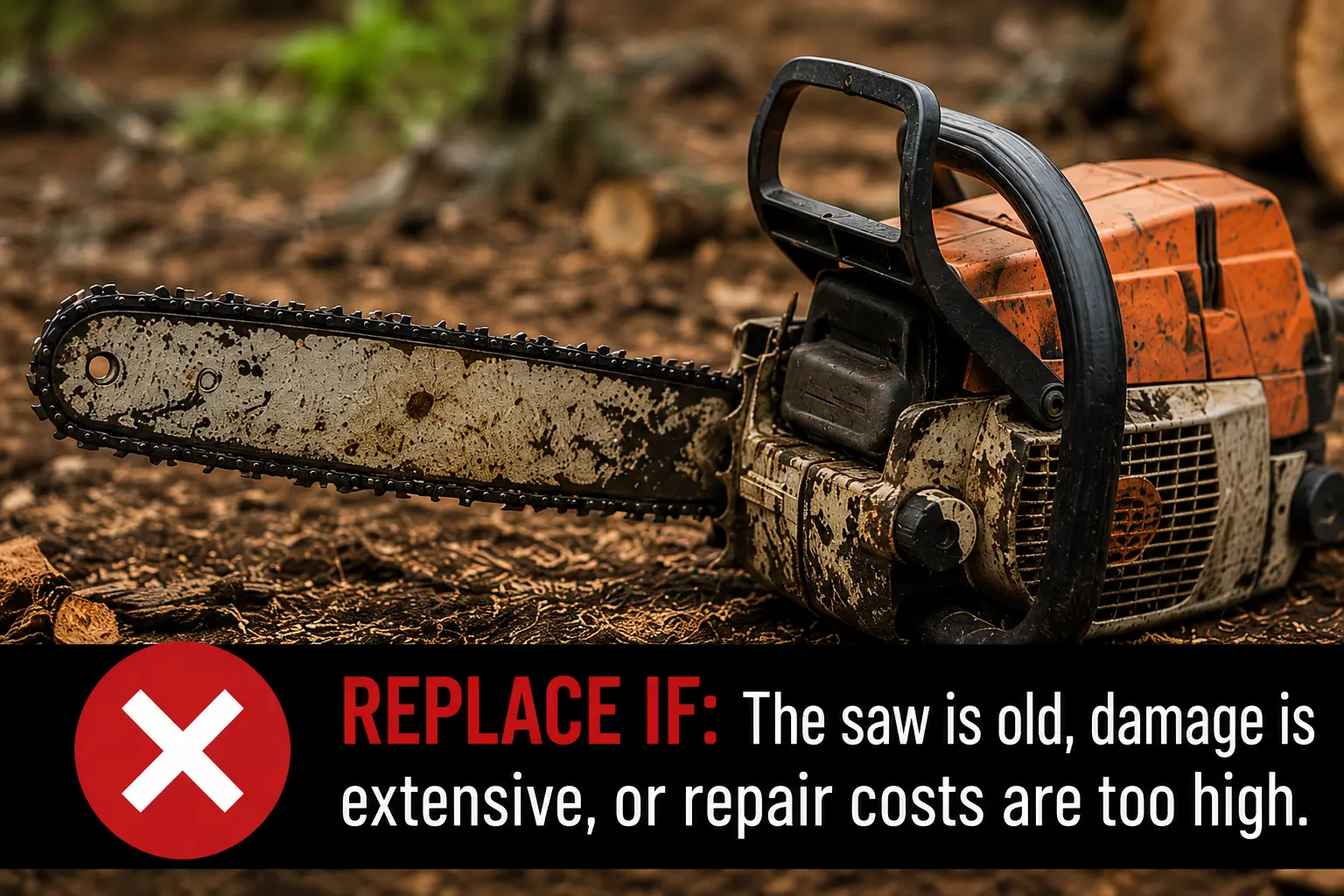
Some saws are at the end of their useful life regardless of the repair cost. Signs that replacement is the right answer even before getting a quote:
The cylinder has scored walls or a damaged piston. If the engine has seized or been run without lubrication, internal damage is likely. A compression test at the shop will tell you. Low compression with a scored cylinder means the engine needs rebuilding, which rarely makes sense on consumer equipment.
The bar rail is severely worn or bent. The bar is replaceable, but a severely worn bar is a symptom of a heavily used saw. Combined with a worn sprocket and a stretched chain, it tells you the saw has a lot of hours behind it.
Parts are unavailable. If the shop tells you it's going to take three weeks to source a part and they're not sure it'll be the right one when it arrives, that's the answer.
You've repaired it twice in the last two years. One repair is normal maintenance. Two repairs in two years on the same saw suggests you're in a cycle — fixing one thing, only to have something else fail a few months later. At some point, the accumulated maintenance cost is better put toward new equipment.
Getting an honest diagnosis
Before authorizing any chainsaw repair, ask the shop for a diagnostic first. Most shops charge $40-80 for a diagnostic and apply it toward the repair if you proceed. This tells you exactly what's wrong and what the full repair scope looks like before you've committed to anything.
When you get the estimate, ask two follow-up questions: "Is there anything else on this saw that's close to needing attention?" and "Are parts readily available?" The first question surfaces deferred problems that might show up within a season. The second question determines how fast the repair can actually be completed.
To find a repair shop near you that works on chainsaws, use the directory search below. If you're looking for a Stihl-authorized shop specifically, see how to find a Stihl authorized repair shop near you.
Repair cost ranges in this guide reflect typical independent shop rates in the United States as of 2026. Rates vary significantly by region and shop. Get a written estimate before authorizing any work.