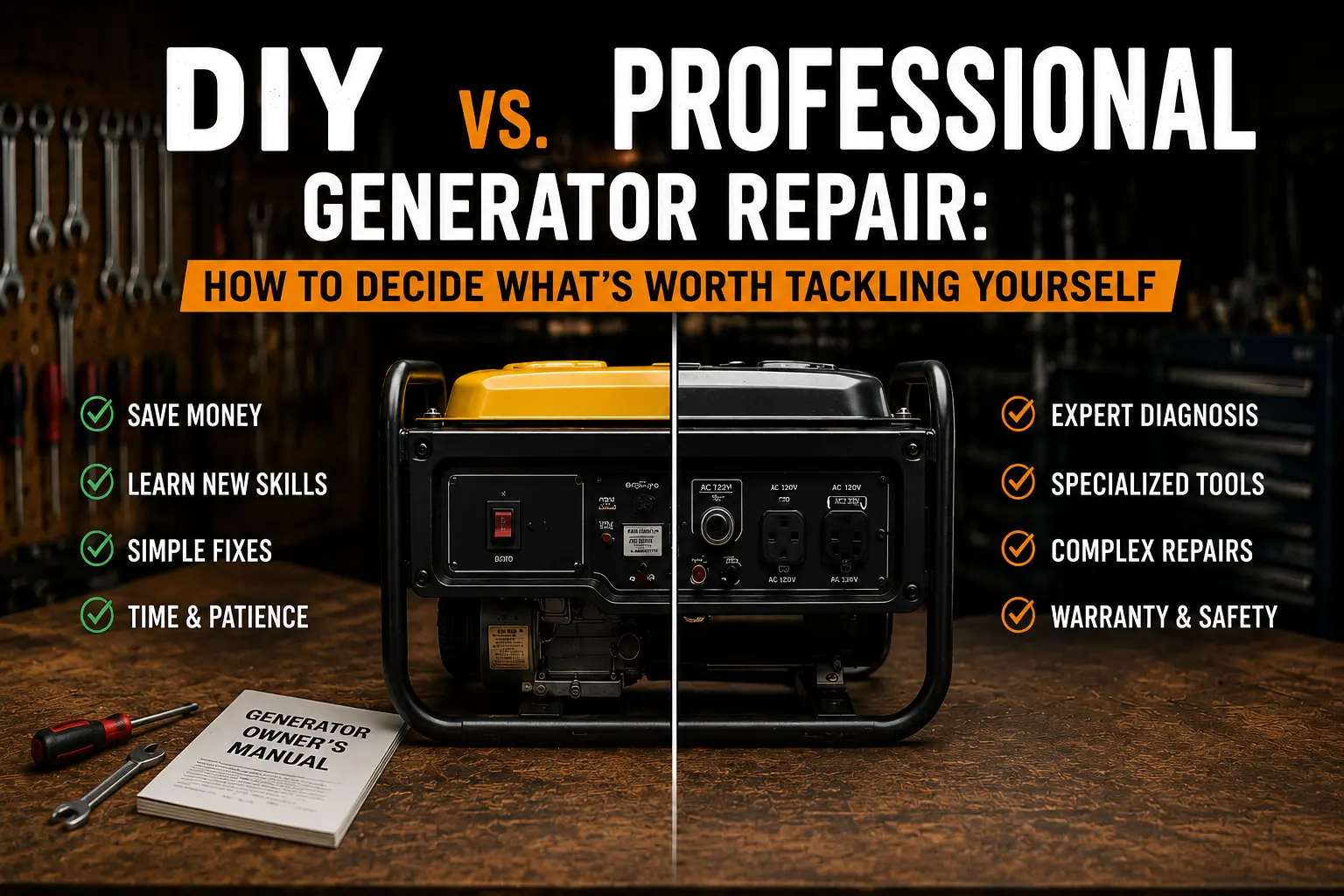
DIY vs. Professional Generator Repair: How to Decide What's Worth Tackling Yourself
The honest answer to "should I fix my generator myself or take it to a shop?" is: it depends on three things, and most owners get the math wrong in a predictable direction.
This guide covers what's reliably DIY-friendly, what's borderline, and what should always go to a professional. It also covers the hidden costs that most decision frameworks miss — both the cost of getting in over your head as a DIYer, and the cost of waiting weeks for a shop appointment during storm season.
If you're at the very start of troubleshooting and your generator won't start at all, read why won't my generator start first. This article assumes you've identified a likely cause and you're deciding what to do about it.
Quick product boxes
The three factors that actually decide it
Most "DIY vs pro" frameworks ask whether you have the tools. The more honest question is:
1. Do you have the diagnostic ability? Generators have multiple systems that can fail (fuel, ignition, electrical, governor) and symptoms often overlap. Misdiagnosis means buying parts you don't need and still not fixing the problem.
2. How much is your time worth? A carburetor service that takes a shop 90 minutes typically takes a careful first-time DIYer 4-5 hours, plus a parts run, plus a follow-up if the first attempt didn't quite work. If your hourly rate exceeds $40, the math often favors paying the shop.
3. What's the consequence of being wrong? Some repairs, done badly, leave the generator working until it dramatically fails later. Others — cylinder reassembly, ignition timing, AVR replacement — done badly cause immediate damage that exceeds the original repair's cost.
A reasonable owner can DIY most fuel system work, basic ignition (plug, spark check), oil and filter changes, and visible mechanical adjustments (choke linkage, governor spring). Anything inside the cylinder, anything involving voltage regulation electronics, and anything with proprietary diagnostic tooling is shop work.
Reliably DIY-friendly repairs
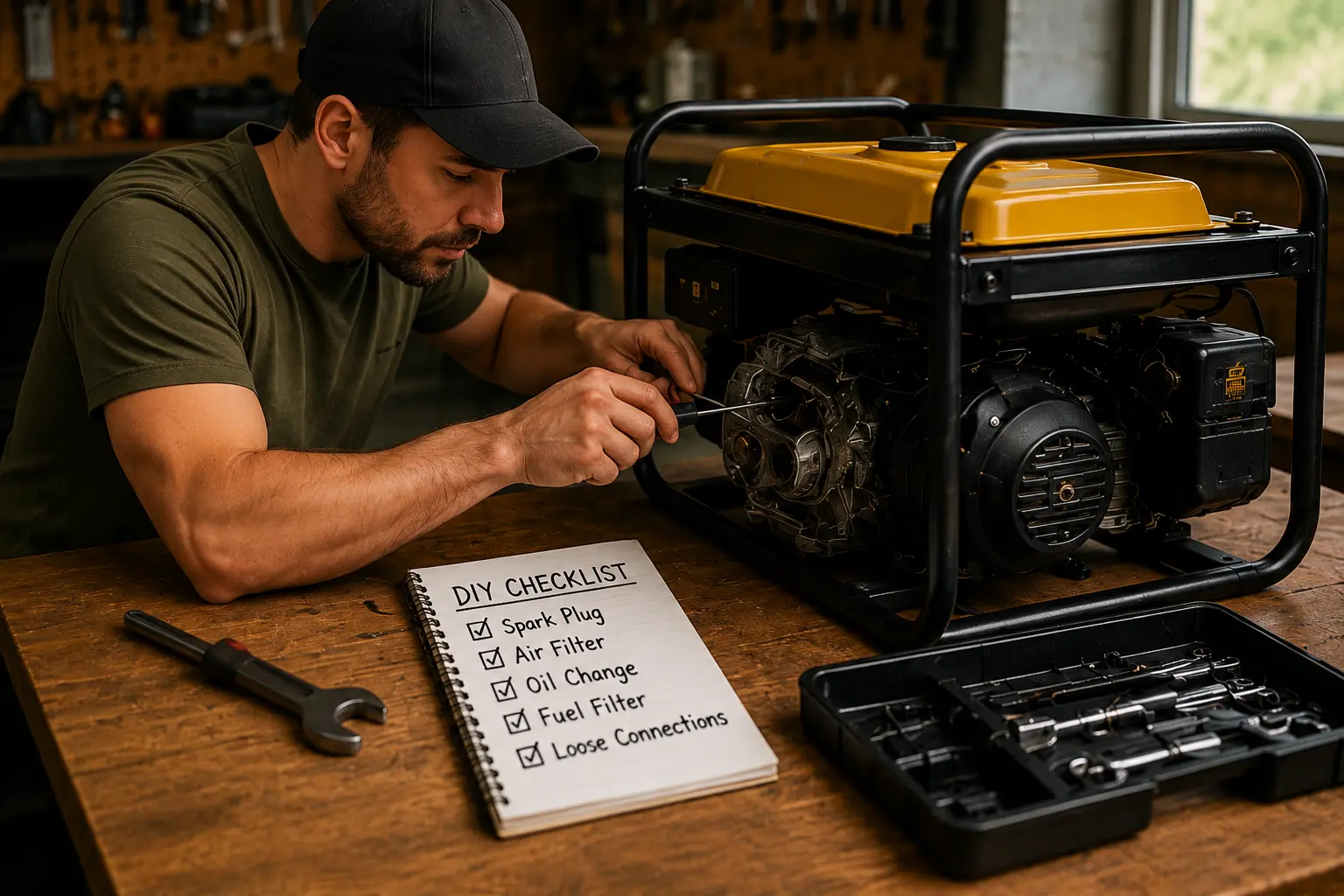
These have low risk, manageable complexity, and parts costs less than a shop's diagnostic fee. If you're mechanically inclined and willing to spend an afternoon, do them yourself.
Oil change. $20 in oil and a basin to catch the old. 15-30 minutes. Even owners who don't think of themselves as mechanical can handle this.
Spark plug replacement. $5-15 in parts, 10 minutes. The hardest part is finding the right plug for your model — check the owner's manual or look up the engine model online.
Air filter replacement. $10-25 depending on whether you're replacing the element or just cleaning the foam pre-filter.
Fuel filter and fuel line replacement. $5-15 in parts. Drain the tank first. The lines themselves are universal stock at any small engine shop.
Carburetor spray-clean (not full disassembly). A can of carburetor cleaner is $8-15 and clears mild varnish without disassembly. Spray into the air intake while the engine is running at low throttle. This won't fix a fully clogged carb but reliably handles minor surge or rough-idle from short-term storage.
Adding stabilizer to fresh fuel. Pour a fuel stabilizer like STA-BIL in at the dosage on the bottle. Preventive — it doesn't fix existing problems but prevents most of them from coming back.
Choke linkage cleaning and lubrication. Free-to-pennies. Work the linkage by hand, add a drop of light oil at each pivot point.
Governor spring replacement. $3-10 in parts. The spring slips on without tools on most models.
Battery replacement on electric-start models. $30-80 in parts. Identical to a small lawn tractor or motorcycle battery swap.
Borderline DIY repairs
These work for some owners and not others. The deciding factor is whether you're comfortable with small-parts disassembly and patient about reading service procedures before starting.
Full carburetor disassembly and rebuild. $15-30 in parts (rebuild kit), 2-4 hours of work. Doable for a careful person with a clean workspace and a magnetic parts tray. The risk: small parts are easy to lose, gaskets are fragile, and reassembly is exacting. About half of first-time attempts work without a follow-up. Many DIYers buy two rebuild kits up front because they expect to need one for practice and one for the actual repair.
Ignition coil replacement. $30-80 in parts. The complication is gapping the coil correctly to the flywheel — usually 0.012" or 0.3mm, set with a feeler gauge or a business card. Done correctly, a 60-minute repair. Done incorrectly, the coil rubs the flywheel magnets or produces weak spark.
Recoil starter rebuild. $20-60 in parts. Spring-loaded mechanisms are uniquely frustrating to first-time owners — the spring wants to escape and fights reassembly. Worth doing if you've worked on bicycle drivetrains or similar tensioned mechanisms; otherwise expect 2-3 hours and possibly a flying spring.
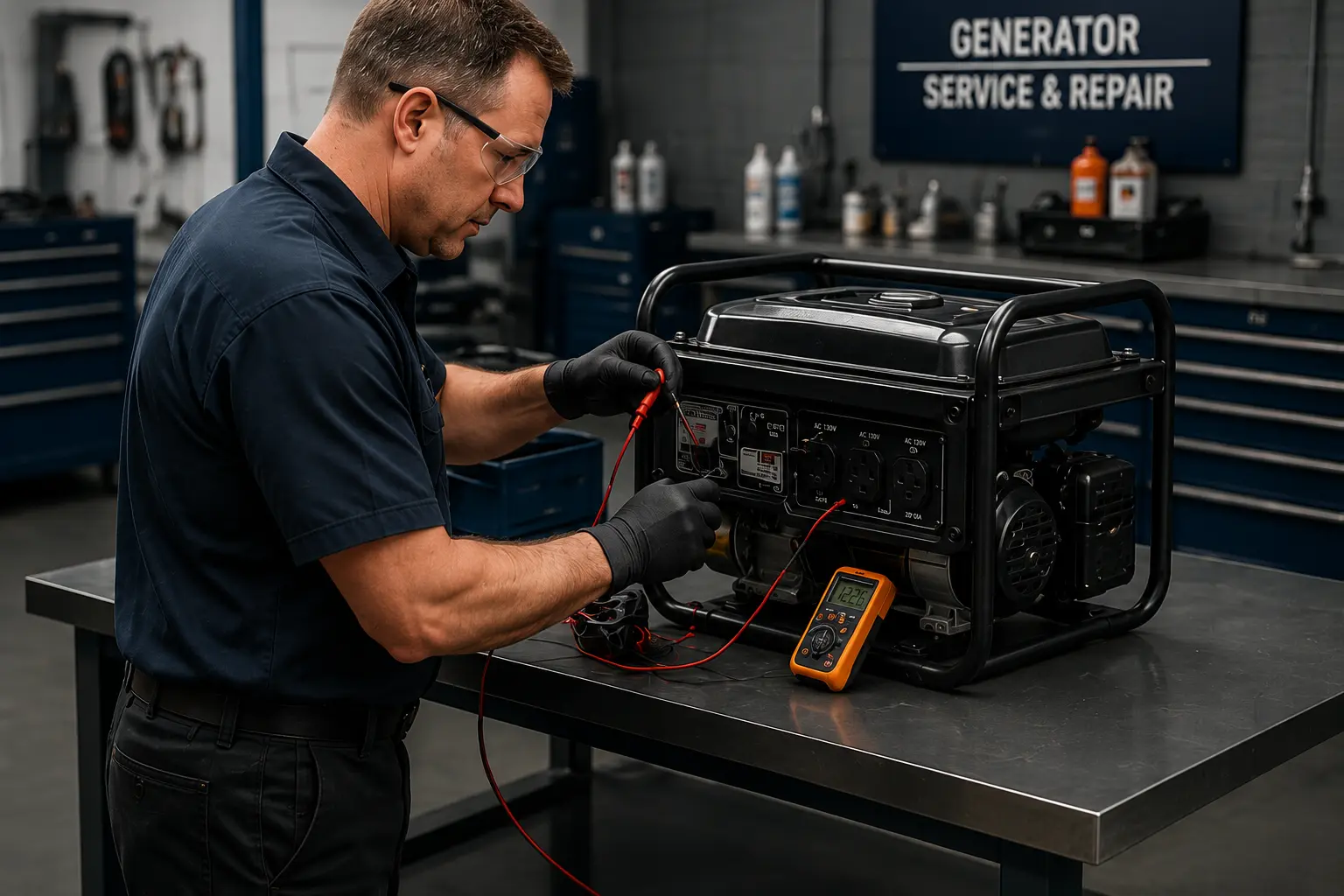
Voltage regulator replacement on portable generators. $40-150 in parts. The challenge is diagnosis — confirming the regulator is the issue rather than a winding problem inside the generator head. With a multimeter and basic electrical comfort, doable. Without those, send it.
Carburetor diaphragm replacement on units with diaphragm carbs (some Honda inverters and small Champion models). $10-25 in parts. The diaphragm itself is delicate and orientation matters. Patient owners do this fine; impatient ones don't.
Always go to a shop
Some repairs reliably fail when DIYed by non-specialists. The cost of doing them wrong exceeds the cost of paying the shop.
Compression issues, cylinder rebuilds, piston ring replacement. Engine internals work requires precise tooling (feeler gauges, ring compressor, torque wrench), specific torque specs that vary by model, and accurate diagnosis. Done badly, these repairs end the generator's life rather than extending it.
Inverter board failures on Honda EU series and similar. Proprietary diagnostic codes, board-level repair specialized tooling, and parts that often must be ordered through the dealer network. Not feasible without a Honda dealer relationship.
M-Tronic or electronically controlled carburetor diagnostics on newer generators. Same as above — diagnostic readouts require shop equipment.
Anything involving the high-voltage side of standby generators. Whole-house standby units include automatic transfer switches and grid-connected components that require licensed electrician work. DIY here is dangerous and may violate code.
Hydrolocked engines. If water has entered the cylinder (storm flooding, tipped storage), the cylinder must be drained correctly before any restart attempt or you'll bend a connecting rod. Shop work — they have the right procedure.
Suspected internal governor failures. Flyweights inside the engine, governor shafts, internal linkages — these require splitting the engine case. Shop work for all but advanced DIYers.
Anything still under warranty. Even repairs you could do yourself should go to an authorized service center while warranty applies. The labor savings of DIYing voids the parts warranty, which is rarely the right tradeoff.
The hidden costs both ways
DIY's hidden costs:
- Parts run when you discover you bought the wrong size or missing piece (1-2 hours, $20-40 in unused parts)
- Doing it twice when the first attempt didn't quite work
- Tool acquisition for one-time uses (a torque wrench you'll use once costs $40-80)
- Time the generator is offline while waiting on parts you ordered online
- The risk of a 4-hour repair becoming a project that drags across multiple weekends
Shop's hidden costs:
- Diagnostic fees ($30-80) before the actual repair starts
- Storm season wait times of 2-4 weeks (the generator that broke during one storm sits in the garage during the next)
- Drop-off and pickup time and fuel
- Parts marked up 30-100% from retail
- Occasional "while it's open" upsells
For a healthy decision, do this math: estimate your DIY time at 3x the shop's expected time. Compare your hourly rate (or what your time is honestly worth) plus parts to the shop's quote plus diagnostic. Whichever is lower wins, with a heavy thumb on the scale toward the shop if the consequence of getting it wrong is high.
A 5-question decision framework
Before starting any generator repair yourself, answer these honestly:
1. Have I correctly identified the cause? If you're guessing among three possibilities, your first DIY task is diagnosis, not repair. Symptoms that overlap (won't start, surges, runs rough) require systematic checks before parts swapping.
2. Do I have a clean, well-lit workspace and four uninterrupted hours? Carburetor and ignition work doesn't tolerate dropped parts on a gravel driveway or partial completion across multiple sessions.
3. Can I get the parts today, or am I ordering and waiting? If you're ordering, factor in days the generator is offline. During storm season, that may matter more than the cost difference.
4. What happens if I do this wrong? A botched plug change is annoying. A botched cylinder reassembly is terminal. The risk asymmetry should bias you toward professional service for high-consequence repairs.
5. Will I learn something useful for next time? Owners who plan to keep their generator 10+ years and run it through multiple storm seasons benefit from learning. One-time owners or those with multiple machines often save more by paying a shop and not building skill they won't use again.
If you answered "yes" or "low risk" to all five, DIY is probably a good call. Two or more "no" or "high risk" answers and the shop is the right move.
When to abandon a DIY mid-job
Sometimes a DIY repair surfaces complications you didn't expect. Stop and bag the parts when:
- The next step requires a tool you don't have and won't be able to source today
- A component breaks on disassembly and the replacement isn't available locally
- You can't tell whether you're reassembling correctly and there's no clear reference photo or diagram
- The repair's actual scope is larger than you thought (a stuck-bolt scenario that will require drilling, for example)
- You've been at it for two-plus hours and aren't materially closer to done
Bagging the parts (with a Sharpie note about what state things are in) and bringing it to a shop is far cheaper than continuing to break things while frustrated. Shops will not judge you. They see partially-disassembled generators every week and have streamlined intake procedures for it.
What a shop visit costs in 2026
For ballparking the comparison side of the math:
- Diagnostic fee: $30-80, often credited toward the eventual repair
- Hourly labor rate: $80-120 at independents, $110-165 at authorized dealers
- Standard carburetor service: $130-180 independent, $180-250 authorized
- Ignition coil replacement: $80-180 total
- Voltage regulator replacement: $150-300 total
- Annual tune-up (oil, plug, filter, fuel system): $120-200
Storm-season pricing can add 25-50% to these baselines, and wait times stretch to 2-4 weeks at most shops. Pre-season service in early-to-mid spring is the right play if you have any reason to expect the generator will see use this year.
For more detail on what specific repairs cost, see the generator repair cost guide.
Bottom line
Most generator owners can save money DIYing fuel system maintenance, basic ignition work, and visible mechanical adjustments. The savings are real and the skills carry across to other small engines.
But generator owners consistently overestimate their tolerance for unfinished projects and underestimate the value of a working generator during a storm. Owners who have been through a season with a broken generator often pay shops the next year without complaint — they've learned what waiting actually costs.
If you're genuinely unsure whether a specific repair is in your range, call a local repair shop. Most will give a five-minute phone diagnosis and an honest opinion about whether the work is DIY-friendly for your specific situation. The answer varies by model, by your skill level, and by whether your local shop has parts in stock.
If you need to find a shop for diagnosis or service, use the directory below — most can give a phone estimate and an honest take on DIY feasibility before you bring the unit in.
This guide covers gas-powered portable and small standby generators (Generac, Honda, Champion, Briggs & Stratton, Kohler, and similar brands). Repair complexity, parts availability, and shop pricing vary by region and model — treat the ranges here as starting points for your own research. If your generator is under warranty, any repair should go to an authorized service center to preserve coverage.