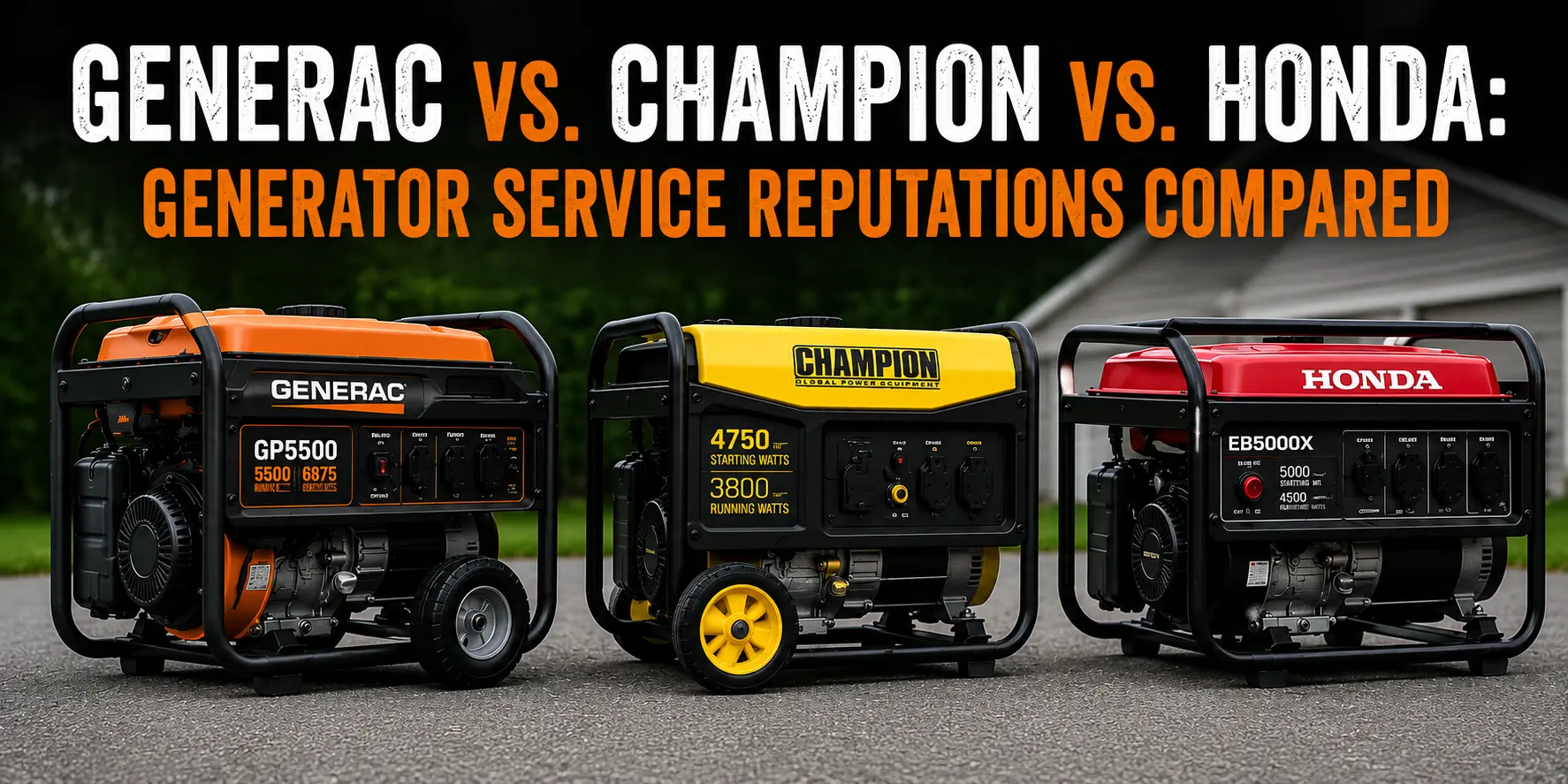
Generac vs. Champion vs. Honda: Generator Service Reputations Compared
Three brands dominate the portable and small standby generator market in the U.S.: Generac, Champion, and Honda. Each has loyal owners and reasonable arguments for why their preferred brand is best. But "best generator" misses the more useful question for someone planning to keep a generator running through 10-20 storm seasons: which one is easiest to service in the place you actually live?
Service support — meaning how easy it is to find a competent technician, how readily parts are available, and what those services actually cost — varies more between these three brands than the spec sheets suggest. This guide breaks down each brand from the perspective of repair-shop accessibility and long-term cost of ownership, drawn from feedback across the small engine repair shop network.
If you're choosing between specific models for storm season, the fullest picture comes from combining this guide with shop-level conversations in your area. The shops at the bottom of this page can tell you which brands they actually see most often in their service queue.
At a glance
| Generac | Champion | Honda | |
|---|---|---|---|
| Service network density | High | Medium | Medium (specialized) |
| Parts availability | Excellent | Good | Excellent at dealers |
| DIY-friendliness | High | High | Medium-High |
| Average repair cost | $$ | $ | $$$ |
| Common DOA issues | Carb varnish, voltage regulator | Carb varnish, fuel valve | Carb varnish, recoil starter |
| Reputation for longevity | 8-12 years typical | 6-10 years typical | 12-20+ years typical |
| Best fit | Whole-house standby, infrequent storm use | Budget portable, occasional runs | Long-term, premium portable |
Each section below unpacks why these distinctions matter when something breaks.
Generac: ubiquitous service, mid-tier longevity
Generac has the deepest service network of the three brands by a wide margin. Authorized Generac dealers are common across the U.S., and Generac's standby generator product line (the Guardian series in particular) is widely installed enough that almost every small engine shop has worked on at least a few. Even shops that aren't authorized dealers can usually source Generac parts from common distributors.
What that means for owners:
- Finding a tech who knows your specific Generac model is usually straightforward
- Common parts (carburetors, fuel valves, voltage regulators) are often in stock at independent shops, not just authorized dealers
- Repair turnaround is typically 1-2 weeks even during storm season, versus 3-4 weeks for other brands
Common Generac service issues:
- Carburetor varnish from sitting between storm seasons (universal across brands, but Generac's smaller portable carbs gum particularly fast)
- Voltage regulator failures on the GP series, often after 5-7 years of intermittent use
- Fuel valve corrosion on units stored with old fuel for extended periods
- For standby units (Guardian, Protector): exercise cycle valve issues if not run weekly per manual
Repair cost reality:
A typical Generac portable generator carburetor service runs $130-180 at independent shops, $180-250 at authorized dealers. Voltage regulator replacement runs $150-300 in parts and labor combined depending on model. A full annual service for a standby unit (oil, filter, plug, exercise cycle test) typically runs $200-350.
Where Generac falls short: Generac portable generators don't have the longevity of Honda equivalents. A heavily-used Generac portable typically needs major service (carb rebuild, possible cylinder work) at the 1,000-hour mark. Honda equivalents commonly go 2,000+ hours with similar maintenance.
Generac's strongest case is when service availability matters more than absolute longevity — which describes most homeowners. Adding a fuel stabilizer like STA-BIL to the tank during seasonal storage extends the time between carburetor services regardless of brand.
Champion: budget-friendly with a steeper service learning curve
Champion has carved out the U.S. budget generator segment with portable units that perform well at price points 20-40% below comparable Generac and Honda models. The reliability gap has narrowed significantly over the past decade — modern Champions are competent machines — but the service experience differs in ways that matter once something fails.
What sets Champion apart:
- Excellent value for money on initial purchase
- Increasingly reliable engines — Champion's own engine line, derived from Honda GX clones, has improved meaningfully since 2018
- Strong 3-year limited warranty backed by responsive corporate support
What complicates service:
- Smaller authorized dealer network — most service work happens at independent shops
- Parts often need to be ordered (1-3 day wait) rather than pulled from shop stock
- Some shops are reluctant to take Champion units in during storm season because parts margins are thinner and warranty work pays less than tier-one brands
- Owners frequently report having to call 3-4 shops to find one willing to take a Champion during peak weeks
Common Champion service issues:
- Carburetor varnish (universal across all brands)
- Fuel valve failure, slightly more common than on Generac equivalents, often related to ethanol exposure
- Recoil starter wear on smaller models — the 2000W/4000W inverter line in particular
- Voltage regulator issues on higher-output portable units after 4-6 years
Repair cost reality:
Champion service runs lower than Generac or Honda — typical carburetor service $100-150, voltage regulator replacement $80-180. The catch: parts wait time often adds 1-2 weeks to repair, which during storm season can be the difference between having power that week or not.
Where Champion shines: for someone who fires up the generator a few times per year and is willing to do basic preventive maintenance themselves (fresh fuel each season, stabilizer, annual carb spray), a Champion can deliver excellent value over 6-10 years. The economics break down for someone running the generator 100+ hours per year for primary backup — the longer the duty cycle, the more the reliability gap with Honda matters.

Honda: highest longevity, sparser service network
Honda generators (EU series inverter, EM/EG series conventional, EB series industrial) have the strongest reliability reputation among small engine technicians. Honda's GX series engines are well-engineered and routinely outlast their owners' patience for storage and maintenance neglect.
What Honda does well:
- Premium build quality — heavier-gauge components, tighter tolerances throughout
- Industry-best engine longevity (the GX160, GX200, and GX270 engines commonly hit 3,000+ hours with basic maintenance)
- Quiet operation — the EU2200i and EU3000iS are class-leading on noise
- Excellent resale value; used Hondas hold value better than competitors
The service tradeoff:
- Honda Power Equipment dealers are less densely distributed than Generac's network. In rural and small-metro areas, the nearest authorized dealer may be 30-60 miles away.
- Independent shops can work on Honda units, but parts often need to be ordered direct from Honda Power Equipment rather than pulled from a generic small-engine parts catalog.
- Premium parts pricing — Honda factory parts cost 30-50% more than Generac or Champion equivalents.
- Older Honda inverters (early EU2000i, pre-2017) have proprietary diagnostic codes that require Honda dealer software to read fully.
Common Honda service issues:
- Carburetor varnish (universal, though Honda carbs handle storage slightly better than competitors)
- Recoil starter wear after 1,500+ hours
- Inverter board failures on older EU2000i units (pre-2017), typically requiring dealer diagnosis
- Fuel valve sticking on units stored with ethanol fuel for years
Repair cost reality:
Honda service runs the highest of the three brands. Carburetor service typically $150-220. Recoil starter rebuild $80-150. Inverter board diagnosis and replacement on older EU models can run $400-700, sometimes pushing the repair cost into the same range as a new but smaller portable.
Where Honda makes sense: for serious users who run their generator 200+ hours per year, value the reliability premium, and live within reasonable distance of a Honda dealer. The repair cost premium is rational only when the longevity dividend is being collected in return.
What this means for your buying decision
If your generator will sit unused for months between storms and only run 20-40 hours per year, all three brands will serve adequately. The differentiator becomes service network access in your specific area. Three things worth checking before you buy:
How many shops within 30 miles will work on this brand? Call 2-3 local small engine repair shops and ask whether they service the brand you're considering. The answer varies more than buyers expect.
Where is the nearest authorized dealer? For warranty work and electronically-controlled models, you may need a dealer rather than an independent. Distance to the nearest dealer is the practical limit on how aggressively you can push repair turnaround.
What's storm-season turnaround for this brand at your local shops? Some shops triage by brand familiarity. Your generator's brand affects how quickly you'll get it back during the busy weeks after a major storm.
For frequent users (200+ hours per year, primary or near-primary backup power), Honda's longevity premium increasingly justifies the higher upfront and service costs. For occasional users (40 hours per year or less), Generac's service network density is often more valuable than Honda's longevity advantage.
Common ground across all three brands
Regardless of which brand you own, three things matter most for keeping a generator running:
Fresh fuel. Drain old fuel before storage, refill with fresh fuel before each use, and add a stabilizer to extend shelf life. This single practice prevents 70-80% of all generator service issues across every brand.
Annual exercise. Run the generator under load for 15-30 minutes once a quarter, even when you don't need it. This burns off accumulated moisture in the engine, keeps fuel system seals supple, and surfaces small problems before they become big ones.
Documented service history. Keep a small notebook in your generator storage area noting oil change dates, plug changes, and any repairs. Shops appreciate this and it helps avoid duplicate work.
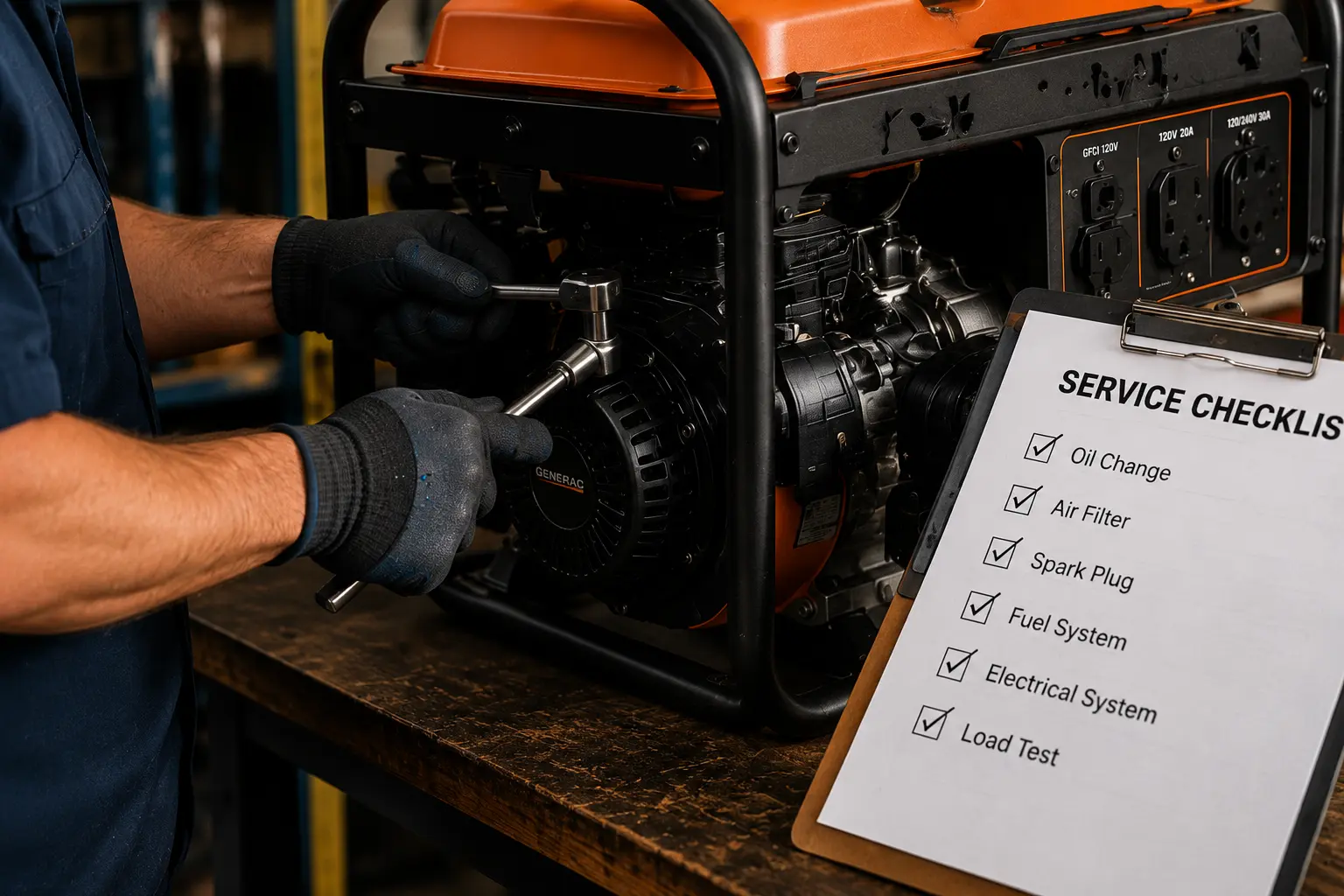
When to bring it to a shop regardless of brand
The brand-specific issues above aren't the most common reasons generators end up at a shop. Brand-agnostic issues that almost always require professional service include:
- Hard-starting after a season of storage with old fuel (full fuel system service)
- Surging or hunting RPM that doesn't clear with stabilized fresh fuel — see the generator surging troubleshooting guide
- No spark after a plug replacement (ignition coil work)
- Visible smoke from exhaust during operation
- Output voltage abnormalities measured at the receptacle
Independent generator repair shops typically charge $80-120 per hour. Brand-authorized dealers run 20-40% higher but are required for warranty work. For a full cost breakdown by repair type before authorizing work, see how much does generator repair cost. Storm-season pricing can add a premium, and wait times stretch to 2-4 weeks after major events — book pre-season service in early-to-mid spring before the rush.
If you need to find a repair shop that handles your specific brand, the directory below filters by brand expertise and authorized service tier. Most shops will give a phone diagnosis before you bring the unit in.
This guide compares portable and small standby generators from Generac, Champion, and Honda. It focuses on service network, parts availability, and repair cost — not horsepower specs or initial purchase price. For hands-on troubleshooting, see the generator-specific guides linked above. Prices and network density reflect 2026 U.S. market conditions.