How Often Should You Run Your Generator?
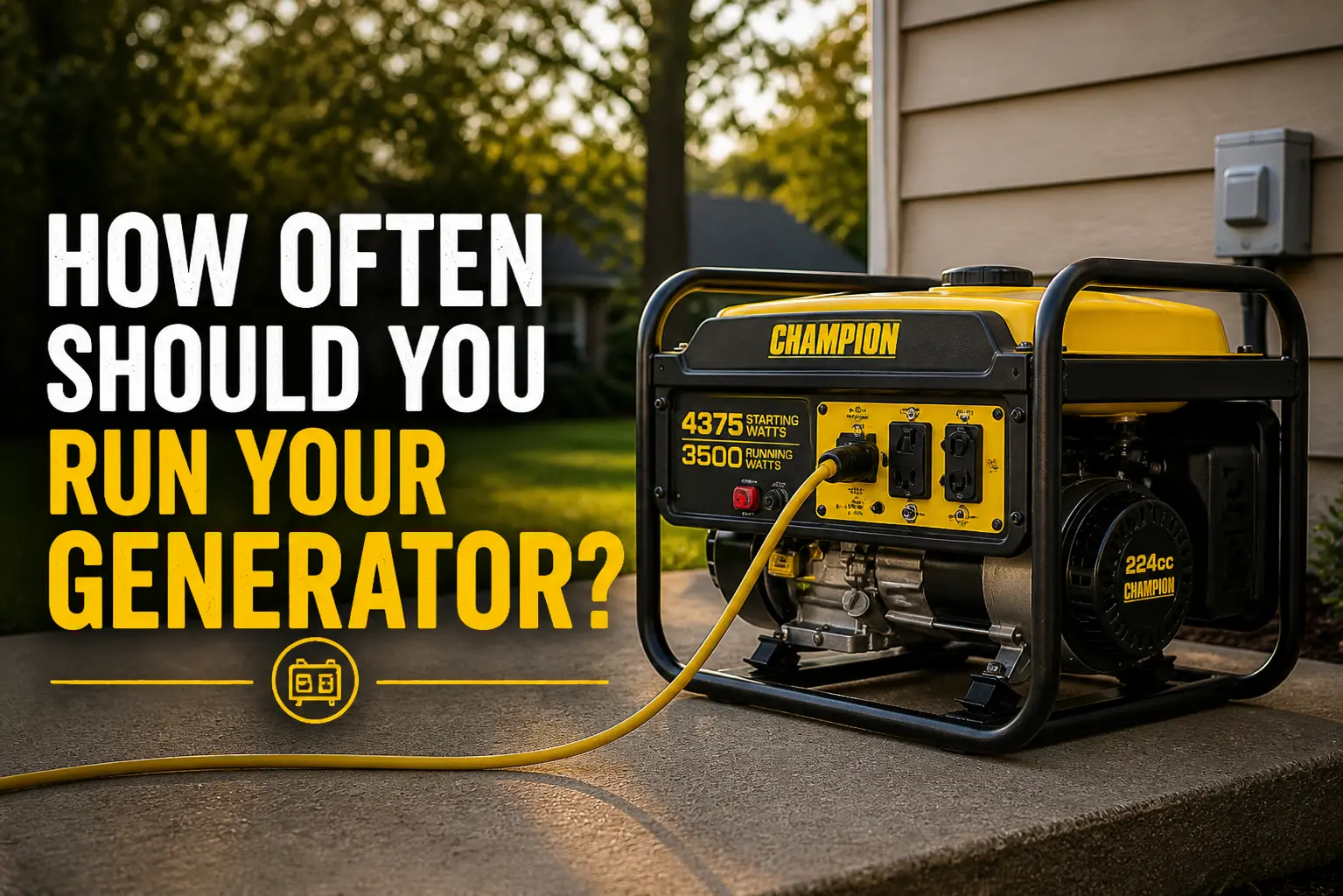
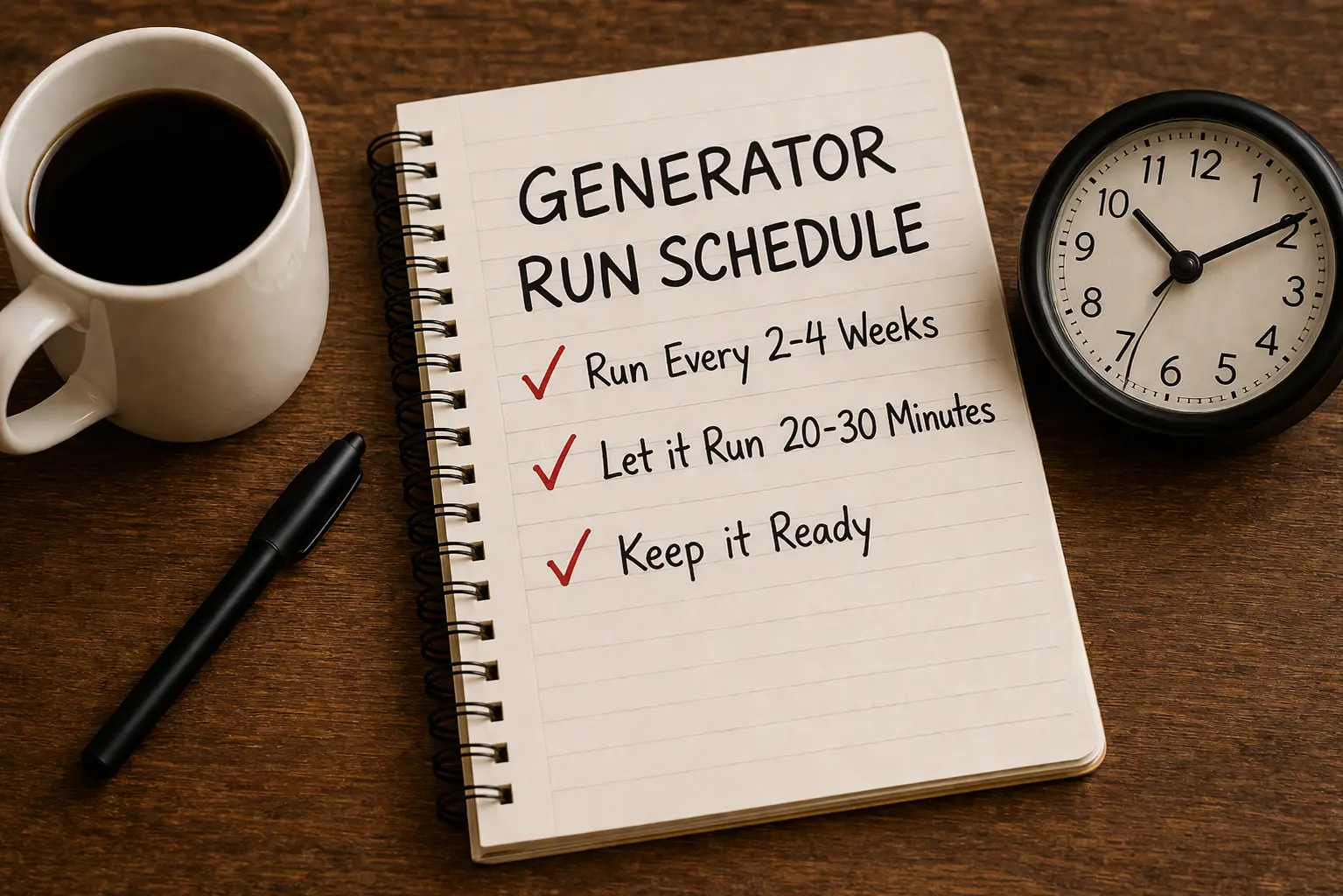
The short answer: every 30 days, for at least 20 minutes, under load.
That's the rule for both portable and standby generators. The longer answer — why this matters, what counts as "under load," and what changes for different generator types — is below.
Most generator owners run their unit twice a year: once when they buy it, and once during the first power outage it's needed. That's the recipe for a no-start in an emergency. Generators are mechanical equipment with seals, fuel systems, batteries, and moving parts that all degrade faster from sitting than from running.
The 30-day rule, explained
Twenty minutes of run time every 30 days does four important things:
1. Cycles fresh fuel through the carburetor. When fuel sits in the carburetor for weeks, the lighter compounds evaporate and varnish builds up in the jets. Running the engine pulls fresh fuel through the system and flushes out anything that's started settling.
2. Keeps internal seals lubricated. The crankshaft seals, valve stem seals, and piston rings rely on a thin film of oil to stay supple. When the engine sits, that oil migrates away from those surfaces. The seals dry out and harden, which leads to leaks and compression loss over months and years.
3. Maintains battery charge (electric-start units). A standby generator's battery loses about 1-2% of its charge per week sitting idle. After 30 days, you've lost roughly 5-8% of capacity. After 6 months, the battery may be too weak to crank the engine. Running the generator with the battery in the circuit recharges it through the alternator.
4. Verifies the unit still works. This is the underrated reason. A monthly run-in tells you about problems while you have weeks to fix them. Finding out your generator won't start at 11 PM with a hurricane bearing down is the worst possible discovery time.
What "under load" actually means
Idling a generator with no load isn't enough. The engine needs to do real work to keep things working properly.
For a portable generator, "under load" means plugging in 1,000+ watts of actual electrical demand. Easy options:
- A space heater on high (1,500W typically)
- A hair dryer (1,500W on high)
- A window air conditioner (700-1,500W depending on size)
- A small power tool drawing continuous load
- Multiple appliances combined
The load doesn't need to match the generator's rated capacity — running a 7,000W generator at 1,500W of load is fine. What matters is that the engine isn't just spinning with no resistance.
For a standby generator (Generac, Kohler, Briggs home standby), monthly self-tests typically run the engine without transferring load — the engine just runs at no-load RPM for 5-15 minutes. This is better than nothing, but it's not as thorough as a real load test. Most standby controllers have an option to schedule an "exercise with load" cycle, which actually transfers some house circuits to generator power for a few minutes. Enable this if your model supports it.
Schedule that actually works
The hardest part of monthly generator maintenance isn't the work — it's remembering to do it. Three approaches that work:
Calendar-based: First Sunday of every month. Set a recurring reminder on your phone. Tie it to something you already do that day.
Bill-based: Run the generator the day you pay your electric bill or check your monthly statements. The mental association makes the habit stick.
Seasonal anchors: If once a month feels excessive, at minimum run it on these dates:
- May 15 (before hurricane season)
- August 15 (mid-season check)
- October 15 (storm season closeout, before fall storage prep)
- February 15 (mid-winter, especially in cold climates where snow and ice events drive use)
Once a month is the standard recommendation for a reason — but inconsistent quarterly maintenance is dramatically better than annual maintenance.
Quick backup power option
Standby generators: monthly self-tests
Modern home standby generators (whole-house permanent installations) come with built-in self-test schedules. The default is usually weekly or biweekly, running for 5-12 minutes without transferring household load. The controller logs each test and flags failures.
Verify your settings:
- The self-test is enabled (some installers leave it off accidentally)
- The schedule fits your household — Tuesday at 1 PM means you're rarely home to hear it; Saturday morning at 10 AM is more useful for catching problems
- The exercise duration is at least 10 minutes (5 isn't enough to fully circulate fuel and reach operating temperature)
- The controller is configured to alert you if a test fails (some require a Wi-Fi or cellular module to send notifications)
If your standby generator hasn't been serviced by a tech in over a year, schedule one regardless of how the self-tests look. Self-tests catch some problems but miss others — fuel quality, valve adjustment, oil condition, and connection corrosion all need eyes on them periodically.
What if you've already missed a few months?
If your generator has been sitting more than 6 months without running, don't just fire it up and hope. The fuel is probably degraded enough to cause problems, and the carburetor may be partially gummed.
The right approach for a generator that's been sitting:
- Check the oil level and condition. If it's been over a year, change it before starting.
- Drain old fuel from the tank and float bowl. Refill with fresh gas + stabilizer.
- Pull the spark plug. If it's wet from previous attempts, dry it. If it's been in the engine for years, just replace it (~$5).
- Try starting. If it fires but runs rough, let it warm up for 5 minutes — sometimes the carburetor self-cleans with fresh fuel running through it.
- If it won't start after fresh fuel and a fresh plug, the carburetor is fouled. See our guide on generator no-starts for next steps.
Most "my generator won't start" emergencies trace back to skipped monthly run-ins. Catching it now, before the next storm, is the entire point.
If the generator is down for parts or diagnosis and you still need a small amount of essential power, a battery station from BLUETTI US can fill the gap for lights, phones, or other modest loads until the repair is finished.
How long can a generator run continuously?
This is a common follow-up question. The answer depends on the generator type:
Portable generators (gasoline): Most portables are rated for 8-12 hours of continuous run time on a tank, but the engine can run as long as you keep adding fuel — there's no hard cap. The practical limits are:
- Oil checks every 8 hours during extended runs
- Cool-down periods aren't required for properly-sized loads
- Run time degrades faster at high load (running at 90% capacity continuously is harder on the engine than 50%)
For multi-day outages, plan to run the generator 8-12 hours during peak demand periods (refrigerator, lights, fans) and turn it off overnight to conserve fuel.
Standby generators (propane, natural gas, diesel): Designed for continuous run. Whole-house standbys can run for days or weeks if needed, with regular oil and filter checks per the manual.
Inverter generators: Similar to conventional portables but quieter and more fuel-efficient at low loads. Some have eco modes that adjust RPM based on demand. Same maintenance schedule applies.
When to call a shop
Monthly run-ins catch most issues, but some problems need a tech:
- Engine surges or hunts even with fresh fuel and a clean plug
- Generator produces voltage but won't hold steady frequency under load (lights flicker, appliances cycle)
- Visible oil leaks at gaskets or seals
- Smoke from the engine that doesn't clear after a few minutes of running
- Standby controller showing fault codes you can't clear
- Excessive vibration or new mechanical noises
Most independent generator shops will book pre-season service slots starting in March or April. After hurricane season starts, expect 2-3 week waits. If your generator is showing any of the warning signs above, get it in before the season instead of during it. For a complete pre-season prep checklist, see how to prepare your generator for hurricane season.
If you're not sure whether something's an issue or just normal wear, find a verified small engine repair shop near you below. Most will give a phone diagnosis before you bring the unit in.
This guide covers gas, propane, and natural gas generators (Generac, Honda, Champion, Briggs & Stratton, Kohler, and similar). Diesel generators have different maintenance schedules and aren't covered here. Always follow the maintenance schedule in your specific generator's manual — these are general guidelines and your model may have specific requirements.