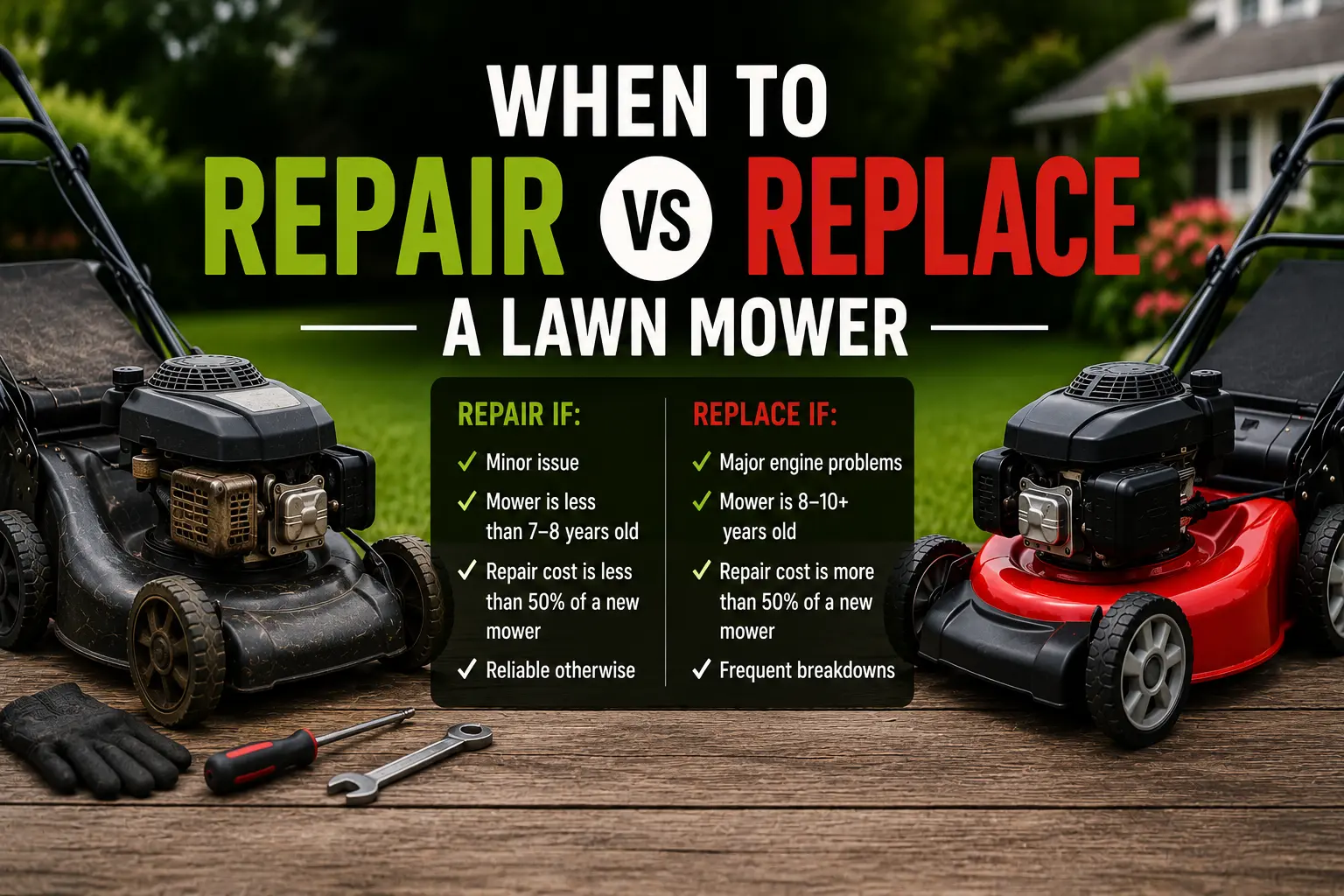
When to Repair vs Replace a Lawn Mower
A repair estimate on a lawn mower lands somewhere in a wide range — $40 for a carburetor cleaning and spark plug, or $350 for a crankshaft seal and deck rebuild. The math at the low end is obvious. At the high end, it gets genuinely complicated, and the right answer depends on factors that go beyond the repair cost alone.
Here's a practical framework for making the call.
Start with what's broken
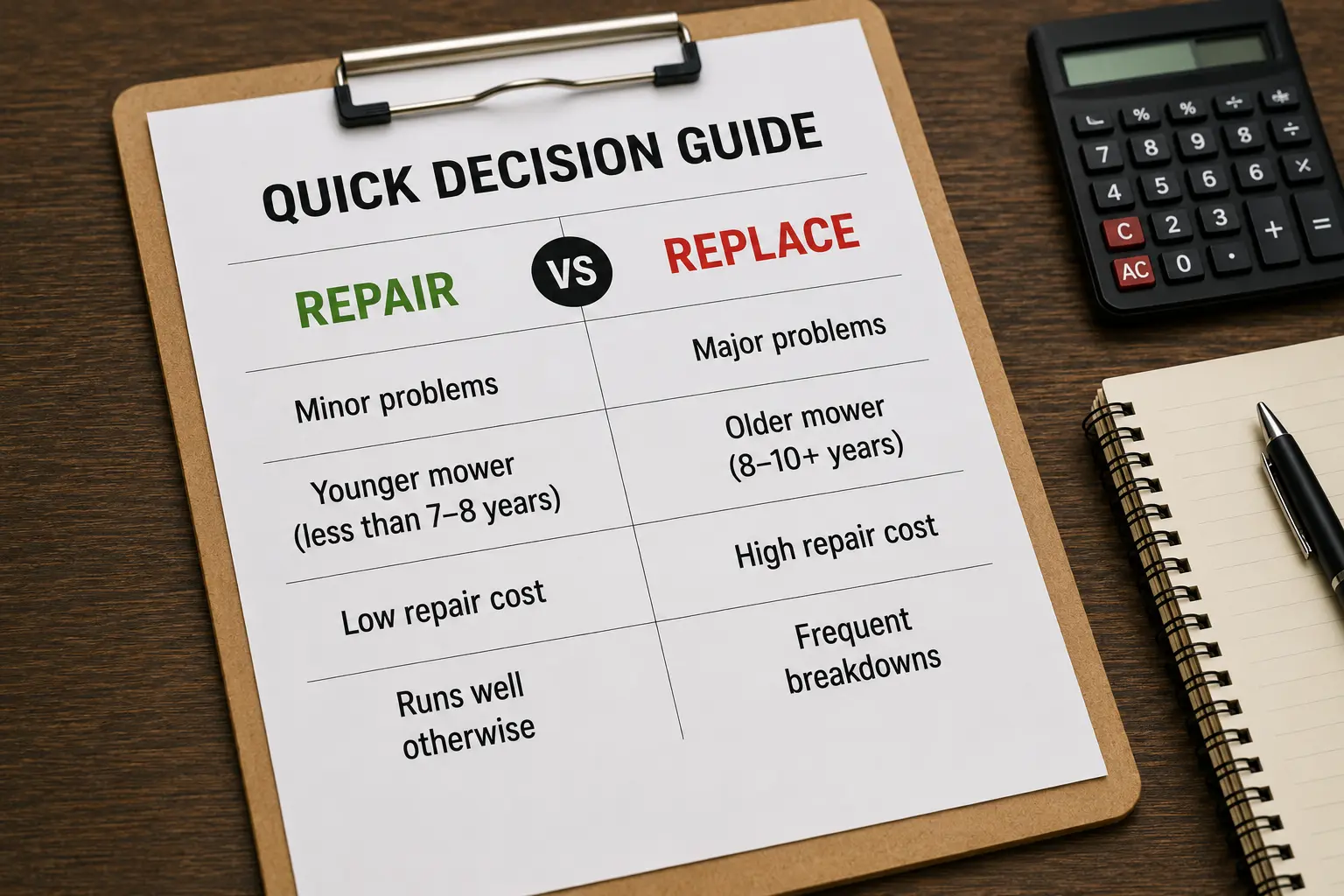
Not every repair is equal. Some problems are cheap to fix, reliable to repair, and leave you with a mower that will run well for years. Others are expensive, involve internal engine wear, and suggest the machine is nearing the end of its useful life even after the repair is done.
Repairs that almost always make sense:
- Carburetor cleaning or rebuild ($60–$120)
- Spark plug, air filter, fuel filter replacement ($20–$40)
- Fuel line replacement ($30–$60)
- Blade replacement or sharpening ($20–$50)
- Drive belt replacement on a self-propelled mower ($60–$120)
- Wheel gear or drive cable replacement ($50–$100)
- Recoil starter replacement ($40–$80)
These are routine repairs with predictable outcomes. A mower that gets a carburetor service will run reliably afterward. The repair cost is well under 50% of replacement value for any mower worth keeping.
Repairs that require more analysis:
- Carburetor replacement (not just cleaning): $100–$200
- Ignition coil failure: $80–$150
- Valve adjustment or replacement: $100–$200
- Deck damage (bent spindle, cracked housing): $100–$300+
- Self-propelled transmission replacement: $150–$250
At these costs, the repair makes sense on a quality mower with real years of life remaining, and may not make sense on a low-end machine that was $200 new.
Repairs that rarely make economic sense on consumer mowers:
- Piston or cylinder replacement: $200–$400+
- Crankshaft damage: $250–$500+
- Connecting rod failure: $200–$400+
- Crankcase damage: often exceeds replacement cost
These involve significant engine disassembly and machine shop work. For a consumer mower, the labor alone often approaches or exceeds the cost of a new machine.
The 50% rule
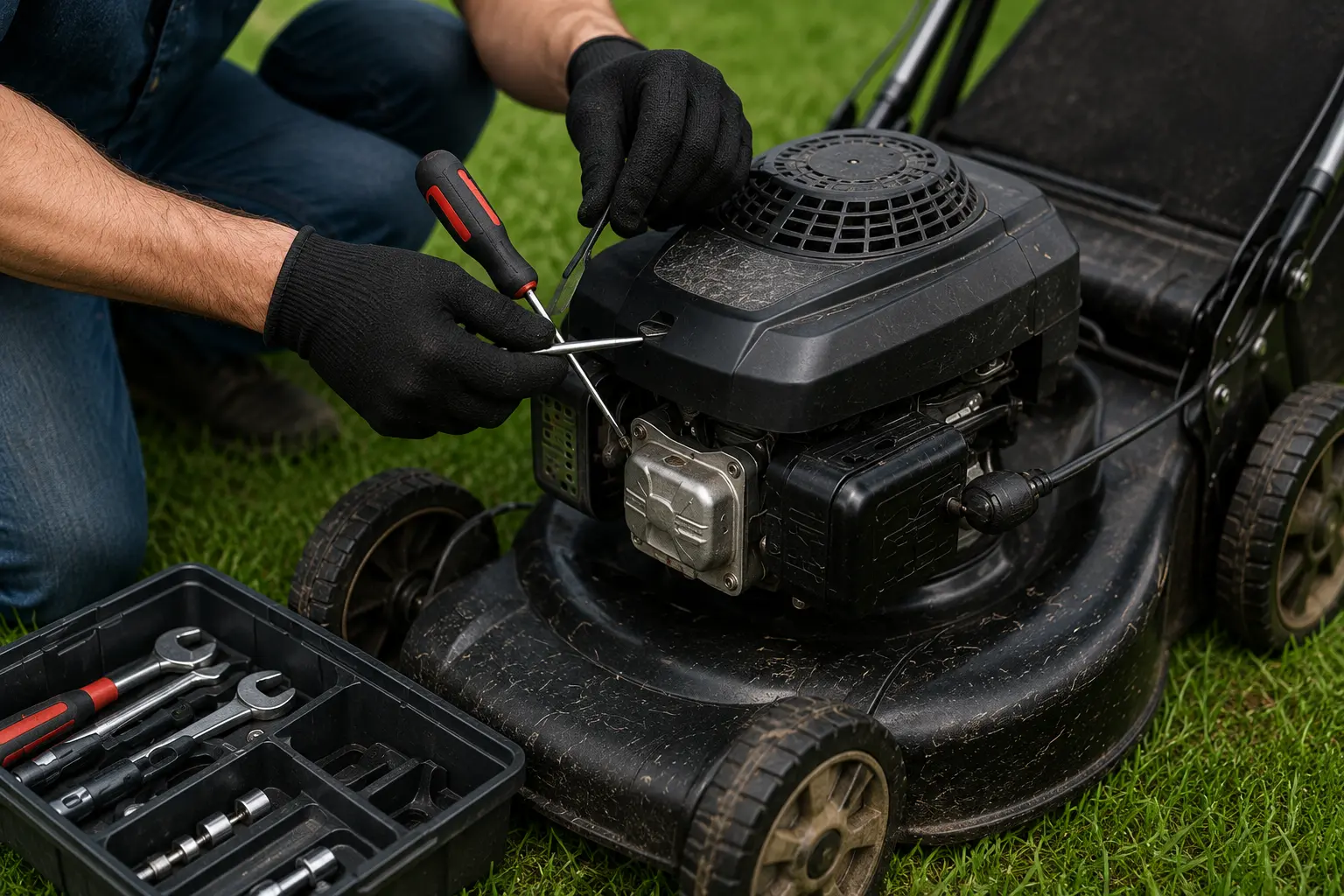
A standard guideline: if the repair costs more than 50% of the mower's replacement value, replacement is usually the better financial decision.
A self-propelled walk-behind mower that would cost $350 new: a $200 repair is right at the threshold and worth careful thought. A $120 repair is clearly worth doing. A $300 repair on a $350 mower is almost certainly not.
The rule isn't absolute. A Honda HRX217 that costs $700 new and has 15 years of life remaining at $280 in repairs is a straightforward repair. A $200 big-box store mower at age 7 with $120 in repairs on an engine showing low compression is a harder call — the repair solves the immediate problem but doesn't address the underlying wear.
Use 50% as a starting point, not a verdict.
Factor in actual age and condition
Age alone is a poor guide. What matters is the condition behind the age — specifically, how much life the engine and deck have remaining.
Ask the shop to do a compression test. Compression is the single best indicator of engine health on a four-cycle mower engine. A standard reading for a healthy small engine is 90–120 PSI. Below 80 PSI indicates worn rings or cylinder damage. A mower with low compression will start harder, burn more oil, and lose power — and no tune-up fixes compression loss. If the shop quotes a significant repair on a mower with low compression, that compression number changes the math significantly.
Look at the deck. Heavy rust on the underside of the deck, cracks in the deck housing, or a bent deck from hitting a rock can all limit the mower's remaining useful life. A deck in good condition on a well-maintained mower can last another decade. A deck that's rotting through the metal isn't worth putting a new engine in.
Consider the engine brand. Honda, Kawasaki, and Kohler engines are known for longevity. A Honda GXV160-powered mower at age 12 with 300 hours of use still has real life remaining. A lower-grade engine at the same age may be approaching end of life. The brand on the engine nameplate matters for assessing remaining value.
The type of mower changes the math
Basic push mower ($150–$280 new): The 50% rule applies conservatively here. At this price point, the window for economical repairs is narrow — stick to carburetor, fuel system, and tune-up repairs. Any internal engine work approaches or exceeds replacement cost.
Self-propelled walk-behind ($300–$600 new): More room for repair investment. Drive system components (belt, cable, transmission) are worth repairing. Carburetor and ignition work is clearly worth it. Internal engine work requires the 50% analysis.
Honda HRX / premium walk-behind ($600–$900 new): Premium engines justify premium repair investment. These mowers last 20+ years with proper maintenance. A $300 repair on a $750 mower that's 10 years old and in otherwise good condition is usually worth doing.
Riding mower / lawn tractor ($1,200–$3,000+ new): Repair almost always beats replace at this price point, unless the engine has failed catastrophically or the frame has structural damage. Deck service, belt replacement, transmission work, and carburetor repairs are all reasonable on riding equipment.
Zero-turn ($2,500–$7,000+ new): Similar logic — repair investment is justified given replacement cost. Hydraulic system issues require specialized expertise; make sure the shop has experience with zero-turn hydraulics before authorizing work.
When the timing matters
Spring breakdown: The most common and most frustrating scenario. The mower dies right when you need it and every shop has a 2-3 week queue. If the repair is clearly worth it, authorize it and arrange interim mowing. If you're borderline, this might be the moment to just buy new — you need a mower now, and a new machine has a warranty.
End-of-season breakdown: The best time to make a clear-headed decision. There's no urgency. Take it to a shop, get a proper diagnosis and estimate, and decide without pressure. If it's borderline, get a second opinion.
Mid-season breakdown on a mower that was already showing symptoms: If the mower has been running rough, using oil, or starting poorly before the breakdown, the current repair may not be the last one. A shop can often tell you whether the machine is in general decline or whether this is an isolated problem.
Questions to ask before authorizing a repair
"Is there anything else on this mower that's showing wear I should know about?" A good shop will tell you if the drive belt is close to failure, if the blade spindle bearings are noisy, or if the compression is marginal. This prevents authorizing a $150 carburetor repair only to have the mower back in the shop with a $120 drive belt failure six weeks later.
"What's the compression reading?" If they did a compression test, ask for the number. It gives you real data to work with.
"If I get this repaired, realistically how many more seasons should I expect from it?" A technician who's honest and experienced will give you a straight answer. Not a promise — but an informed opinion.
"If I were buying a replacement, what would you recommend for my yard size and use?" A good shop gives you useful guidance here. They know what they're repairing week after week and what holds up.
Finding a shop that gives you straight answers
The repair vs. replace decision is only as good as the diagnosis behind it. A shop that gives you a written estimate, does a compression test, and tells you what else is showing wear is giving you the information you need to decide. A shop that quotes work without that context isn't set up for a good outcome for either of you.
Use the search below to find small engine repair shops near you. Look for shops with strong Google reviews that specifically mention lawn mower work.
Prices in this guide reflect typical independent shop rates across the United States as of 2026. Rates vary by region. Always get a written estimate before authorizing work.