OEM vs Aftermarket Parts: What Small Engine Shops Use
When your small engine goes in for repair, the shop makes a parts decision you may never hear about: OEM or aftermarket. For most repairs, it doesn't significantly affect the outcome. For some, it matters a great deal. Knowing the difference lets you ask the right question before authorizing work.
What OEM and aftermarket mean
OEM stands for Original Equipment Manufacturer. An OEM part is made by or for the manufacturer of the engine — a Briggs & Stratton carburetor from Briggs & Stratton, a Honda air filter from Honda, a Stihl fuel line from Stihl. OEM parts are designed to exact factory specifications and usually carry the manufacturer's warranty when installed by an authorized service center.
Aftermarket parts are made by third-party suppliers. Some are designed to meet or exceed OEM specifications. Others are generic parts that fit multiple engine models with some degree of approximation. Quality ranges enormously — from parts that perform identically to OEM at half the price, to parts that technically fit but fail prematurely or don't perform correctly.
The major aftermarket suppliers in the small engine market — Oregon, Stens, Rotary, Arnold — are established companies with decades of history. Their parts cover most service needs for common engine brands, are well-supported, and are used routinely by reputable shops. These are not the same as no-name parts from discount import suppliers.
Where aftermarket performs just as well
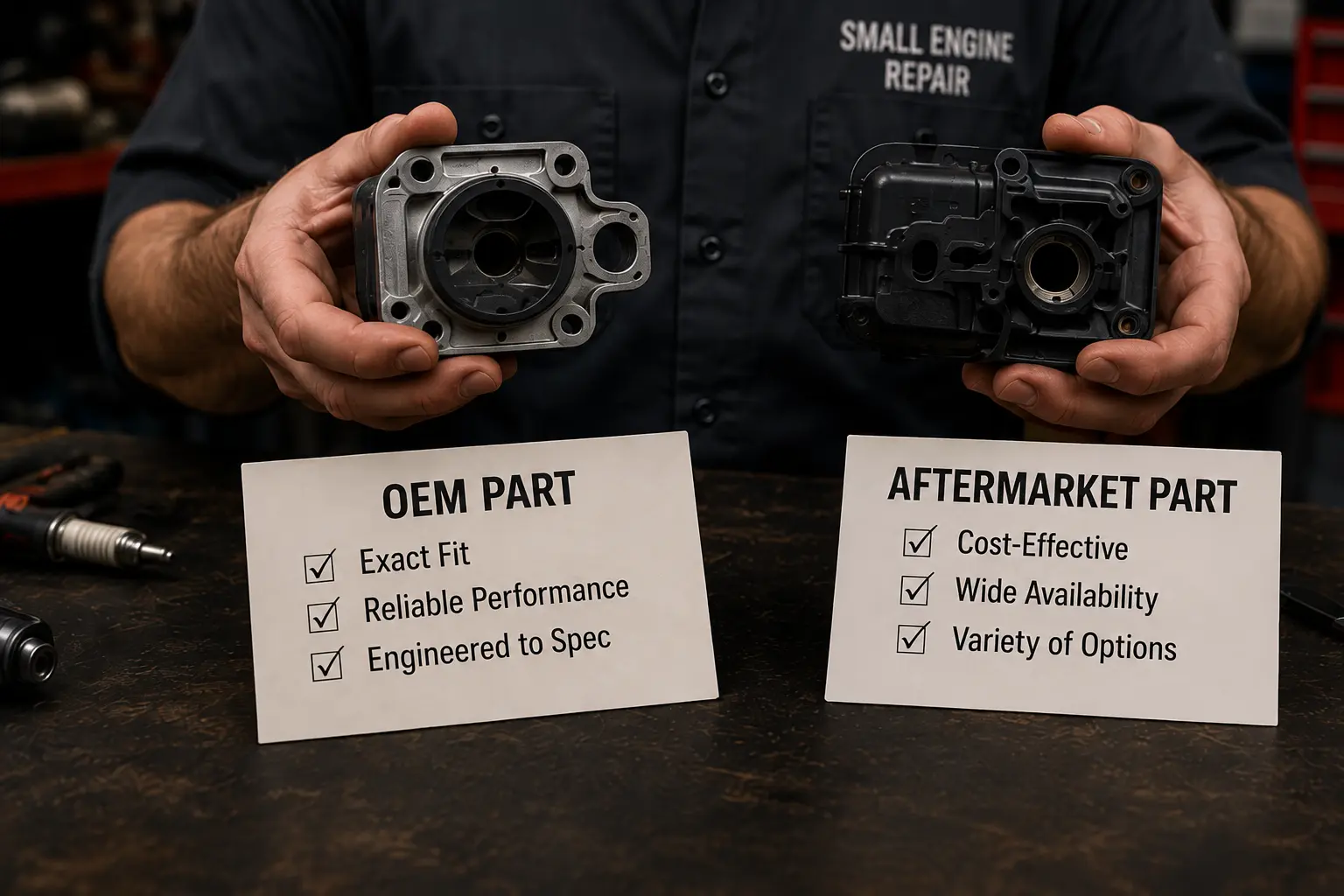
For consumable maintenance parts, reputable aftermarket is typically equivalent to OEM:
Air filters. Oregon and Stens make filters for common Briggs & Stratton, Honda, Kawasaki, and Kohler engines that meet or exceed OEM filtration ratings. On a walk-behind mower getting a tune-up, the brand of the air filter makes no meaningful difference to the outcome.
Spark plugs. NGK and Champion plugs are OEM suppliers for many engine manufacturers — the "OEM" plug on some Honda engines is an NGK manufactured to Honda's spec. An NGK plug sold in a generic box is often the same part.
Fuel filters. Generic fuel filters in the correct size work fine for most applications.
Belts. Reputable aftermarket belts for deck drive and motion drive applications work well. The key is getting the correct cross-reference — an aftermarket belt that's 1/8" off in length or slightly wrong in profile won't grip the pulleys correctly.
Blades. Oregon blades are widely used in shops and perform as well as OEM on most residential equipment. Oregon manufactures blades to the same steel specifications and heat treatment as OEM for most common applications.
Recoil assemblies and general hardware. Widely available aftermarket versions are generally reliable.
Where OEM makes a meaningful difference
Some parts are worth paying OEM prices for:
Carburetors. This is the most significant category. Aftermarket carburetors for common engines are available at low prices, but fit and calibration can vary. A carburetor that's slightly off in jet sizing, needle taper, or float height won't deliver the correct fuel-air mixture, resulting in a machine that runs but not quite right. For precision fuel delivery components on an engine you want running well for years, OEM or a premium aftermarket supplier is worth the premium.
Ignition coils. Aftermarket coils exist for common engines at significant cost savings. Some work well; others have inconsistent air gap tolerances or shorter lifespans. For a machine you depend on, OEM coil quality is harder to replicate in aftermarket.
Carburetor rebuild kits. The rubber diaphragms, needle seats, and gaskets in rebuild kits vary in material quality. OEM or premium aftermarket kits (Zama, Walbro, and Tillotson make kits for their own carburetors) use correct durometer rubber. Cheap kits may use rubber that doesn't seal properly or hardens faster. Given that the labor to rebuild is the majority of the cost, a quality rebuild kit is false economy to cheap out on.
Two-cycle engine components. Two-cycle engines run on tighter tolerances than four-cycle. Piston rings, cylinder kits, and crankshaft seals for Stihl and Husqvarna two-cycle engines are generally better sourced OEM or from premium suppliers. The consequences of a subpar part in a two-cycle engine are more immediate.
Safety-critical components. Chain brake assemblies, blade brake clutches, and interlock switch components should be OEM or from a verified supplier. These components exist to prevent injury. Saving $15 on a chain brake part is not worth the risk.
What shops actually do
Most independent shops use a mix of OEM and reputable aftermarket depending on the part category and the customer's equipment. A shop replacing an air filter on a $250 mower will reach for an Oregon or Stens filter. The same shop doing a carburetor rebuild on a premium Honda or Kawasaki engine will likely use OEM components.
The determining factors:
Parts availability. Independent shops stock heavily used aftermarket parts and order OEM as needed. If you need your machine back quickly and the OEM part is three days out, the shop may use an available aftermarket equivalent.
Equipment value. More expensive equipment warrants higher parts quality. A $150 carburetor for a commercial Kawasaki engine on a $4,000 zero-turn is a no-brainer. The same logic applied to a $200 consumer mower changes the math.
Warranty considerations. Authorized dealers doing warranty work are required to use OEM parts. Independent shops have more flexibility.
How to ask about it
When getting a repair estimate, it's reasonable to ask: "Are you using OEM parts for this, or aftermarket?" A good shop answers directly and can explain their reasoning.
If a shop automatically defaults to the cheapest available parts without any consideration of quality, that's a flag. If a shop explains that they use Stens filters and Oregon blades but OEM carburetors on precision work, they're telling you they've thought about it — which is what you want.
For machines you intend to run for a long time, it's also fair to ask: "If I want OEM on all of this, what does that change the estimate to?" The answer may surprise you — OEM parts on standard maintenance items sometimes cost less than you'd expect.
To find a repair shop near you, use the directory search below.
Part quality and availability vary by region and shop. Authorized dealer shops for specific brands (Stihl, Husqvarna, Honda) are required to use OEM parts for warranty work and typically stock OEM for non-warranty repairs as well.