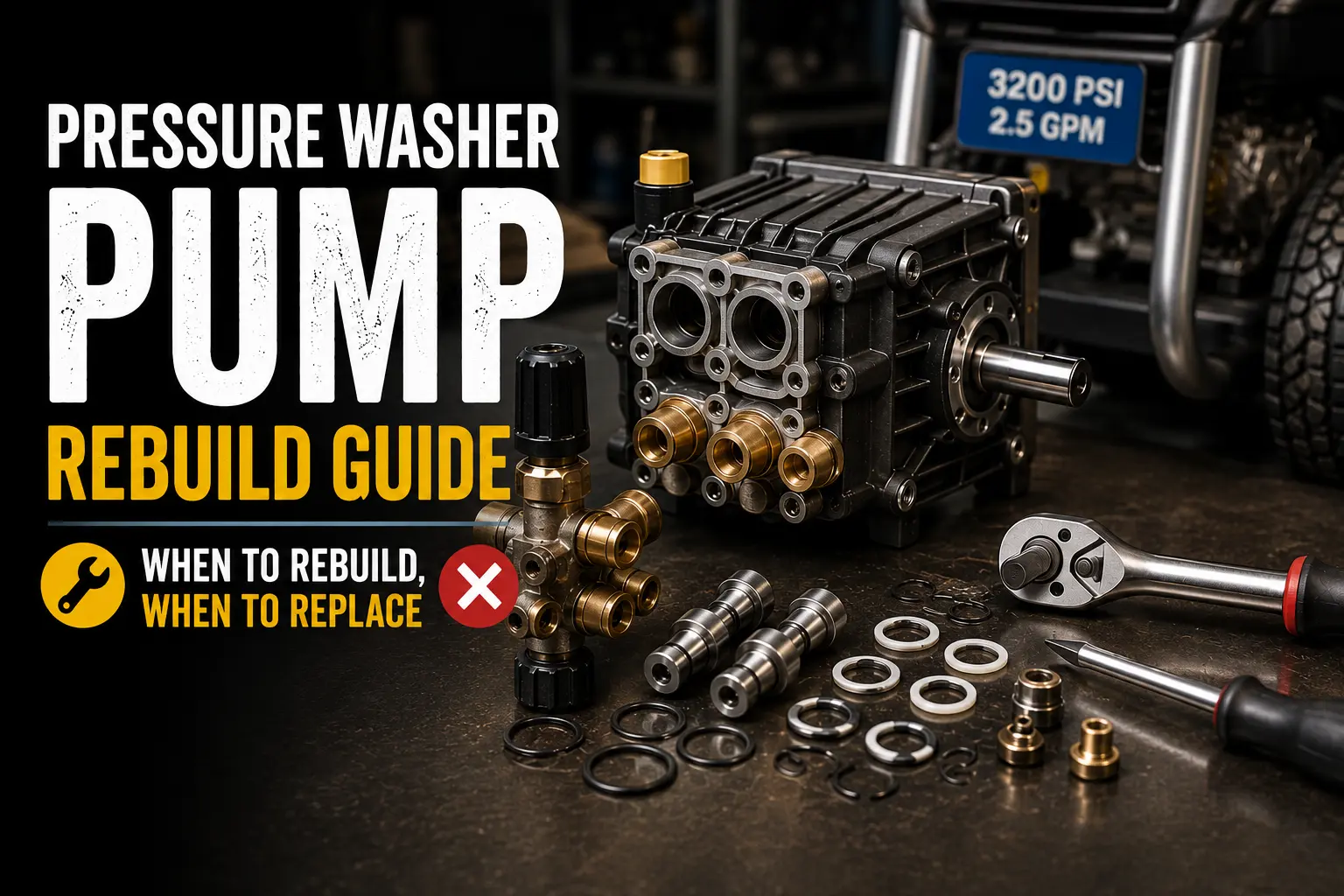
Pressure Washer Pump Rebuild Guide: When to Rebuild, When to Replace
The engine starts fine. The water comes on. But the spray gun fires a weak, sputtering stream — or no stream at all. The pump on your pressure washer has failed.
Pump failure is the second most common reason consumer pressure washers stop working, after fuel system issues. The good news: most pump problems are fixable with $30-60 in parts and 2-3 hours of careful work. The complicated news: not every pump is worth rebuilding, and the decision depends on what kind of pump you have, how it failed, and what the unit cost new.
This guide covers how to diagnose a pump failure, identify what kind of pump you have, decide whether to rebuild or replace, and execute the rebuild if that's the right call. If your pressure washer won't start at all, the pressure washer won't start guide covers engine-side troubleshooting first.
How to know the pump is the problem (not the engine)
Pump failure looks different from engine failure. The engine is fine if:
- It starts and runs at a steady RPM
- It accelerates when you squeeze the spray gun trigger (engine governor responding to demand)
- It runs without smoking or surging
Pump failure shows as one or more of these symptoms:
- No pressure or weak pressure — water comes out but at garden-hose pressure, not pressure-washer pressure
- Pulsing pressure — stream surges between weak and strong
- Water leaking from the pump — visible drips or sprays from pump body during operation
- Engine stalls when trigger is pulled — unloader valve failure, fuel-starvation-like behavior
- Loud knocking or screeching from the pump — internal damage, possibly seized bearings
- Soap injector won't pull soap — pump head pressure low enough that the venturi doesn't work
- Pump runs hot to the touch within 5 minutes — internal friction from worn parts
If you have any combination of these and the engine seems fine, the pump is the issue.
What kind of pump do you have
Consumer and prosumer pressure washers use three main pump types. The type determines whether rebuild is worth attempting.
Wobble plate pumps
The cheapest pump design, found on most consumer pressure washers under $250 (Ryobi, Greenworks budget lines, Karcher consumer models, many Craftsman). A flat plate wobbles against three pistons to create pressure.
Identifying features:
- Pump body is usually plastic or thin aluminum
- Smaller than the other types — fits in your hand
- No oil dipstick or fill cap (sealed for life)
- Output pressure typically 1,400-2,000 PSI on a 1.0-1.5 GPM flow
Rebuild reality: Generally not worth rebuilding. Wobble pumps are designed as sealed assemblies. Parts aren't widely available, and labor on disassembly often exceeds the cost of a new pump assembly. If you have a wobble-pump unit and the pump has failed, the math usually says replace the whole pressure washer if it's over 3-5 years old.
Axial cam pumps
The middle tier, found on most prosumer pressure washers $250-600 (Simpson, Generac consumer, Honda-powered models, mid-range Briggs & Stratton). A cam plate on the engine shaft drives three pistons axially — in line with the shaft.
Identifying features:
- Aluminum or brass pump body
- Visible oil fill cap or dipstick on most models
- Output pressure typically 2,400-3,400 PSI on 2.0-2.8 GPM flow
- AR Annovi Reverberi, Comet, and Cat Pumps are common manufacturers
Rebuild reality: Often worth rebuilding. Seal kits like the AR2747 ($20-40) cover the most common failure (worn high-pressure seals). Full rebuild kits with new pistons run $40-80. Labor is 2-3 hours for someone careful with hand tools. A new axial cam pump costs $150-300, so rebuilding saves $100-200.
Triplex plunger pumps
Commercial-grade pumps found on professional pressure washers $700+ (Mi-T-M, Pressure-Pro, top-tier Simpson commercial, top-tier Generac commercial). Three plungers driven by an offset crankshaft, much like a small water-pumping engine.
Identifying features:
- Brass or stainless pump body, heavy
- Visible oil dipstick and fill cap
- Output pressure typically 3,000-4,000+ PSI on 3.0-4.0 GPM flow
- General Pump, Comet ZW/CW series, AR XM/XR series, and Cat Pumps are common
Rebuild reality: Designed to be rebuilt indefinitely. Full rebuild kits with seals, pistons, and valves run $50-120. The pump itself was the most expensive part of the pressure washer; rebuilding extends life 3-5 more years. Professional users rebuild on a schedule (every 200-500 hours).
The rebuild-vs-replace decision
For each pump type, the rough math:
| Pump type | Rebuild kit cost | Rebuild labor | New pump cost | Worth rebuilding? |
|---|---|---|---|---|
| Wobble | $15-30 (parts only) | 2-3 hr | $80-150 | Usually no — sealed design, parts hard to find |
| Axial cam | $30-60 | 2-3 hr | $150-300 | Yes, on units worth $300+ new |
| Triplex plunger | $50-120 | 3-4 hr | $400-800 | Almost always yes |
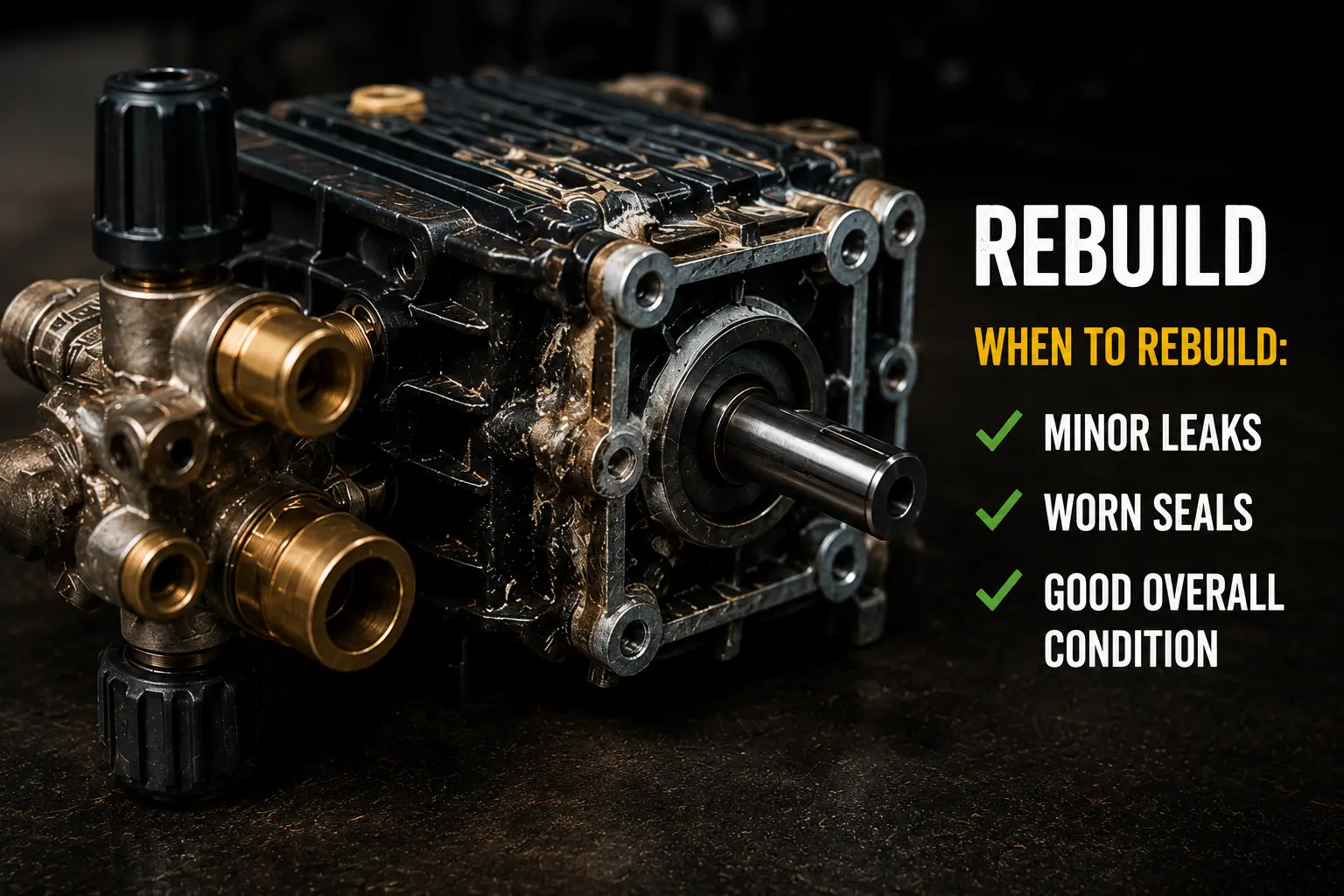
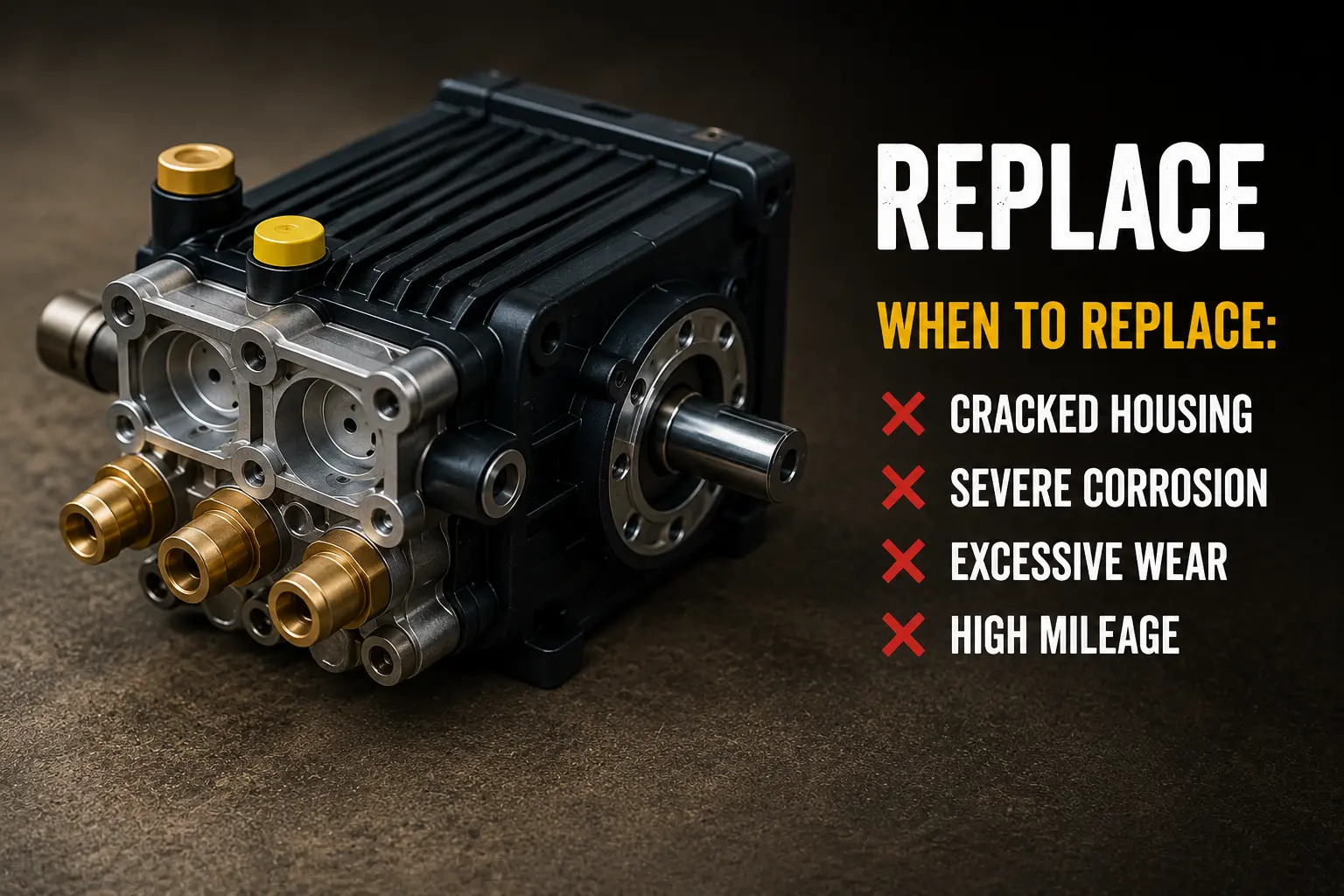
Three things tip the math toward replacement even on rebuildable pumps:
- Cracked pump body or manifold — usually means freeze damage during winter storage, can't be repaired
- Pressure washer is over 8-10 years old — the engine may be next to fail anyway
- Pump head bolts are seized or stripped — common on units stored outdoors, removing the head without breaking it becomes its own project
What's in a rebuild kit
Standard pressure washer pump rebuild kits include:
- High-pressure seals (three sets) — the most common failure point. Black rubber rings that seal the pistons against the cylinder bore.
- Low-pressure seals (three sets) — sit behind the high-pressure seals as a backup.
- O-rings for valve caps and oil drain plug
- Inlet and outlet valve assemblies — sometimes; depends on kit tier
- Backup rings and spacers
- Anti-extrusion rings — modern kits include these to prevent seal blow-out
What kits typically do NOT include:
- Pistons or plungers (separate parts, $15-25 each)
- Pump oil (separate, $5-10)
- Crankshaft or bearings (rare failures)
When ordering a kit, you need the pump manufacturer AND model number — not the pressure washer brand. The pump has its own model plate, usually a sticker or stamped tag on the pump body. Common manufacturers: AR (Annovi Reverberi), Comet, Cat Pumps, General Pump.
Step-by-step rebuild (axial cam pump)
The process below applies to axial cam pumps — the most common rebuildable type. Triplex plunger pumps follow a similar process but with more parts. Wobble pumps usually aren't worth rebuilding (see above).
1. Drain water and oil. Disconnect water hose. Pull the trigger to relieve any stored pressure. Drain pump oil into a container if your pump has a dipstick — most consumer axial cam pumps hold 4-8 oz of oil.
2. Remove the pump from the engine. Four bolts on the pump-to-engine flange hold the pump on the engine shaft. Loosen them in a cross pattern. Pull the pump straight off the shaft — wiggle slightly if it's stuck on the keyway.
3. Remove the manifold (pump head). Four to six bolts hold the brass or aluminum manifold to the pump body. Loosen in cross pattern, remove. The manifold contains the inlet and outlet valves; set it aside in a clean spot.
4. Pull the pistons. With the manifold off, the three pistons are exposed. Pull them straight out. They should slide freely — if they're stuck, the seals have welded to the cylinder walls and you'll need to use gentle prying with a plastic tool (never a screwdriver — it scratches the bore).
5. Replace seals. Each piston has a high-pressure seal at the manifold end and a low-pressure seal at the engine end. Use a small flat-blade tool to gently lift the old seals out. Drop new seals in, oriented per the kit's diagram. Some kits include a seal-installation tool — use it.
6. Replace valves (if kit includes them). The inlet and outlet valves in the manifold are small assemblies — typically brass cages with rubber seals. Unscrew the valve caps on the manifold, lift the old valves out, drop new ones in, retorque caps.
7. Reinstall pistons. Apply a thin coat of pump oil to each piston, then slide back into the cylinder. They should glide in without force. If they don't, the seal is misaligned — pull and reinstall.
8. Reinstall manifold. Bolt back to pump body in cross pattern, working up from finger-tight to spec torque (usually 80-110 in-lb for consumer axial pumps — check your manual).
9. Refill oil. Add fresh pump oil to the fill mark. Pump oil is NOT the same as engine oil — use SAE 30 non-detergent pump oil, or the manufacturer-specific oil if the manual specifies.
10. Reinstall pump on engine. Bolt back to engine flange in cross pattern. Hand-tighten then torque to spec.
11. Test. Reconnect water hose. Start engine without pulling spray trigger — pump should not leak. Pull trigger briefly to test pressure. Expect full pressure to take 2-3 minutes to develop as the new seals seat.
Total time: 2-3 hours for a first attempt, 60-90 minutes once you've done it before.
Common rebuild mistakes
These are the failures shops see when DIYers bring in a "rebuilt" pump that didn't work:
Seal orientation reversed. Pump seals have a directional design — the lip faces the pressure side. Installed backwards, they leak under pressure within minutes. Always check the kit's installation diagram.
Manifold over-torqued. Aluminum and brass manifolds crack at the bolt holes if over-torqued. If your kit's torque spec is 80 in-lb, don't go to 120 thinking "tighter is safer."
Wrong pump oil used. Engine oil (10W-30, SAE 30 detergent) foams in pump applications. Use non-detergent pump-specific oil. Mixing oils mid-cycle (e.g., topping off engine oil into the pump) destroys seals fast.
Pistons reinstalled in wrong cylinder. Pistons wear into their cylinders over time. Mark each piston before removal and reinstall in the same position. Mixing them up causes pressure inconsistencies.
Skipping the inlet/outlet valves. If the kit includes valve parts, install them. Old valves with new seals often produces pulsing pressure even when the rebuild "worked."
Forgetting to pre-fill water. First start after rebuild, the pump is dry. Run water through it for 30 seconds before starting the engine. Otherwise dry running on first start damages new seals.
When to bring it to a shop
Pump rebuilds are DIY-friendly with patience and the right tools. Bring it to a shop when:
- The pump body or manifold is cracked — replacement only
- Pump head bolts are stripped or seized — extraction work, specialized tools
- Pump is a wobble design — usually not rebuildable
- Internal bearings or crankshaft are damaged — beyond kit-level repair
- You don't have a clean workspace (pump rebuild parts don't tolerate dirt)
- The pressure washer is under warranty — DIY voids it
Independent pressure washer shops typically charge $80-120 per hour for pump work. A full rebuild service runs $150-280 at most independent shops including parts. Authorized dealer pricing runs 20-40% higher. For full pricing context across all common pressure washer repairs, see gas pressure washer repair cost.
For pressure washers over 8 years old, ask the shop for a candid take on whether the rebuild is worth it. Sometimes the right answer is to put $150 toward a new mid-tier consumer unit instead of $250 into a 10-year-old budget pressure washer.
If you're not sure where to start, find a verified pressure washer repair shop near you below — most will give a phone diagnosis and a rough cost estimate before you bring the unit in.
This guide covers gas-powered consumer and prosumer pressure washers with axial cam, triplex plunger, or wobble plate pumps. Electric pressure washer pumps follow different designs (often sealed motor-pump assemblies) and aren't covered here. Pump rebuild specs vary by manufacturer — always consult your pump's service manual for torque values and specific procedures.