Why Won't My Lawn Mower Start? 8 Common Causes (And What To Try)
It's the first warm Saturday of the season. You pull the mower out of the garage, give the cord a yank, and nothing happens. Or it coughs once and dies. Or it runs for ten seconds and stalls.
Before calling a shop, the good news: the majority of lawn mower no-start problems are fuel or carburetor issues caused by sitting over winter, and many of them can be resolved at home with basic tools in under an hour. The causes below are listed in the order a technician would check them — start at the top and work down.
1. Old or stale fuel
Gasoline left in a lawn mower tank over winter degrades. The lighter, ignitable compounds evaporate within 30-60 days, leaving behind a heavier residue that doesn't ignite well. By spring, the fuel in the tank is often too degraded to start a cold engine — and it may have left varnish deposits in the carburetor that make the problem worse even after you add fresh fuel.
This is the most common cause of spring no-starts, by a significant margin.
What to try:
Drain the tank completely using a hand pump or by disconnecting the fuel line. Refill with fresh gasoline — ideally ethanol-free (sold at some hardware stores and marinas), or standard pump gas if that's what's available. Add a fuel stabilizer at the recommended dose, run the engine for 5 minutes to circulate fresh fuel through the carburetor, and try starting from scratch.
If the engine fires briefly and dies after draining the tank, the carburetor itself is gummed. Move to cause #2.
2. Clogged carburetor
When stale fuel evaporates inside the carburetor, it leaves behind sticky varnish that coats the tiny passages the carburetor uses to meter fuel. Even with fresh fuel in the tank, a varnished carburetor won't deliver fuel correctly.
Symptoms: the engine won't start at all, fires briefly and dies, or runs only with the choke fully engaged.
What to try:
Spray carburetor cleaner (available at any hardware store) directly into the air intake while pulling the starter. If the engine fires for 2-3 seconds then dies, that confirms the carburetor is the issue — the spray is providing enough fuel to run briefly, but the clogged passages aren't delivering continuous fuel from the tank.
A mild carburetor gumming can sometimes be resolved by removing the float bowl, soaking it in carburetor cleaner, clearing the jets with a fine wire, and reassembling. This is a 20-30 minute job for someone comfortable with small engine work. Severe varnishing usually requires a full carburetor rebuild or replacement — at that point, most people take it to a shop.
Carburetor cleaning or rebuild at an independent shop typically runs $80-150. For full pricing detail, see [lawn mower tune-up cost: what to expect] when that guide is available.
3. Stale fuel in the float bowl
The float bowl is the small reservoir at the base of the carburetor. It's the first place fuel sits before entering the engine, and it's the first place old fuel turns to varnish.
Many carburetors have a drain screw on the bottom of the float bowl. With the fuel valve on (or tip the mower slightly), open this screw briefly. If dark, brown, or thick fuel comes out, drain it completely until fresh fuel flows through. This 2-minute check sometimes fixes the problem without any further disassembly.
4. Dirty or clogged air filter
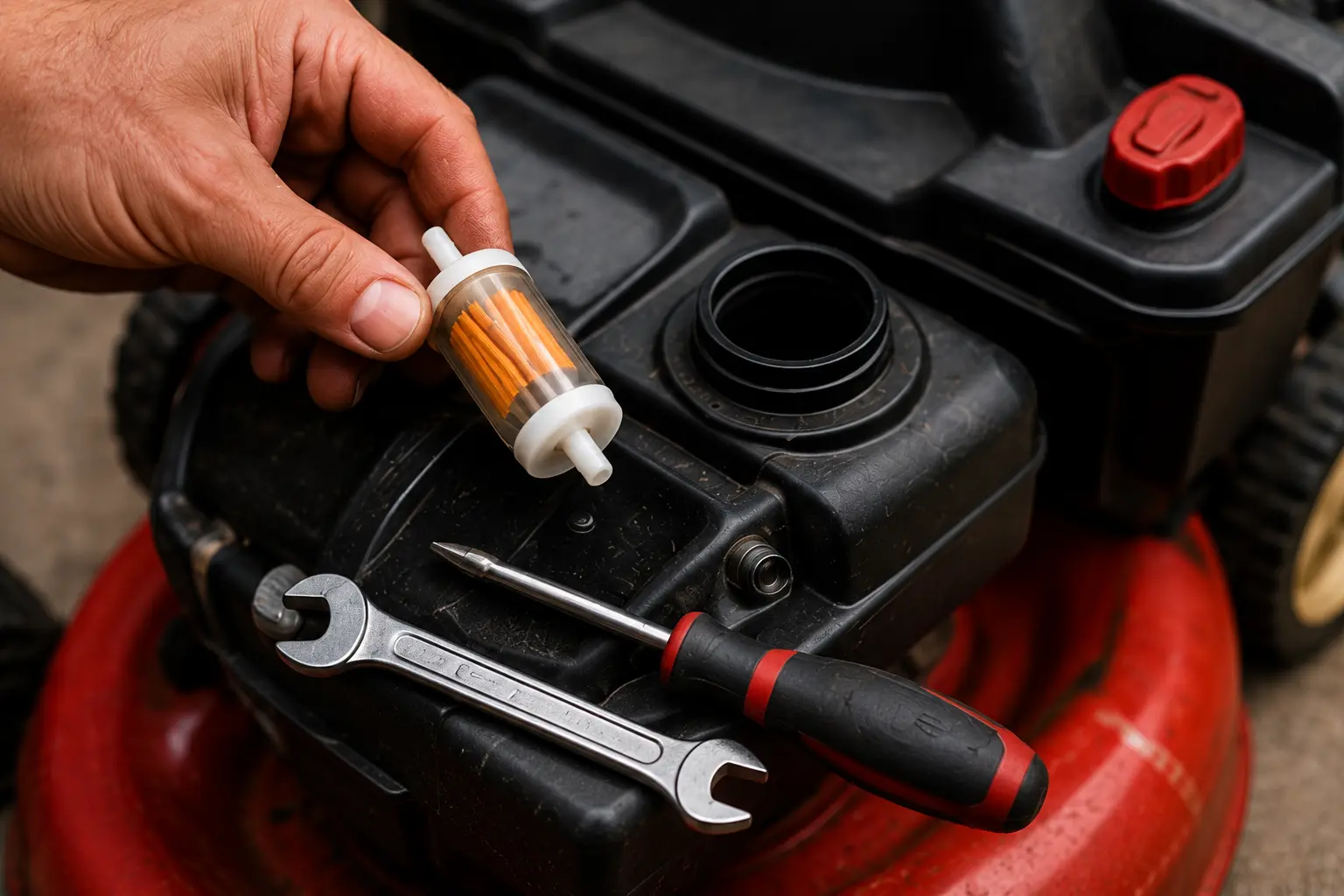
The air filter prevents debris from entering the carburetor. A severely clogged filter restricts airflow enough to throw the fuel-air ratio too rich, preventing combustion.
What to try:
Remove the air filter cover (usually one or two screws). Pull out the filter element — it's either foam, paper, or a combination. Hold it up to a light. If you can barely see light through it, replace it. Foam elements can sometimes be washed in dish soap, dried completely, and lightly oiled. Paper elements should be replaced when dirty.
Try starting the mower with the filter completely removed. If it starts, the filter was the problem. Don't run the mower without the filter for more than a minute or two — dirt in the cylinder causes serious long-term wear.
Air filters for common lawn mower engines (Briggs & Stratton, Honda, Kawasaki, Kohler) typically cost $8-15 and take five minutes to replace.
5. Fouled or worn spark plug
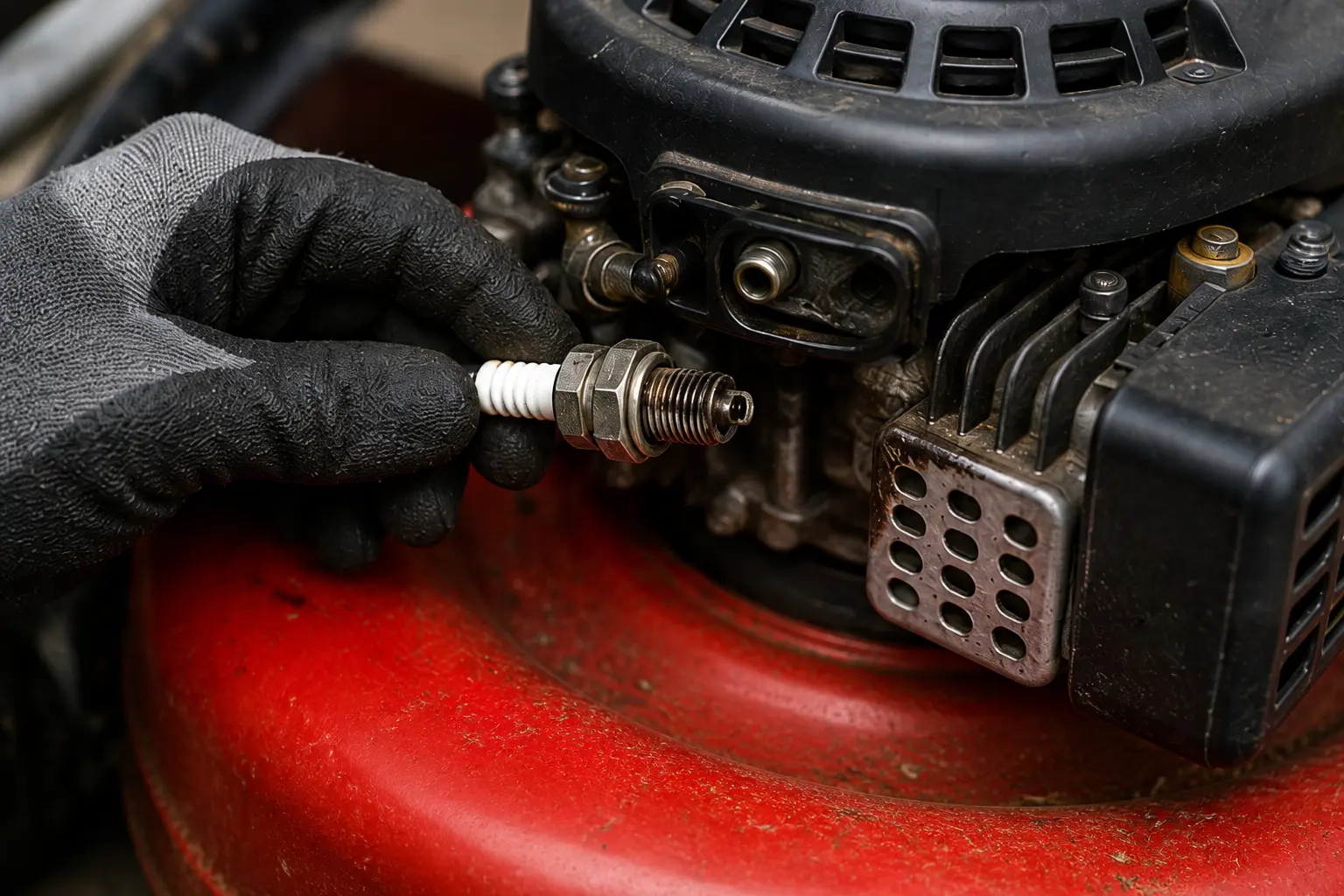
The spark plug ignites the fuel-air mixture. A plug that's fouled with carbon deposits, covered in oil, or simply worn out won't fire reliably enough to start a cold engine.
What to try:
Remove the spark plug using a plug socket (usually 5/8" or 3/4"). Examine the tip. If it's:
- Wet with fuel: you flooded the engine. Leave the plug out, pull the starter 5-6 times to clear the cylinder, reinstall the plug, and try with the choke in the run position.
- Black and sooty: carbon fouling from a rich mixture. Clean it with a wire brush or replace it.
- Coated in oily black residue: oil is getting past the rings. The engine has internal wear to address.
- White or blistered: the engine has been running lean or overheating.
- Physically worn (rounded electrode, large gap): simply replace it.
With the plug out, ground the metal body of the plug against the engine block and pull the starter. You should see a sharp blue spark. No spark, or a weak orange spark, points to an ignition system problem (coil or flywheel timing) that a shop will need to address.
Spark plugs for most push mower engines cost $4-8 and are worth replacing as a matter of course any time you're doing diagnosis. Replace every season as part of routine maintenance.
6. Safety switch not engaging
Modern lawn mowers have multiple safety interlock switches. Push mowers typically have a blade engagement bail (the bar you hold against the handle while mowing) that cuts the engine when released. Riding mowers have seat switches, blade engagement switches, and brake/clutch switches.
These switches fail in two ways: they stick open (engine won't start) or stick closed (engine runs without the safety condition being met, which is dangerous).
What to try:
Make sure all safety conditions are met before attempting to start: operator in the seat (riding mowers), blade bail held firmly against the handle (push mowers), blade disengaged, parking brake set.
On push mowers, inspect the bail cable and make sure it's properly connected and moving the switch lever when the bail is squeezed. A disconnected or broken bail cable means the switch reads "operator not present" even when you're holding the handle.
Diagnosing and bypassing safety switches to isolate the issue is possible but needs to be done carefully — these switches exist for real safety reasons. If you suspect a faulty switch is causing the problem, a shop can test and replace it quickly.
7. Primer bulb issue (push mowers)
Many push mower carburetors have a primer bulb — the small rubber bubble you push several times before pulling the start cord. The primer forces extra fuel into the carburetor for cold starts.
If the primer bulb is cracked, stiff, or not drawing fuel, the initial fuel enrichment doesn't happen and cold starts become very difficult.
What to try:
Press the primer bulb and watch it. It should push in firmly and spring back immediately. If it's soft and stays deformed, it has a crack. If it's rigid and barely compresses, the rubber has hardened. Either condition warrants replacement.
Primer bulbs are $5-10 and take minutes to replace. The part number is usually printed on the old bulb or findable by engine model number.
8. Low oil (oil-alert engines)
Many Honda engines, and some other brands, have an oil-alert system that prevents the engine from starting if oil level is too low. This protects against catastrophic engine damage from running without sufficient lubrication.
If your Honda-powered mower won't start and you've checked fuel, spark, and air, check the oil level before going further.
What to try:
With the mower on level ground, pull the dipstick (or check the sight glass on engines that have one). Wipe it, reinsert, pull again. The level should be at or near the full mark. If it's at or below the low mark, top off with the correct grade (SAE 30 or 10W-30 for most four-cycle mower engines — check the cap label or owner's manual).
Don't overfill. Overfilling can cause the engine to smoke, foul the spark plug, and in some cases hydro-lock the cylinder.
When to call a repair shop
If you've worked through the fuel, spark, and safety switch checks above and the mower still won't start, the problem is likely internal and worth having a professional diagnose:
- No spark after new plug installed — ignition coil or flywheel key failure
- Engine cranks freely but never fires — compression problem or major carburetor blockage
- Loud knocking or rattling on start attempt — internal damage, possible rod or bearing failure
- Visible smoke from the engine area — oil leak near the exhaust, possible head gasket failure
- Can't pull the cord at all — hydrolocked cylinder (usually from tipping the mower incorrectly and flooding it with oil), or a seized engine
An independent small engine shop will typically charge $50-80 for a diagnostic, which applies toward the repair if you authorize it. Most straightforward no-start repairs run $100-200 all-in.
To find a repair shop near you, use the search below — filter by lawn mower to find shops that specifically service this equipment type.
This guide covers four-cycle push and self-propelled walk-behind mowers with standard gasoline engines (Briggs & Stratton, Honda, Kawasaki, Kohler, and similar). Riding mowers share many of the same principles but have additional electrical complexity. Battery-powered mowers are not covered here — consult the manufacturer's troubleshooting guide for electric models.