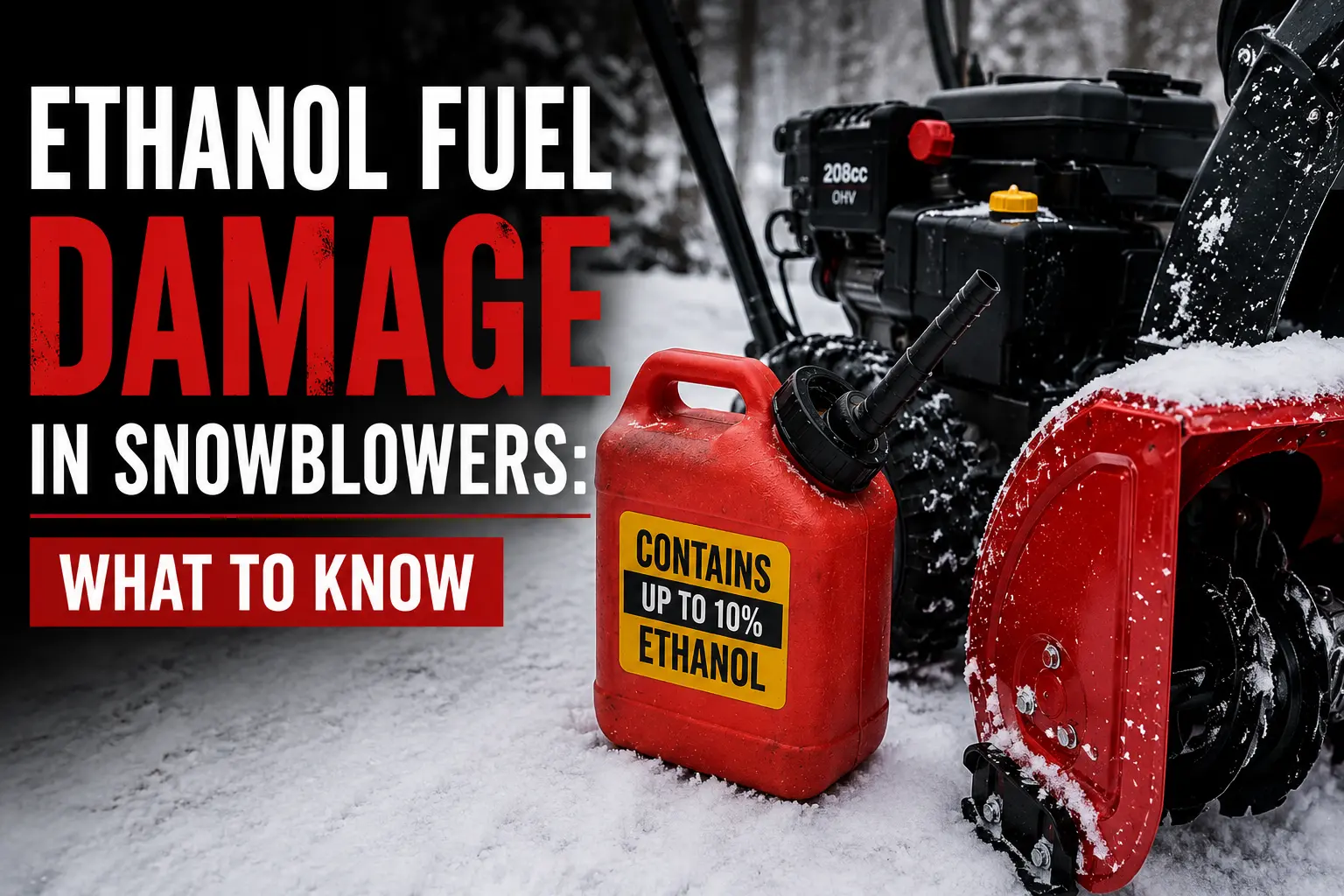
Ethanol Fuel Damage in Snowblowers: What to Know
Snowblowers are uniquely vulnerable to ethanol damage — more so than lawn mowers, and arguably more so than any other small engine equipment most homeowners own. The reason comes down to timing. Snowblowers work hard for three to four months, then sit completely unused for eight months. That's eight months for ethanol-blended fuel to absorb moisture, separate from the gasoline, and leave behind the sticky varnish deposits that cause most fall no-start calls to repair shops.
Understanding what ethanol does — and specifically what it does during a long storage period — is the difference between a snowblower that fires up in October and one that needs a carburetor service before its first use of the season.
Why snowblowers get hit harder than other equipment
A car burns through a tank of gas in a week or two. A lawn mower might sit for a few weeks between uses, but runs frequently enough that fuel turns over regularly during the season. A snowblower runs hard for a few months, then sits for the better part of a year without the tank being touched.
Standard pump gasoline (E10, which is 10% ethanol) begins degrading within 30 days. The ethanol absorbs atmospheric moisture through the vented fuel cap. As moisture accumulates, the ethanol-water mixture eventually separates from the gasoline and sinks to the bottom of the tank — a process called phase separation. By April, the fuel in an untreated snowblower tank is typically a separated, varnished mess.
The damage doesn't stay in the tank. That degraded fuel was drawn into the carburetor during the last use of the season, where it sat in the float bowl, jets, and passages all summer. By fall, what's coating the inside of the carburetor is a hard, lacquer-like residue that blocks the fuel passages the carburetor needs to meter fuel correctly.
What it looks like at the repair shop
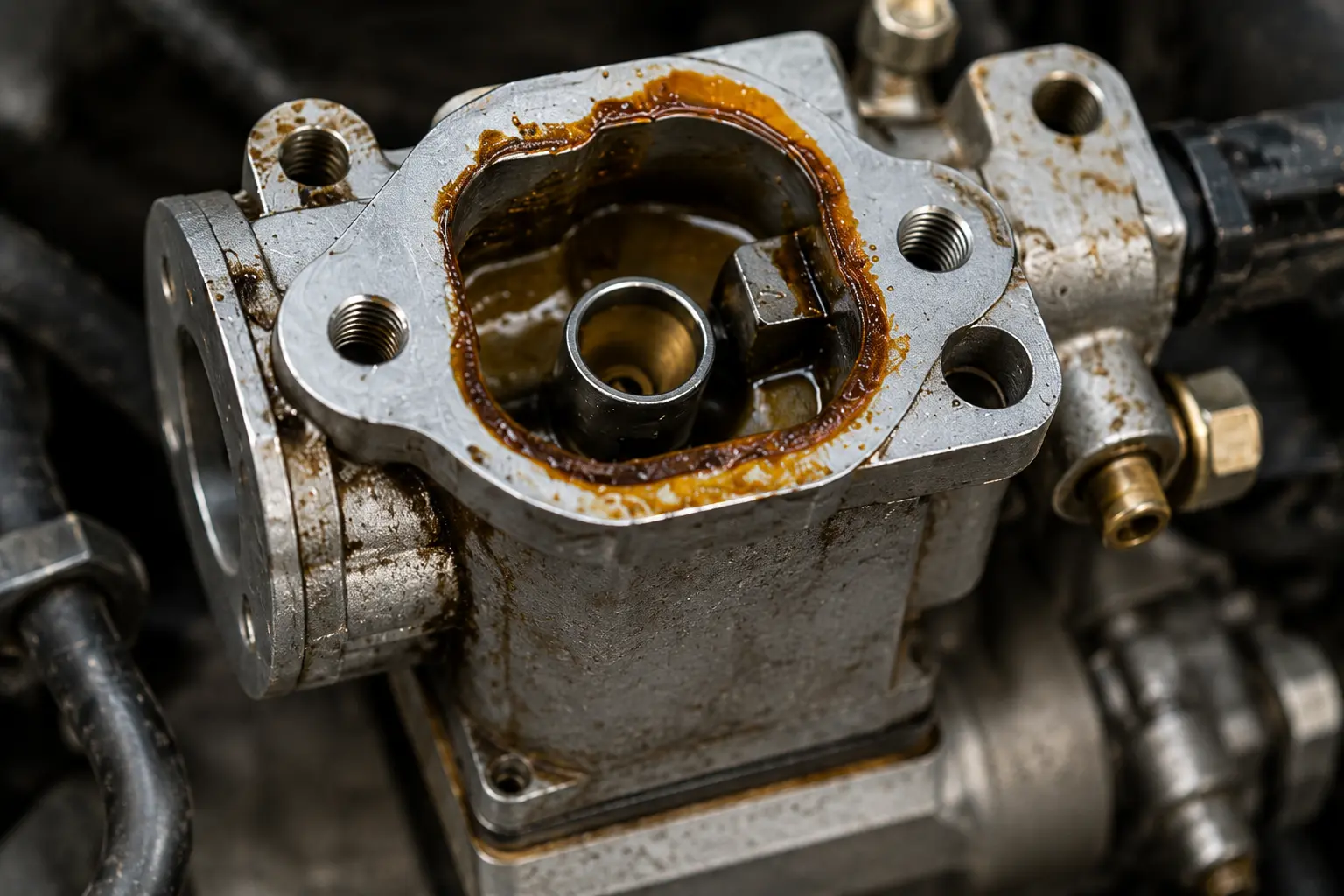
When a snowblower comes in for a fall no-start that's traced to ethanol damage, the technician typically finds some combination of:
Varnished carburetor passages. The main jet, idle jet, and emulsion tube are partially or fully blocked by brown or yellowish varnish. The float needle may be stuck in the closed position, preventing fuel from entering the bowl at all.
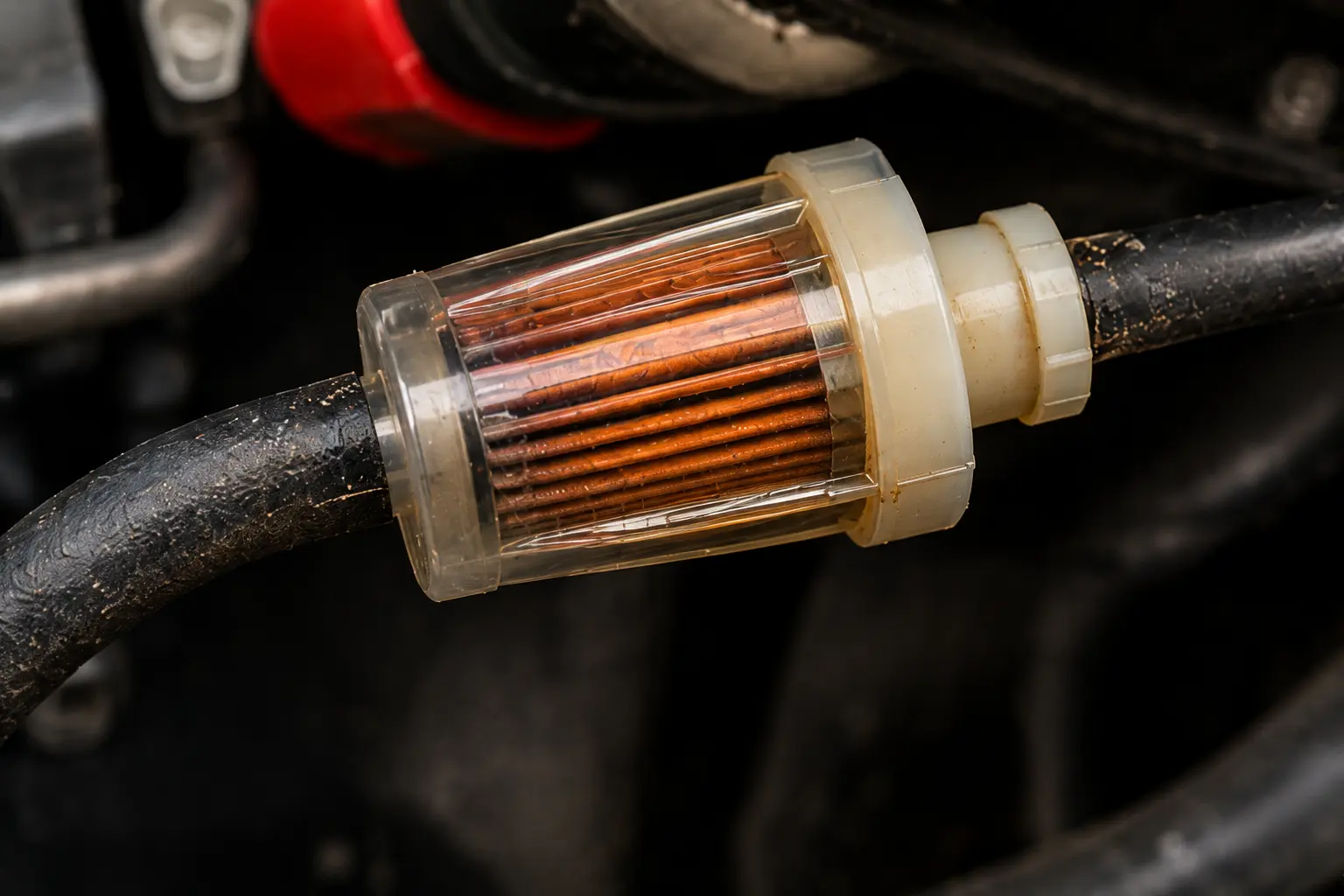
Degraded rubber components. The fuel lines between the tank and carburetor have become stiff and brittle. The primer bulb (if present) has hardened and no longer draws fuel. The carburetor diaphragm or float bowl gasket has swollen, cracked, or hardened.
Corrosion in the fuel system. The ethanol-water mixture is mildly acidic. Over a full storage season, it can cause visible pitting on brass carburetor components and surface corrosion inside aluminum fuel bowls.
Phase-separated fuel in the tank. A cloudy, layered appearance to the remaining fuel, with water visible at the bottom.
A mild case — varnish in the passages, intact rubber — can be addressed with a carburetor cleaning and fresh fuel lines. A severe case requires carburetor rebuild or replacement, plus new fuel lines and primer bulb. The cost difference between catching it early and finding it after a full season is significant.
Prevention: what actually works
Use ethanol-free fuel
Ethanol-free gasoline (E0) eliminates the problem at its source. It doesn't absorb moisture, doesn't phase-separate, and has a storage life measured in months rather than weeks. It costs more — typically $0.50 to $1.50 more per gallon depending on your area — but for a snowblower that uses 1-3 gallons per season, the cost difference is negligible against the cost of a carburetor service.
Ethanol-free fuel is sold at some hardware stores, small engine dealers, marinas, and specialty fuel stations. The website pure-gas.org maintains a searchable database of stations that carry it. It's worth checking once — if there's a source near you, using it for your snowblower and other seasonal equipment is a straightforward decision.
Add fuel stabilizer to every tank
If ethanol-free fuel isn't available or practical, a quality fuel stabilizer added to every tank — not just before storage — significantly slows ethanol-related degradation. Stabilizers work by slowing oxidation and inhibiting the phase separation process.
For ethanol-blended fuel specifically, look for stabilizers formulated for ethanol compatibility. Sta-Bil 360 Protection and Sea Foam are both well-regarded. Follow the dosage on the label — more is not better.
After adding stabilizer, run the engine for 5-10 minutes. This ensures the treated fuel circulates through the entire fuel system, including the carburetor bowl and passages, not just the tank.
End-of-season fuel management
The most critical intervention is what you do when you put the snowblower away in March or April. You have two options:
Option 1: Drain completely. Turn the fuel valve off, run the engine until it stalls from fuel starvation, then drain any remaining fuel from the tank. This leaves the system dry — no fuel, no degradation. The tradeoff is that you need to add fresh fuel next fall before starting.
Option 2: Fill with stabilized fuel and run it through. Add a full tank of fresh fuel with stabilizer at the recommended dose, run the engine for 10 minutes to distribute it, then store. This leaves treated fuel in the system and means the snowblower is ready to start in fall without adding fuel.
Either approach is vastly better than storing with whatever fuel is left in the tank from the last storm.
What you should not do: store the machine with partially used, unstabilized fuel from February sitting in the tank through October. That's the scenario that fills repair shop queues every fall.
Mid-season considerations
Ethanol degradation doesn't only happen during storage. If your snowblower sits for four to six weeks between storms — common in areas with inconsistent winters — the fuel in the tank is already partway through the degradation process before the next use.
For mid-season gaps longer than three to four weeks, either add stabilizer to the existing fuel or drain and refill with fresh fuel before the next storm. A machine that's been sitting since mid-January with untreated fuel may have degraded enough to start poorly by late February.
This is also why machines are more reliable in heavy-winter areas (frequent use, fuel turns over) than in areas with one or two snow events per season (long gaps between uses, fuel sits).
When to call a shop
If your snowblower won't start in fall and you suspect ethanol damage, fresh fuel alone won't fix a varnished carburetor. The varnish doesn't dissolve in gasoline — it has to be physically cleaned or chemically stripped with carburetor cleaner.
Signs the carburetor needs professional service:
- Engine won't start despite fresh fuel and a new spark plug
- Engine starts with starting fluid sprayed into the air intake but dies immediately
- Engine runs only with the choke fully closed (rich condition caused by blocked passages)
- Visible gummy brown residue in the fuel if you remove the fuel cap and look inside the tank
A carburetor cleaning at an independent shop typically runs $80-150. A rebuild or replacement runs $120-250 depending on the carburetor design and parts availability for your engine. See snowblower tune-up cost: what to expect for a full breakdown of what fall service typically includes.
To find a snowblower repair shop near you, use the search below. If you're calling in September or October, ask about current wait times — fall is the busiest season for snowblower shops.
This guide applies to four-cycle single-stage and two-stage snowblowers with gasoline engines. Two-cycle engines, used in some older and smaller units, have different fuel requirements — always mix at the ratio specified in the owner's manual and use fresh mix each season.