Husqvarna vs. Stihl: Chainsaw Repair Networks Compared
Stihl and Husqvarna make most of the chainsaws actually used by U.S. property owners and arborists. Both brands have loyalists who'll argue at length about cylinder geometry, anti-vibration mounts, and which engineering team has more of a soul. But "best chainsaw" misses the more useful question for someone planning to keep a saw running through 10-20 years of seasonal cleanup: which one is easier to service in the place you actually live?
Service support — meaning how easy it is to find a competent technician, how readily parts are available, and what those services actually cost — varies between these two brands in ways the spec sheets don't reveal. This guide breaks each brand down from the perspective of repair-shop accessibility and long-term cost of ownership, drawn from feedback across the small engine repair shop network.
If you're choosing between specific saw models, the fullest picture comes from combining this guide with shop-level conversations in your area. The shops at the bottom of this page can tell you which brand they actually see most often in their service queue.
Before ordering parts for either brand, confirm the exact model and serial information with the small-engine model-number guide. Stihl M-Tronic and Husqvarna AutoTune parts are especially model-specific.
At a glance
| Stihl | Husqvarna | |
|---|---|---|
| U.S. service network density | Higher — ~10,000 authorized shops nationwide | Lower — ~3,800 qualified dealers nationwide |
| Distribution model | Authorized dealers only (no big-box retail) | Authorized dealers + selected big-box retail |
| Parts availability at independents | Good for older models, restricted for M-Tronic | Good across most consumer and pro models |
| DIY-friendliness | Medium — restricted on newer M-Tronic models | Medium — restricted on newer AutoTune models |
| Average repair cost | $$$ | $$ |
| Pro saw rebuild reputation | Excellent (MS 261+, MS 362+, MS 462+) | Excellent (550 XP+, 562 XP+, 572 XP+) |
| Consumer saw lifespan reputation | 8-15 years typical | 6-12 years typical |
| Best fit for | Owners prioritizing service quality and dealer support | Owners prioritizing initial value and aftermarket parts |
Each section below unpacks why these distinctions matter when something breaks.
Stihl: dense network, premium positioning
Stihl operates an authorized-dealer-only U.S. distribution model. You can't buy a new Stihl saw at Home Depot, Lowe's, or Tractor Supply — the only legitimate retail channel is independent power equipment dealers and a smaller number of farm/ranch supply stores that hold authorized status.
This distribution model produces some specific service-side consequences:
Wider service network. Because every Stihl seller is also a Stihl service center, the brand has roughly 10,000 service points nationwide — about 2.5x the comparable Husqvarna network. For most U.S. zip codes, the nearest authorized Stihl service is closer than the nearest authorized Husqvarna service.
Tighter quality control on service. Stihl runs a more standardized dealer training program than most competitors. Service experience is more consistent across dealers — fewer shops where the tech is "the guy in the back who's been here 30 years and is mostly self-taught."
Premium parts pricing. Stihl OEM parts run 15-30% higher than Husqvarna equivalents. A Stihl piston ring kit for an MS 261 costs roughly $25-35; the Husqvarna 550 XP equivalent runs $20-28.
M-Tronic restriction on newer models. Stihl's M-Tronic carburetor system (electronically controlled fuel mixture, no manual adjustment screws) is on most pro saws built after roughly 2015 — MS 261 C-M, MS 362 C-M, MS 462 C-M, MS 500i. M-Tronic carb work requires Stihl-specific diagnostic readout, which restricts repairs to authorized dealers. Independent shops can still do basic service on M-Tronic saws (filters, plugs, oil pumps) but full carburetor diagnosis goes to a dealer.
Common Stihl service issues
- Carburetor varnish — universal across two-stroke saws stored with ethanol fuel. Stihl Walbro and Zama carbs are no more or less prone than other brands.
- Fuel line cracking — Stihl's small-diameter fuel lines harden after 3-5 years and develop air leaks. Replacement runs $15-30 in parts plus 30-60 minutes of labor.
- Ignition coil failure — Stihl coils are durable but eventually heat-fatigue. Replacement runs $60-150 total at most shops.
- Bar oil pump wear — the Stihl Ematic oiler is sturdy but the worm gear eventually strips on heavily-used saws. $80-180 total to replace.
- Worn anti-vibration mounts — pro saws develop more vibration as the rubber AV mounts harden. Replacement set runs $40-120 plus 1-2 hours labor.
For a deeper look at common Stihl-specific issues by model family, see Stihl chainsaw repair: 7 common issues.
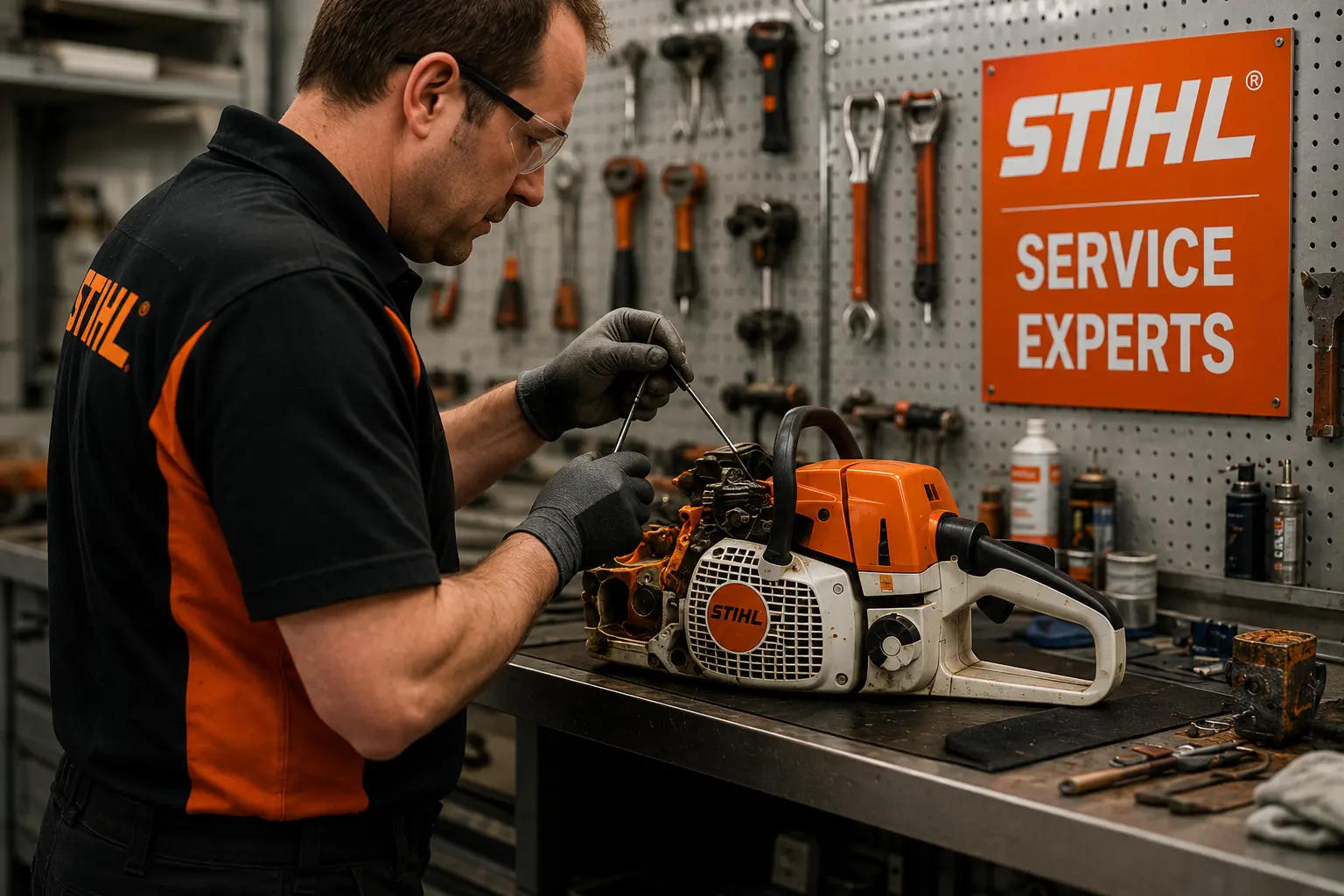
Stihl repair cost reality
Typical pricing at independent shops servicing Stihl out-of-warranty:
- Carburetor service (non-M-Tronic): $80-150
- Carburetor service (M-Tronic, dealer required): $130-200
- Ignition coil replacement: $60-150
- Bar oil pump replacement: $80-180
- Top-end rebuild (piston, rings, cylinder cleanup): $250-500
- Annual tune-up (oil, plug, filter, fuel system): $50-90
Authorized dealer pricing typically runs 15-30% higher than independents on the same work, with the gap largest on M-Tronic-related diagnostics where the independents can't compete.
Husqvarna: leaner network, broader retail access
Husqvarna sells through both authorized dealers (Crown Dealers, Preferred Partners) and selected big-box retailers (Lowe's, Northern Tool). The big-box channel is sales-focused rather than service-focused — most Lowe's locations don't service Husqvarna equipment, only sell it. The qualified service network sits mostly within authorized power equipment dealers, similar to Stihl but with a smaller footprint.
Smaller authorized service network. Husqvarna has roughly 3,800 qualified service dealers in the U.S. — about 40% of Stihl's network density. In rural areas and smaller metros, this can mean meaningfully more travel to get authorized service.
Stronger aftermarket parts ecosystem. Husqvarna has been around long enough that the aftermarket parts market is robust. For older saws (10+ years), aftermarket pistons, rings, fuel lines, and even cylinders are widely available at meaningful discounts to OEM. This makes long-term ownership of consumer-grade Husqvarna saws (440, 450, 455 Rancher) more economically viable than equivalent Stihl saws past the 8-year mark.
Slightly lower parts pricing. Husqvarna OEM parts run 10-25% less than Stihl equivalents on the same component. The gap closes on smaller parts (fuel lines, gaskets) and widens on engine internals.
AutoTune restriction on newer pro models. Husqvarna's AutoTune system parallels Stihl M-Tronic — electronically controlled fuel mixture, no manual screws, requires Husqvarna diagnostic readout for full carb diagnosis. AutoTune is on the 550 XP, 555, 562 XP, 572 XP. Same restriction pattern as M-Tronic: most service stays accessible to independents, full carb work goes to a dealer.
Common Husqvarna service issues
- Carburetor varnish — same baseline as Stihl, universal to two-stroke saws.
- AutoTune sensor faults — on AutoTune-equipped saws, the temperature and barometric sensors can fail and produce confusing symptoms (won't accept full throttle, surging, won't idle). Diagnostic readout at a dealer typically required.
- Fuel tank vent issues — Husqvarna's tank vent design has had episodic issues across model years where the vent clogs and creates fuel pressure imbalances. Cleaning is typically a 30-minute fix.
- Anti-vibration mount wear — similar pattern to Stihl on pro saws.
- Starter pawl wear on older Rancher series — recoil starter pawls on the 440/450/455 series wear over time, sometimes producing a saw that won't catch on the cord. $15-40 in parts.
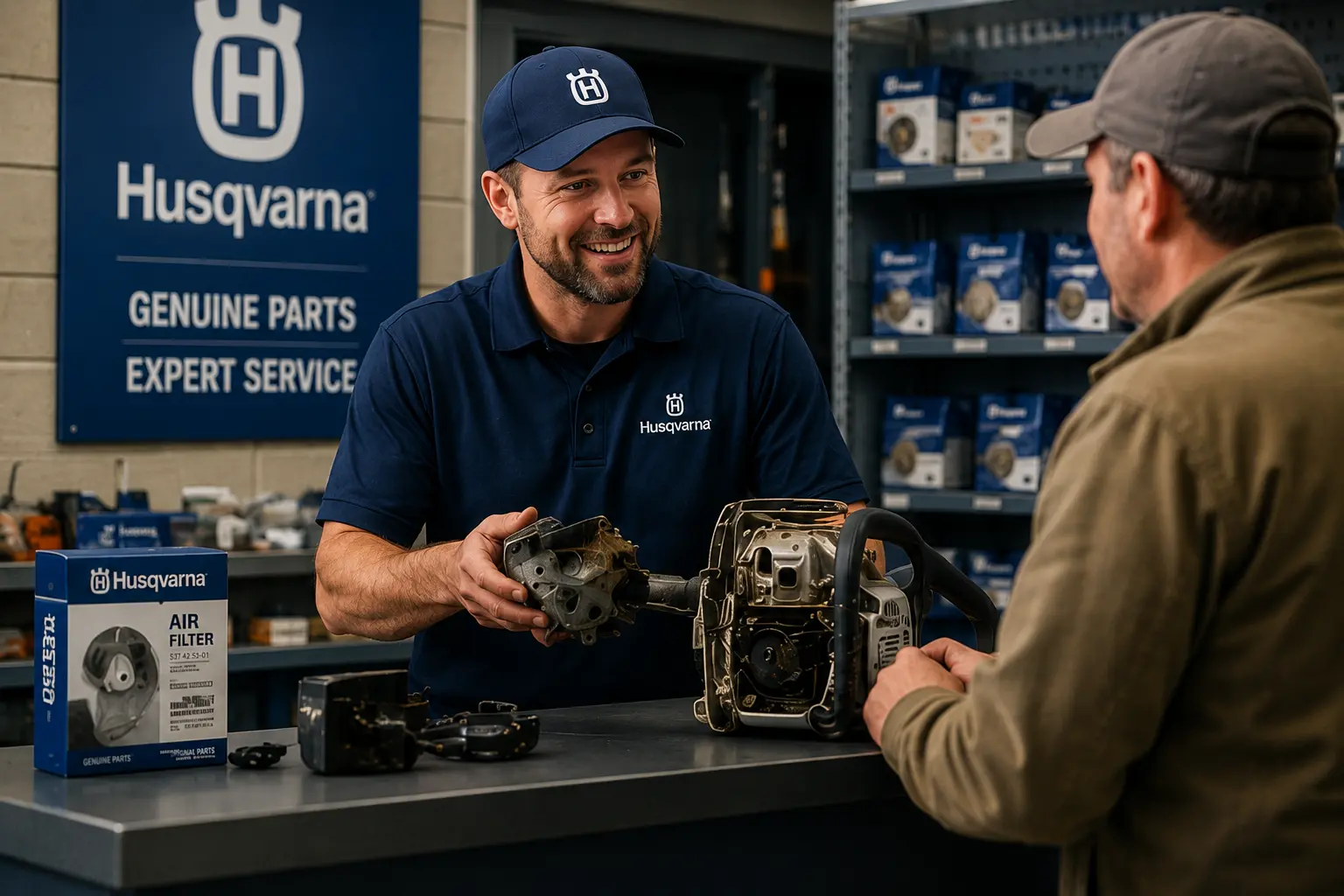
Husqvarna repair cost reality
Typical pricing at independent shops servicing Husqvarna out-of-warranty:
- Carburetor service (non-AutoTune): $80-150
- Carburetor service (AutoTune, dealer required): $120-180
- Ignition coil replacement: $60-130
- Top-end rebuild (piston, rings, cylinder cleanup): $250-450
- Annual tune-up: $50-90
Authorized dealer pricing on Husqvarna runs 15-25% higher than independents — slightly tighter than the Stihl gap, in part because Husqvarna's parts margins for dealers are narrower.
What this means for your buying decision
Both brands make excellent saws. The service-side differences sharpen the decision in three predictable ways.
For owners in dense suburban or rural areas with multiple service options nearby: the Stihl network advantage is real but not decisive. Either brand will be serviceable within 20 minutes of home. Pick on saw feel, dealer relationship, and price.
For owners in geographically isolated areas (60+ miles to the nearest population center): Stihl's wider network usually means a closer authorized service center. Worth checking your specific zip code before deciding — the easy way is calling 2-3 local repair shops and asking which brand they actually service most often.
For long-term owners (planning to keep the saw 10+ years) on a budget: Husqvarna's aftermarket parts ecosystem makes consumer-grade saws meaningfully cheaper to keep running past the 8-year mark. Stihl saws are arguably built better, but when something does fail, OEM-only parts make repair more expensive than the saw is worth on consumer models.
For pro users running the saw 200+ hours per year: both brands are equally good choices for prosumer/pro models. The MS 261, MS 362, MS 462 line and the 550 XP, 562 XP, 572 XP line are both designed for multiple top-end rebuilds across a 5,000+ hour useful life. Pick on saw weight, anti-vibration feel, and dealer relationship rather than network density.
Common ground across both brands
Three things matter more than brand choice for keeping a chainsaw running:
Fresh fuel matters most. Drain old fuel before storage, mix fresh fuel before each cutting session, and use a fuel stabilizer for any fuel that won't be burned within 30 days. This single practice prevents 70-80% of all chainsaw service issues regardless of brand. For owners who don't cut often enough to keep fresh-mixed fuel on hand, TruFuel 50:1 pre-mixed stays stable for 2+ years in storage and works in either brand's saw. The post-storm cleanup window is when stale fuel destroys saws — see post-storm chainsaw repair for what happens when fuel discipline slips during heavy use.
Sharp chains save bars and engines. A dull chain forces the operator to push harder, which heats the engine, accelerates bar wear, and increases kickback risk. Sharpening every 4-6 hours of cutting is the right cadence for both brands. See how to sharpen a chainsaw chain for technique.
Bar oil at every fuel stop. Both Stihl and Husqvarna run their bar oil tanks slightly smaller than fuel tanks, so bar oil runs out before fuel does on hard cuts. Topping off bar oil every time you refill fuel is universal advice and prevents the bar/chain damage that drives up repair costs.
When to call a shop regardless of brand
Some problems are not worth DIYing on either brand:
- No spark after replacing the plug — likely an ignition coil failure
- Compression issues confirmed by a thumb-over-plug-hole test
- Engine cranks freely but never fires after fresh fuel and a fresh plug
- Bar oil pump failure (chain runs dry mid-cut)
- Clutch slipping at running RPM (chain stops engaging)
- Visible cylinder damage during a top-end inspection
For an honest take on which chainsaw repairs are worth tackling yourself versus paying a shop, see the related decision content in the chainsaw guides.
Independent chainsaw shops typically charge $80-120 per hour. Authorized dealers run 15-30% higher. Storm-season pricing can stretch wait times to 2-4 weeks at most shops — book pre-season service in early-to-mid spring before the rush hits.
If you need to find a shop that handles your specific brand, the directory below filters by brand expertise and authorized service tier. Most shops will give a phone diagnosis before you bring the saw in.
This guide compares Stihl and Husqvarna gas-powered chainsaws. Battery-powered saws (Stihl MSA series, Husqvarna T-series battery line) have entirely different service profiles dominated by battery and motor controller issues, not covered here. Service network observations are drawn from independent shop feedback across the small engine repair network and may vary by region. If you're under warranty, follow your manufacturer's authorized service requirements before attempting any DIY work to preserve coverage.