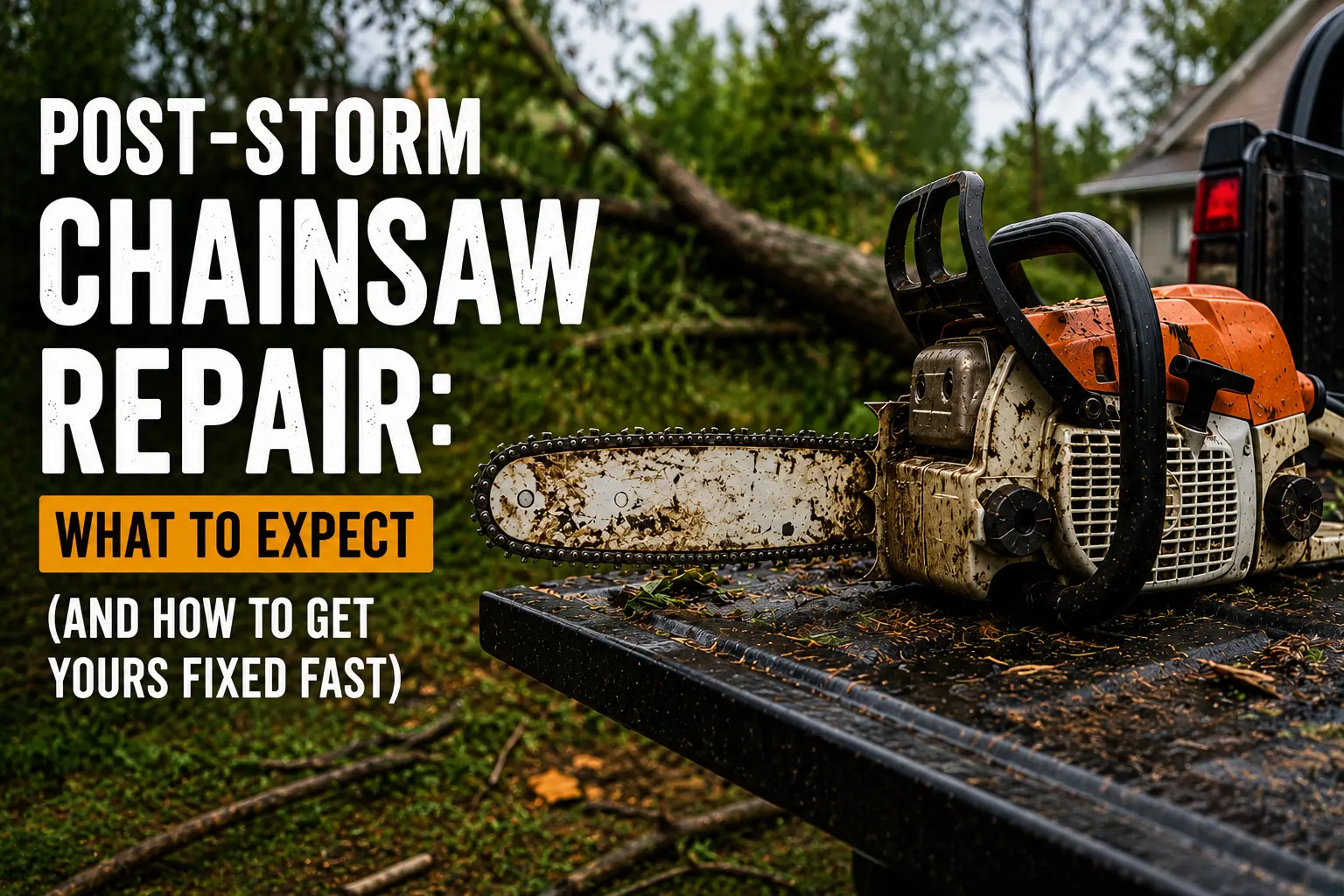
Post-Storm Chainsaw Repair: What to Expect (And How to Get Yours Fixed Fast)
After a major storm, the first 72 hours separate the people who're already cutting from the people whose chainsaws sit broken on the workbench. If your saw made it through the first round of cleanup but isn't running right — or won't start at all — you're not alone. Chainsaw repair shops in storm-affected regions see a 5-10x volume spike in the days following a hurricane, derecho, ice storm, or major windthrow event.
This guide covers what typically goes wrong with chainsaws during storm cleanup, what's worth fixing yourself versus taking to a shop, and how to navigate the wait times when every shop in your region is buried.
If your chainsaw won't start at all, the chainsaw won't start guide covers troubleshooting first. This article assumes you've been actively cutting and the saw started developing problems mid-cleanup, or quit on you entirely after a few tanks of fuel.
Why post-storm cleanup is uniquely punishing on chainsaws
Storm cleanup operates chainsaws in conditions they're not optimized for:
- Sustained heavy cutting — homeowner saws are designed for occasional weekend use. Cutting through 30+ logs in a single afternoon is closer to professional duty cycle.
- Foreign objects in the wood — storm-fallen trees often contain embedded debris: nails from old fences, ice pellets, embedded rocks, sand from soil washouts, even fragments of metal roofing from upwind buildings.
- Wet wood — recently fallen wood is much wetter than seasoned firewood and produces wet sawdust that clogs filters and air passages faster.
- Dirty fuel — gas cans that got rained on, knocked over, or shared between chainsaws and other equipment introduce contamination.
- Operator fatigue — storm cleanup means tired people running saws, which means dropped saws, contact with the ground, and reactive cuts instead of careful ones.
The result: a chainsaw that ran fine for a year of weekend yard work can develop multiple problems in 6 hours of post-storm cutting.
The eight most common post-storm chainsaw problems
Listed in the order shops actually see them, not necessarily order of severity.
1. Damaged or destroyed chain
Chains hit rocks, nails, embedded fence wire, and concealed debris during storm cleanup. Even glancing contact with metal or stone instantly dulls multiple cutters, and a hard hit can snap rivets or break individual teeth off entirely.
Symptoms:
- Saw cuts crooked, pulls to one side
- Visible cutter damage (broken teeth, chipped edges, bent tips)
- Saw smokes during cuts despite proper bar oil
- Cuts produce dust instead of clean chips
Fix scope: A chain with 1-2 chipped cutters can be salvaged with aggressive sharpening. Multiple damaged cutters or any rivet damage means replacement — $20-40 for most consumer saws. Sharpening service at a shop runs $10-15 per chain on a bench grinder. For sharpening details, see how to sharpen a chainsaw chain.
2. Bent or damaged bar
Bar damage usually comes from kickback into the ground, lateral pressure during pinched cuts, or heat damage from running with insufficient bar oil during heavy use.
Symptoms:
- Bar visibly curved when sighted along its length
- Chain pulls to one side even with a sharp chain
- Heat discoloration (blue/purple) near the bar tip
- Bar rails worn unevenly or burred at the edges
Fix scope: Minor rail burrs can be filed down. Bent bars usually require replacement — $40-100 depending on saw size. Heat-damaged bars are end-of-life regardless of how they look.
3. Air filter clogged with wet sawdust
Wet sawdust clogs air filters dramatically faster than the dry sawdust from seasoned wood. After 4-8 hours of cutting fresh-fallen wood, the filter can be solid enough to choke the engine.
Symptoms:
- Engine runs rich (smoky exhaust, fouls plugs)
- Saw bogs down under load even with sharp chain
- Won't accept full throttle
- Engine starts and runs at idle but dies under load
Fix scope: Pull the cylinder cover, remove the filter. If it's a foam filter, wash in soapy water, dry completely, lightly oil with two-stroke oil. If paper, replace — $10-15. Don't blow compressed air at the dirty side; that pushes debris through the filter media.
4. Stale or contaminated fuel
Storm conditions are uniquely hard on fuel. Cans get rained on, lids get loose, fuel sits exposed to humidity for days. Two-stroke fuel mixed with ethanol pump gas degrades within 30 days under normal conditions and faster when contaminated.
Symptoms:
- Hard starting after sitting overnight
- Surging or hunting RPM under load
- Engine fires briefly and dies
- Visible water or sediment in the fuel tank when drained
Fix: Drain the fuel tank into a separate container. Inspect for water, debris, or off-color fuel. Refill with fresh mixed fuel. TruFuel pre-mixed is the no-mix option that stays stable for 2+ years — useful for keeping a storm-prep can ready year-round. If the carburetor is contaminated, spray carburetor cleaner through the air intake while running at low throttle.
5. Carburetor varnish from moisture-contaminated fuel
If contaminated fuel sat in the carburetor between cutting sessions, the small fuel passages varnish quickly. This is the most common reason a saw that ran fine on day 1 of cleanup won't start on day 3.
Symptoms:
- Engine fires briefly and dies (fuel reaching the cylinder, but not enough)
- Surging at all throttle positions
- Won't idle, runs only with the choke partially on
- Hard starting after the saw has cooled
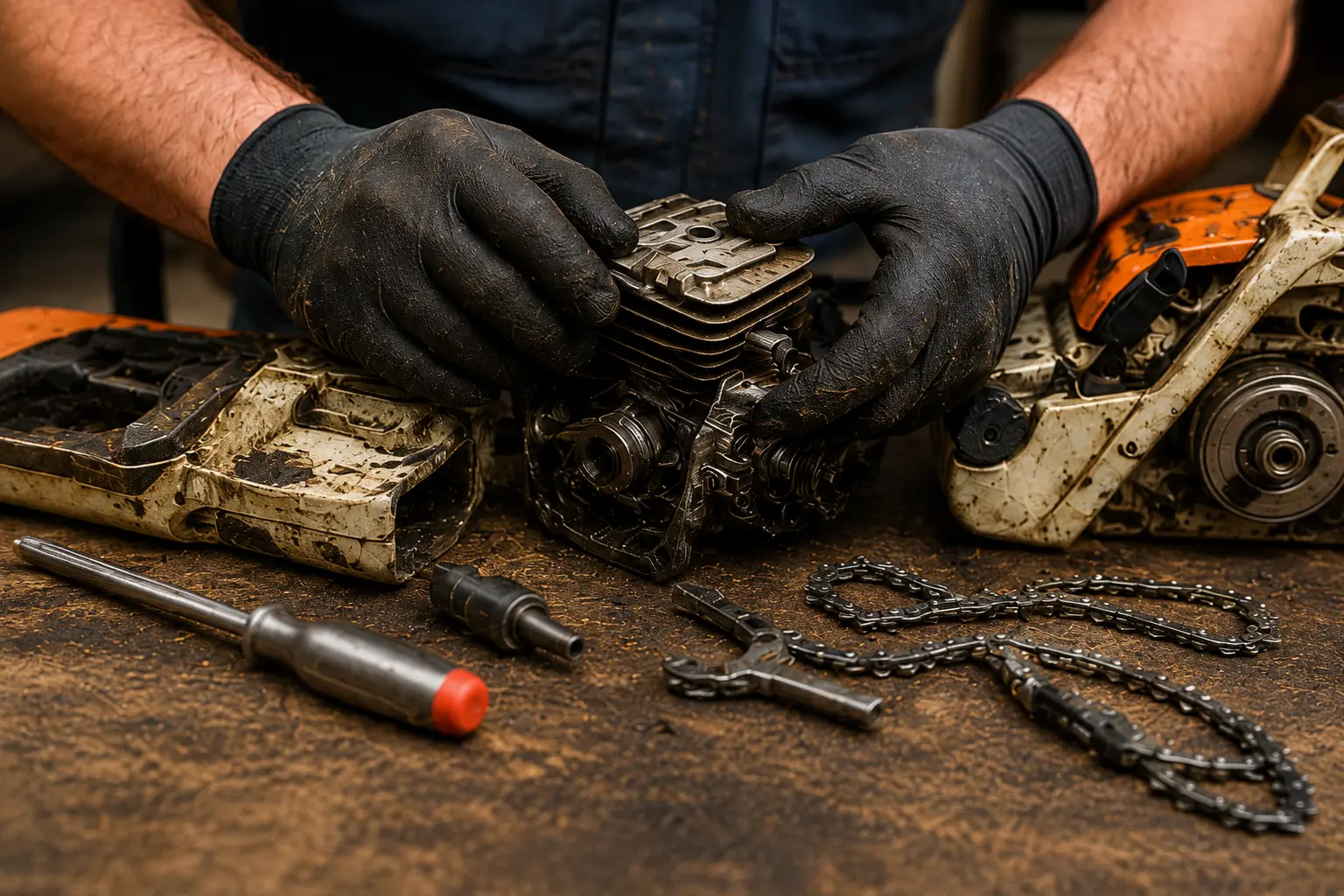
Fix scope: Spray carb cleaner during operation as a temporary fix. A real fix means full carburetor disassembly, cleaning, and replacing the diaphragm and gaskets. Rebuild kits run $10-20 for most consumer saws. Shop service runs $80-150. Many DIYers won't tackle a chainsaw carb during active storm cleanup — it's a 2-3 hour bench job that requires patience.
6. Chain tension lost or sprocket worn
Heavy cutting on hot wood causes the chain to stretch and the bar/sprocket to wear faster than normal use. After a hard day of cutting, the chain may be visibly loose on the bar or the sprocket teeth visibly hooked.
Symptoms:
- Chain visibly slack at idle (sags below the bar bottom)
- Chain throws off the bar mid-cut
- Sprocket teeth visibly hooked or worn unevenly
- Burning smell during cuts (clutch slipping)
Fix scope: Adjust chain tension first — usually a side-cover screw adjustment. If that doesn't hold, replace the chain. If the sprocket is worn, replace it too — $15-30 in parts. Worn sprockets eat new chains; don't swap one without inspecting the other.
7. Bar oil pump failure or low bar oil
Heavy cutting drains bar oil fast. If you weren't refilling at every fuel stop, the pump may have run dry and the chain is now running unlubricated. Sustained dry running damages the bar groove and overheats the chain.
Symptoms:
- Bar oil reservoir empty when checked
- Chain looks dry after cuts
- Bar discolored from heat near the tip
- Smoke from the bar tip during cutting
Fix: Refill bar oil at every fuel stop during storm cleanup — every can of fuel mix should match a refill of bar oil. If the pump itself failed, that's shop work — $80-180 in parts and labor.
8. Electrical/ignition issues from moisture exposure
Saws stored outside during the storm itself, or used in heavy rain afterward, can develop ignition issues from moisture in the kill switch, wiring harness, or coil.
Symptoms:
- Engine runs intermittently with no clear pattern
- Cuts out when the saw gets warm
- No spark at the plug despite the plug looking fine
- Saw starts then dies after 30 seconds
Fix scope: Let the saw fully dry in a warm, dry space for 24 hours. Spray contact cleaner on the kill switch and at the coil terminals. If the issue persists after drying, the coil itself may have failed — $30-80 in parts plus 60-90 minutes of labor.
What shops actually do during the post-storm rush
During peak post-storm weeks, most independent chainsaw shops shift into triage mode:
First-come, first-served on minor repairs. Sharpening, simple tune-ups, and parts swaps go first. Drop-off, pick up in 1-3 days versus the normal 3-5.
Triage queue for major repairs. Carb rebuilds, ignition coils, clutch work — these wait 1-3 weeks behind the simple-repair queue.
Loaner saws for established customers (sometimes). Some shops keep a few rental or loaner saws for customers who need to keep cutting while their saw is in service. Almost always reserved for established customers, not walk-ins.
Parts shortages. Air filters, chains, plugs, and bar oil routinely run out at local shops 2-3 days into a major storm. Bigger shops with deeper inventory hold up better, but expect "we'll order it, here in 5 days" answers on more obscure parts.
Wait times during peak storm response
For ballparking how long your saw will be at a shop:
| Repair type | Normal | Day 1-3 post-storm | Day 4-14 post-storm |
|---|---|---|---|
| Chain sharpening | Same day | Same day to 1 day | 1-2 days |
| Plug/filter swap | Same day | 1-2 days | 2-3 days |
| Carburetor service | 3-5 days | 5-10 days | 10-14 days |
| Ignition coil | 3-7 days | 7-14 days | 14-21 days |
| Major engine work | 1-2 weeks | 2-3 weeks | 3-4 weeks |
Adding to the wait: most shops are running on shorter staff during storm response (employees may have their own cleanup) and on fewer hours (power outages affect shop hours too).
What to do if your chainsaw breaks during active cleanup
If you have wood that needs cutting now and your saw is dead, the realistic options:
1. Try the simple stuff first. Sharpen the chain, clean the air filter, drain old fuel and refill with fresh. These three things cover roughly 60% of mid-cleanup failures.
2. Borrow before you buy. Neighbors with a working saw, local rental yards, hardware stores with rental fleets. Renting a saw for $30-50 a day beats buying a $150-300 backup unit you'll only use during storms.
3. Buy a backup unit if you're regularly in storm-prone areas. A $150-200 entry-level Echo or Husqvarna kept in dry storage with stabilized fuel is the cheapest insurance against being saw-less during cleanup. Pre-mixed fuel stays stable for 2+ years, so a backup saw with a full tank is genuinely ready when you need it.
4. Drop the broken saw at a shop and pick up a new one. Some hardware stores will hold a saw for repair while selling you a new one. Cleanup happens, you have a working saw, the repair is ready when the rush dies down.
Pre-storm preparation that prevents most of this
Most storm-driven chainsaw failures are preventable with 30 minutes of pre-season service:
- Drain old fuel and refill with fresh mix the week before storm season
- Sharpen the chain or have a fresh chain ready to install
- Clean the air filter and have a spare filter on hand
- Top off bar oil and have a 1-gallon refill nearby
- Check chain tension and adjust to spec
- Run the saw for 5 minutes to confirm it actually starts under load before you need it
Pre-season service at a shop runs $50-100 and avoids most of the post-storm queue.
When to call a shop versus replace the saw
After a hard storm cleanup, sometimes the math says replace, not repair:
- Consumer saw under $300 new + repair quote over $150 — usually replace
- Pro saw (Stihl MS 261+, Husqvarna 562 XP+) needing engine work — almost always repair, these are designed for rebuilds
- Saw that's seen 1,000+ hours with original cylinder/piston — get a compression test before authorizing major work
- Bar AND chain AND sprocket all worn — replace all three together; the savings of swapping just one are usually false economy
When you need a shop
If you've worked through the list above and the saw still isn't right, it's time. Find a verified chainsaw repair shop near you below — most are running expanded hours during storm response and can give a phone diagnosis before you bring the saw in. Ask specifically about their current backlog and whether they're prioritizing storm-related repairs (most are).
This guide covers two-stroke gasoline chainsaws (Stihl, Husqvarna, Echo, Poulan, Craftsman, and similar consumer and prosumer brands). Battery-powered chainsaws have different post-storm failure modes (mostly battery degradation from prolonged use and motor controller issues from moisture) and aren't covered here. Always follow safety practices when running a fatigued saw — operator fatigue is a contributing factor in many storm-cleanup chainsaw injuries.