
Why Your Lawn Mower Starts Then Dies: 7 Causes and Fixes
The mower catches on the first pull — then dies within a few seconds. You try again, same thing. It runs just long enough to be frustrating.
This specific symptom — starts, runs briefly, stalls — is different from a mower that won't start at all. The engine is clearly getting some fuel and spark. Something is cutting it off. That narrows the list of likely causes significantly, and most of them are fixable without a shop visit.
Use the interactive starts-then-dies diagnostic to narrow the likely cause from exactly when and how the mower stalls.
This guide includes some Amazon Associate links. We earn a small commission on qualifying purchases at no extra cost to you, and we only link products we'd recommend to a neighbor.
1. Stale or degraded fuel
This is the most common cause by a wide margin, especially at the start of mowing season after the mower sat through winter.
Gasoline starts to degrade in about 30 days. After 60–90 days, ethanol-blended fuel (the standard pump gas sold at most stations) absorbs moisture from the air and begins to separate. The ethanol-water layer sinks to the bottom of the tank and carburetor bowl, where it does not combust cleanly. The result: the engine starts on whatever clean fuel is in the lines, runs for a few seconds, then starves.
What to check: Drain the tank and carburetor bowl. Fresh fuel is usually a light amber color. Stale fuel looks darker, may smell sour or varnish-like, and sometimes has a cloudy or separated layer at the bottom.
Quick mower-repair box
The fix: Drain the tank completely. Remove the carburetor bowl and drain it too — the bolt at the bottom of the bowl is usually accessible without full disassembly. Refill with fresh fuel. If you store fuel for longer than a month, add a fuel stabilizer like STA-BIL to the can — not just the tank — to extend shelf life to 12–24 months.
If the mower still starts-then-dies after fresh fuel, the stale gas has likely left varnish deposits in the carburetor. Move to step 2.
2. Dirty or varnished carburetor
When stale fuel evaporates inside the carburetor, it leaves behind a sticky, lacquer-like residue. This varnish clogs the small fuel passages and jets that meter fuel delivery. The engine gets enough fuel to start but not enough to sustain a run.
What to check: If the mower sat for more than one season or the fuel was old, assume the carburetor has some degree of varnish. The main jet and the emulsion tubes are the most common clog points.
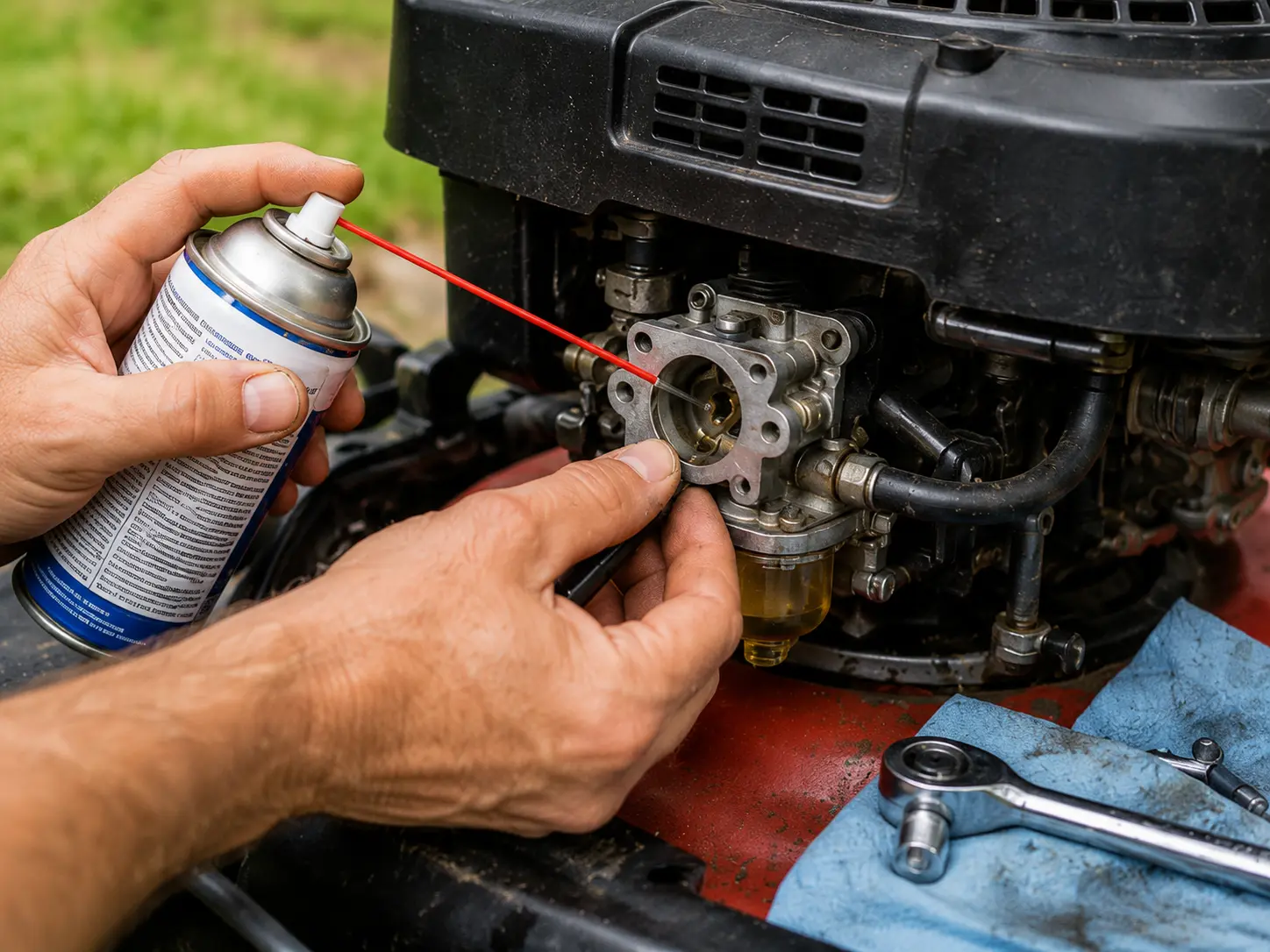
The fix — cleaning: Spray carburetor cleaner directly into the air intake and through the fuel inlet. On a small push-mower carb, you can often clean the jets with the carburetor still on the engine by removing the bowl, soaking the jets, and blasting them with carb cleaner. Let it soak for 5–10 minutes, then blow through each passage with compressed air or a thin wire.
The fix — rebuild: If cleaning doesn't resolve the issue, a carburetor rebuild kit ($8–$20 online) replaces the needle, seat, gaskets, and emulsion tube — the small parts that wear or corrode. For Honda GCV engines specifically, rebuild kits are readily available and are a common weekend repair.
When to replace instead: On a carb where the main body is cracked, a jet is corroded beyond cleaning, or the throttle shaft is worn and letting air bypass, cleaning won't help. See the full guide on carburetor clean vs replacement for the decision logic.
3. Clogged air filter
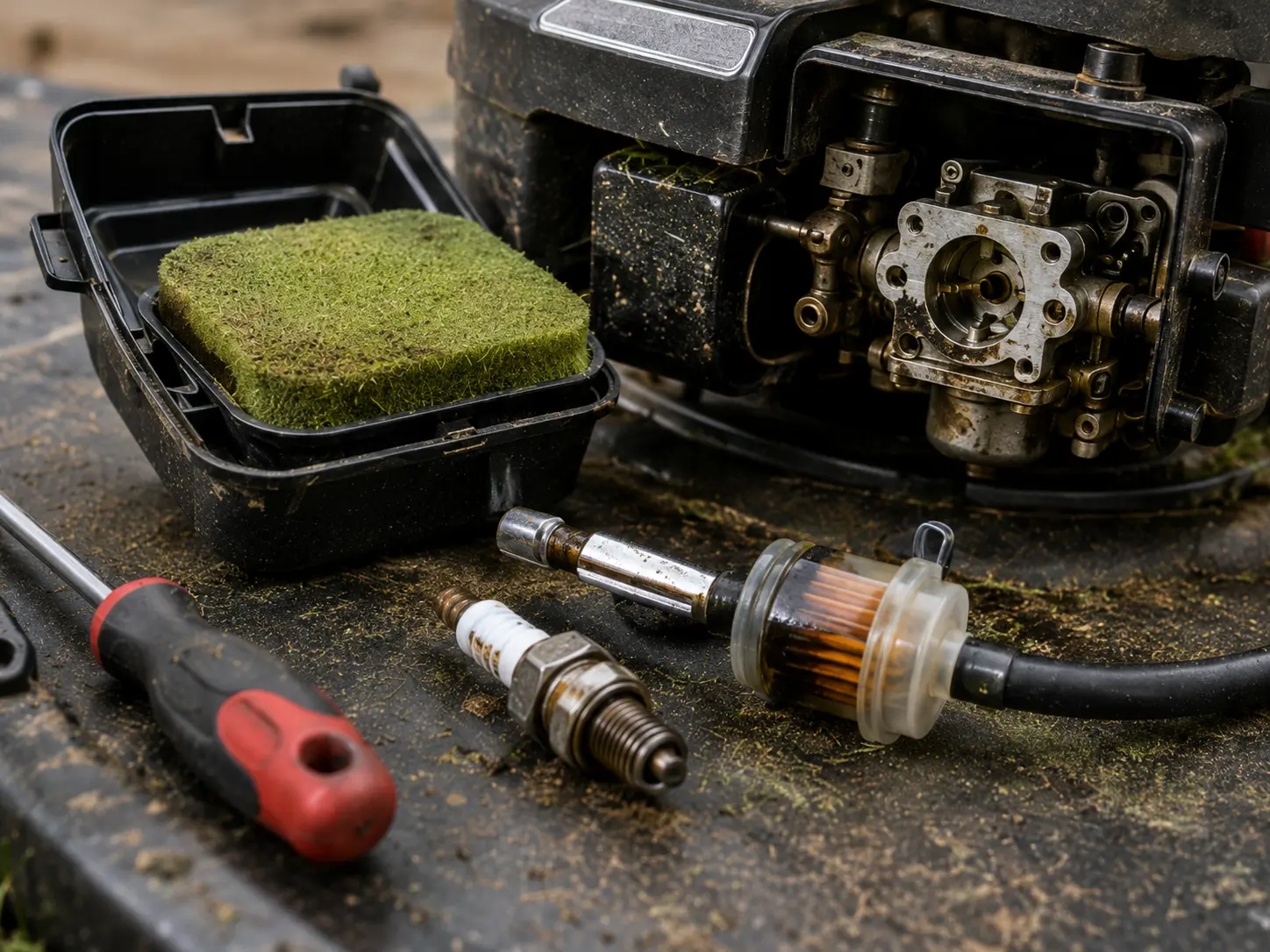
An engine needs three things: fuel, spark, and air. A severely clogged air filter restricts airflow enough that the engine runs rich (too much fuel, not enough air), which can cause it to start and immediately stall — especially under any load like engaging the blade.
What to check: Remove the air filter cover (usually a single wing nut or clip on top of the carburetor). Pull out the filter element and hold it up to light. On a foam filter, you should see light through it. On a paper filter, you should see the light-colored paper. If it is brown/black or plugged with dirt and debris, it needs replacement.
The fix: Foam filters can be washed with dish soap, dried completely, and lightly oiled before reinstalling. Paper filters should be replaced — tapping them against a workbench removes loose dust but won't restore a truly clogged filter. Paper filter replacements are typically $4–$12 and are sold by engine brand and model number.
4. Choke stuck in the closed position
The choke enriches the fuel mixture for cold starts by restricting airflow. Once the engine warms up — usually 15–30 seconds — the choke should open (either manually or automatically). If it stays closed, the engine runs too rich and stalls.
What to check: Manually operated chokes: confirm you are moving the choke lever to "run" (open) after the engine starts. Automatic chokes (called thermostatic chokes or automatic choke systems on some Briggs engines): check that the choke plate opens freely when the engine warms. A stuck or partially closed choke plate is visible from the air intake opening.
The fix: On automatic chokes, the thermostatic spring that opens the choke when warm can weaken or break. Spraying carburetor cleaner on the choke shaft and plate often frees a stuck plate. A broken thermostat spring requires a replacement part, which varies by engine model.
5. Fuel cap vapor lock
The gas cap has a small vent hole that allows air into the tank as fuel is drawn down. If this vent is clogged, the tank creates a partial vacuum that eventually starves the engine of fuel. The mower starts and dies within 30–90 seconds — just long enough for enough fuel to be drawn out that the vacuum becomes significant.
What to check: When the mower stalls, loosen (but don't remove) the gas cap and try restarting immediately. If the engine runs normally with the cap loose, vapor lock is the cause.
The fix: Clean the cap's vent hole. On many caps, the vent is a small hole or slot — poke it clear with a thin wire. If the cap is damaged or the vent can't be cleared, a replacement cap is $6–$15 and is sold by engine brand and model number.
6. Faulty or fouled spark plug
A spark plug that is fouled, cracked, or has the wrong gap can deliver inconsistent spark. The engine starts (barely enough spark for that), then misfires and stalls as the load increases or the combustion cycle requires consistent timing.
What to check: Remove the plug (usually a 5/8" socket). Look at the electrode end. A healthy plug is light gray or tan. Black and oily means the engine is running rich. Black and sooty means rich or fouled from old fuel. White or blistered means it has been running lean or overheating. A cracked ceramic insulator means the plug is done.
The fix: Check the gap with a feeler gauge (most small engines use .030"–.035") and adjust if needed. If the plug looks fouled or worn, replace it — plugs are $4–$8 and are a standard maintenance item. Match the replacement to your engine's spec (printed in the owner's manual or on a sticker under the hood on riding mowers).
7. Low or no oil (oil shutdown activated)
Most engines made after the mid-1990s have a low-oil shutdown switch — sometimes called an oil alert system. When oil level drops below a safe threshold, the switch grounds the ignition, cutting the engine. This is intentional — a safety feature to prevent engine seizure.
What to check: Check the oil level with the dipstick before every mowing session. The engine should read between the low and full marks on the dipstick, with the mower on level ground. If the level is low, the oil shutdown will kill the engine shortly after start.
The fix: Fill to the proper level with the oil weight specified in your owner's manual (typically SAE 30 for warm weather, 10W-30 for variable temperatures). Do not overfill — too much oil can foam and cause its own problems.
If the oil is full but the shutdown is still triggering, the switch itself may be faulty. A shop can test the switch and bypass it temporarily to confirm — but do not bypass it permanently, as the underlying low-oil protection is there for a reason.
When to take it to a shop
If you have worked through the above list — fresh fuel, clean carb, clean air filter, functional choke, cleared cap vent, new plug, correct oil level — and the mower still starts and dies, the problem is likely one of the following:
- Governor issues: The governor controls engine speed under load. A worn or damaged governor can cause the engine to hunt and stall.
- Compression leak: A head gasket leak or worn piston rings allow combustion pressure to escape, giving marginal compression that is enough to start but not sustain.
- Ignition module failure: The ignition coil can fail intermittently — working cold, failing once it heats up.
All three of these require a shop diagnosis. Most small engine shops can run a compression test and ignition timing check in under an hour.
Manufacturer note: Engine repair procedures and part specifications vary by model. Always refer to your engine manufacturer's service manual for model-specific guidance. smallengine.directory is an independent repair-shop directory and is not affiliated with Honda, Briggs & Stratton, Kawasaki, Kohler, Toro, Husqvarna, or any other equipment manufacturer.