
Riding Mower vs Push Mower Repair Costs: What to Expect
The repair economics of a riding mower and a push mower are different enough that it's worth treating them separately. A carburetor cleaning costs roughly the same on both. But a riding mower has a transmission, a battery, multiple drive belts, a deck engagement system, and an electrical interlock network that a push mower simply doesn't have — and each of those is a potential repair.
This guide breaks down common repairs on both types, what they realistically cost at an independent shop, and the factors that move the price in either direction.
Push mower repair costs
Push mowers — both standard and self-propelled walk-behinds — have straightforward engines and relatively simple mechanics. Most repairs fall into a predictable range.
Carburetor cleaning or rebuild: $80–$150 The most common repair on any push mower. Old fuel leaves varnish deposits that block the carburetor's fuel passages, causing hard starting, rough running, or a no-start condition. A cleaning addresses mild cases; a rebuild (new needle, seat, diaphragm, gaskets) handles severe gumming. Carburetor replacement on a consumer mower runs $100–$200 including labor when a rebuild isn't viable.
Tune-up (plug, filter, oil, blade): $60–$100 Annual maintenance that prevents most problems. Includes spark plug, air filter, oil change, and blade sharpening. Some shops include a carburetor inspection; others charge separately if cleaning is needed.
Fuel line and primer bulb replacement: $40–$80 Rubber fuel system components degrade from ethanol exposure. Cracked lines cause lean running and fuel leaks; a hardened primer bulb makes cold starting difficult. Usually done as a set.
Recoil starter replacement: $50–$90 The pull-cord assembly can fail in two ways — the spring breaks (cord pulls with no resistance and doesn't retract) or the pawls that engage the flywheel wear out. The recoil housing is a bolt-on replacement on most engines.
Drive belt replacement (self-propelled): $80–$130 Self-propelled mowers use a belt to drive the rear wheels. Belts glaze, crack, and eventually snap. Replacement is a moderate disassembly job — not complex, but time-consuming enough that labor is the majority of the cost.
Wheel gear or drive cable replacement: $60–$110 Self-propelled wheel gears wear out on mowers with individual wheel drive. Drive cables fray and lose adjustment. Either is a straightforward repair.
Ignition coil failure: $90–$150 No spark despite a new plug points to the coil. Replacement requires removing the flywheel shroud but is otherwise straightforward.
Valve adjustment or replacement: $100–$200 Four-cycle engines occasionally need valve clearance adjustment as they age. Tight valves cause hard starting and low compression. Burned valves require head removal and machine shop work — at this repair level on a push mower, the repair vs. replace question is worth asking.
Riding mower repair costs
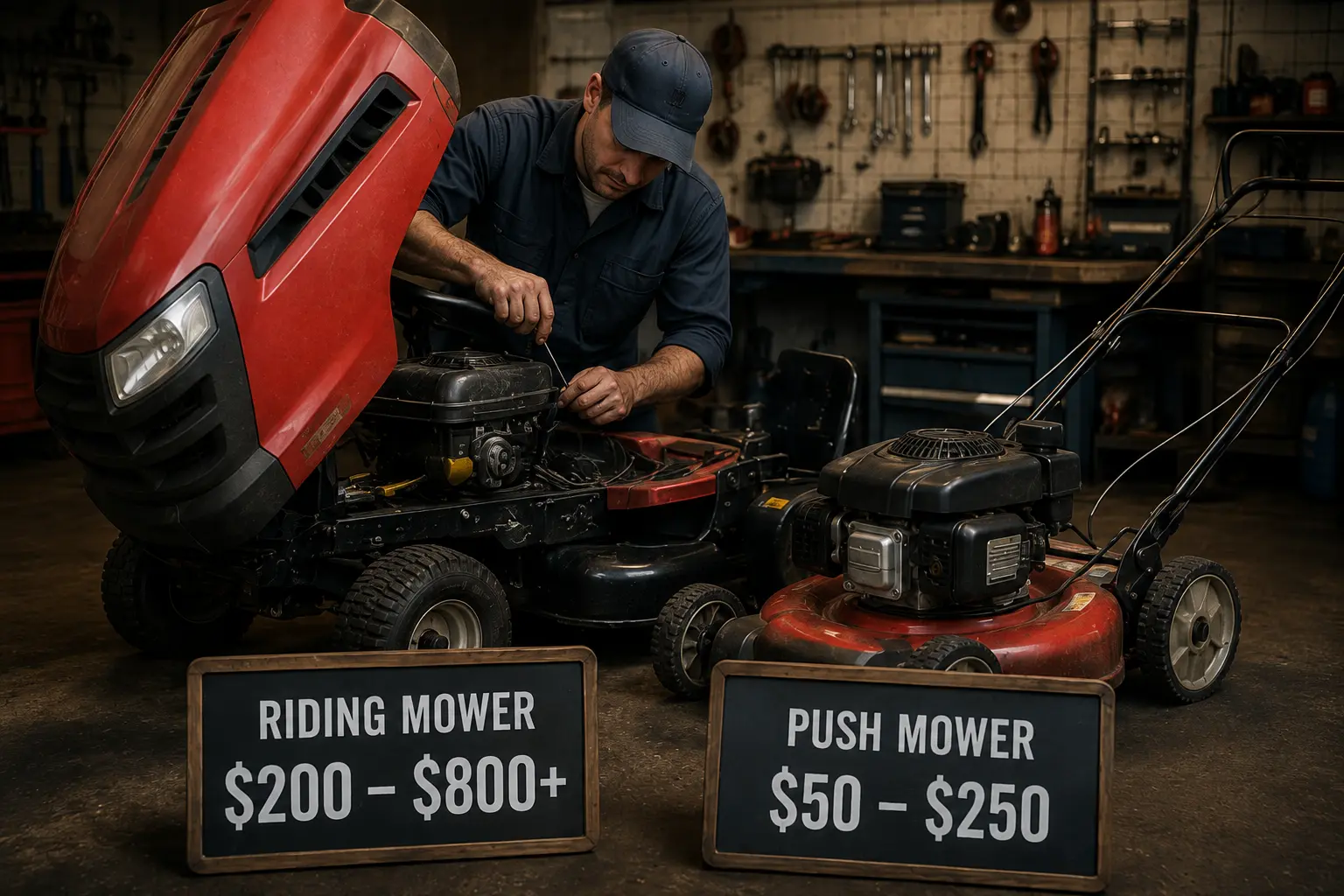
Riding mowers have all the engine repairs of a push mower, plus a larger set of mechanical and electrical systems. The engine repairs are similar in cost; the additional systems are where riding mower repair bills diverge from push mower bills.
Engine repairs (carburetor, tune-up, ignition): $100–$250 Similar in scope to push mower engine work, but larger engines sometimes require more carburetor work, and some riding mower engines (Kawasaki, Kohler, Briggs V-twin) have two cylinders — doubling some service items.
Deck belt replacement: $100–$180 The belt that spins the cutting blades stretches and wears with use. Most riding mowers have one or two deck belts. Replacement requires removing the deck, which adds labor time.
Blade spindle bearing replacement: $120–$220 per spindle Each cutting blade has a spindle with bearings that wear over time. Worn spindle bearings cause vibration and noise. Most riding mowers have two or three spindles. Catching them early (when you hear a rumble) is cheaper than waiting until they seize.
Blade sharpening and balancing: $30–$60 Riding mowers typically have two or three blades. Sharpening each and balancing runs $10–$20 per blade.
Drive belt (motion drive) replacement: $120–$200 Separate from the deck belt, the motion drive belt transmits power to the transmission. Replacement is more involved than deck belt work.
Transmission service or replacement: $200–$600+ Hydrostatic transmissions (the most common type on modern riding mowers) are sealed units that rarely need service if kept cool and properly loaded. When they fail — usually from overheating or a severe impact — repair or replacement is expensive. A rebuilt transmission for a common Husqvarna or Cub Cadet runs $300–$500 in parts alone.
Battery replacement: $40–$80 Riding mowers use a small lead-acid battery for electric start. Batteries that sit discharged over winter lose capacity and typically need replacement every 3–5 years.
Ignition switch or safety interlock switch: $50–$120 Riding mowers have multiple safety switches — seat switch, blade engagement switch, brake/clutch switch. Any of these failing in the open position prevents starting. Diagnosis is straightforward with a multimeter; replacement is inexpensive.
Steering linkage or tie rod: $80–$160 Wear in the steering system causes wandering or loose steering feel. Tie rods and drag links wear at pivot points over time.
Carburetor rebuild (twin-cylinder engines): $150–$280 V-twin engines have two carburetors (or a single two-throat carburetor). Carb service on these engines is more involved than on single-cylinder units.
Zero-turn mower repair costs
Zero-turns share most of the same repairs as riding mowers, with higher labor costs due to their more complex deck and drive systems.
Hydraulic pump or wheel motor service: $300–$800+ The zero-turn drive system uses hydraulic pumps and wheel motors instead of a traditional transmission. These are durable but expensive when they fail. Rebuilding is possible at some shops; replacement is the more common solution.
Deck service (spindles, belts, blades): $150–$350 Zero-turns typically have three blades and three spindles. A full deck service — belts, spindle bearings, and blade sharpening — adds up quickly.
What drives repair costs up or down
Age and parts availability. Replacement parts for common engines (Briggs & Stratton, Kohler, Kawasaki) are widely stocked and priced competitively. Older or discontinued models may require sourcing parts that are back-ordered or only available from specialty suppliers, adding both cost and wait time.
Brand authorization. Authorized dealers for Husqvarna, Cub Cadet, and other major brands have direct parts access and factory training. Independent shops may be equally capable for most repairs but may have slower parts sourcing for brand-specific components.
Regional labor rates. Shop labor rates range from $55/hour in rural markets to $100+/hour in high cost-of-living areas. A repair that takes 90 minutes of labor costs meaningfully more in one market than another.
Diagnostic clarity. A mower brought in with a clear symptom and accurate history gets diagnosed faster than one brought in with "it just doesn't work right." Accurate symptom description saves diagnostic labor, which saves money.
When to use the repair vs. replace framework
For push mowers: any repair over $150 on a mower worth less than $300 warrants a careful look. Internal engine work (valves, piston) on a consumer push mower is rarely economical.
For riding mowers: the higher replacement cost ($1,200–$3,000+) means repair is almost always preferable for anything short of transmission failure or catastrophic engine damage. A $400 repair on a $1,800 mower in otherwise good condition is straightforward math.
For zero-turns: same logic at higher numbers. A $600 hydraulic repair on a $4,000 zero-turn is worth doing.
For a full repair vs. replace framework, see when to repair vs replace a lawn mower.
Prices in this guide reflect typical independent shop rates across the United States as of 2026. Rates vary by region, shop, and parts availability. Always get a written estimate before authorizing work.