Why Small Engine Shops Charge a Diagnostic Fee
You drop off a mower that won't start. The shop calls back: there is a $40 diagnostic fee before they can tell you what is wrong.
This surprises a lot of people. You brought the machine in for repair, not for a test. But diagnostic fees are standard practice at most small engine shops — and once you understand what they cover, they are generally reasonable.
What the diagnostic fee actually covers
A technician's time is the shop's primary cost. When your equipment comes in, someone has to:
- Pull it out of the queue, move it to a bay
- Review whatever you described as the problem
- Actually run or attempt to run the equipment
- Systematically test fuel delivery, spark, compression, and air — not just guess
- Document findings and translate them into a repair estimate
This process takes 30–90 minutes depending on equipment type and symptom. At shop labor rates of $45–$95/hour, that is $25–$140 in technician time before a single wrench is turned.
The diagnostic fee — typically $20–$60 for walk-in small engine equipment — offsets that time. Without it, shops would routinely absorb unpaid labor hours on every machine brought in for a look.
When the diagnostic fee is applied to the repair
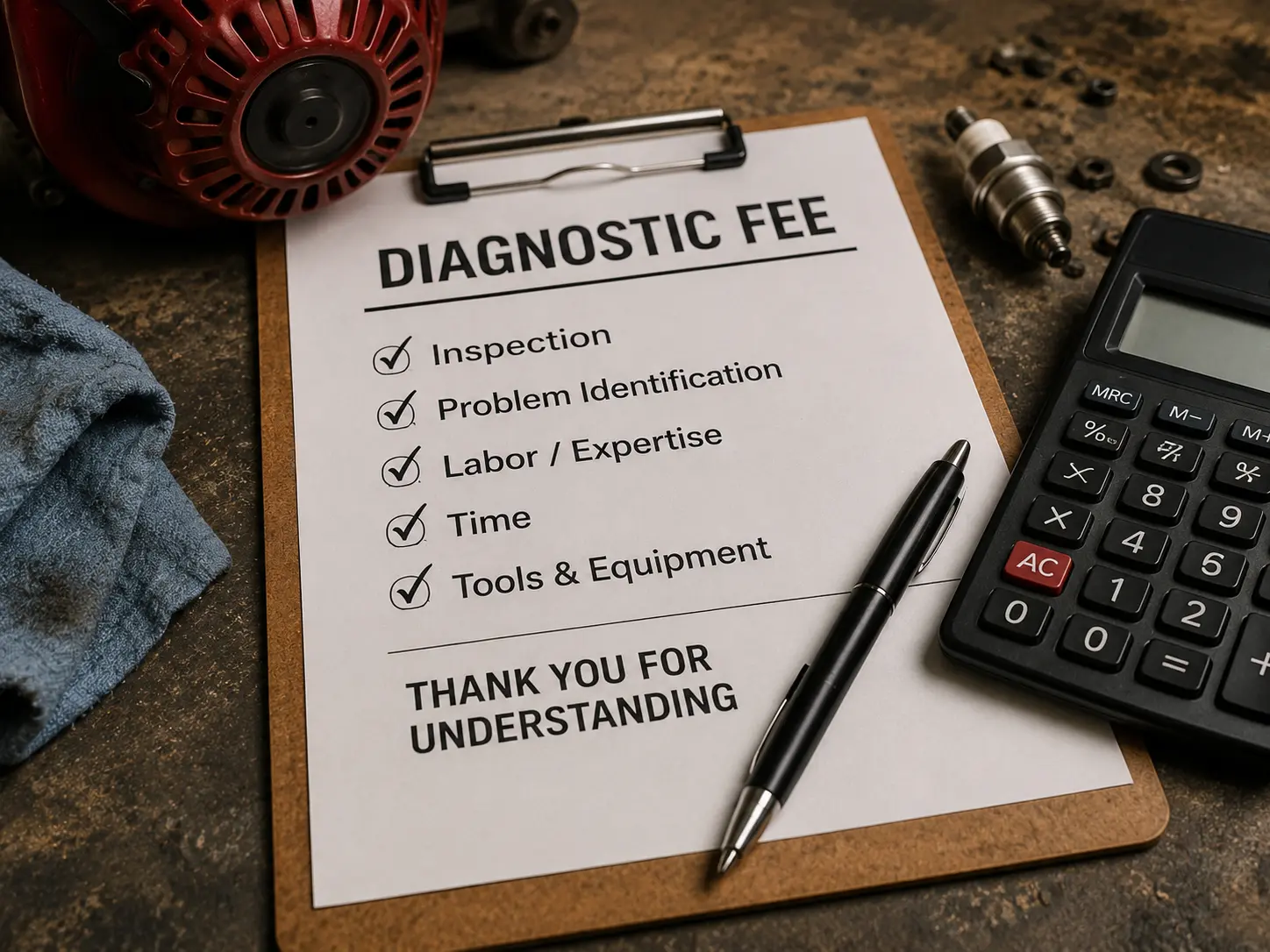
Most shops apply the diagnostic fee toward the repair if you proceed. This is sometimes called "shop fee included in repair" or "diagnostic applied to labor." It means:
- You pay the diagnostic fee upfront or at dropoff
- The shop diagnoses and provides a repair estimate
- If you authorize the repair, the diagnostic fee is credited against the total invoice
- If you decline the repair and take the equipment elsewhere, you pay the diagnostic fee only
This is the standard practice at reputable shops. It aligns incentives — the shop earns for their time either way, and you only pay for diagnosis once.
If a shop charges a diagnostic fee AND does not apply it toward the repair upon authorization, ask about this policy upfront. It is not universal.
When shops waive the diagnostic fee
Some shops waive the fee under specific conditions:
- Obvious failure: If the problem is visually obvious — a snapped belt, a seized pull cord, a completely empty fuel tank — no diagnostic time was needed. Many shops will not charge for a five-minute visual assessment.
- Return repairs: If the equipment was repaired at that shop and the same issue recurs, most shops will re-diagnose at no charge.
- High-value repairs: On a $600 transmission repair, some shops absorb the diagnostic cost as a cost of winning the job.
- Longtime customers: Relationship matters at small independent shops.
Why the fee protects you
A shop that does not charge a diagnostic fee has little incentive to spend time on a thorough diagnosis. They may guess, or recommend replacing the part they suspect rather than confirming it.
A diagnostic fee creates accountability. The shop is charging for systematic testing. That systematic testing protects you from authorizing a repair based on a guess that turns out to be wrong.
If a shop diagnoses your mower as needing a carburetor replacement, charges you for a carburetor, and the problem was actually the spark plug, a proper diagnostic would have caught that. Shops that rush to skip the diagnostic step to seem competitive on price create more problems than they solve.
How to handle diagnostic fees as a customer
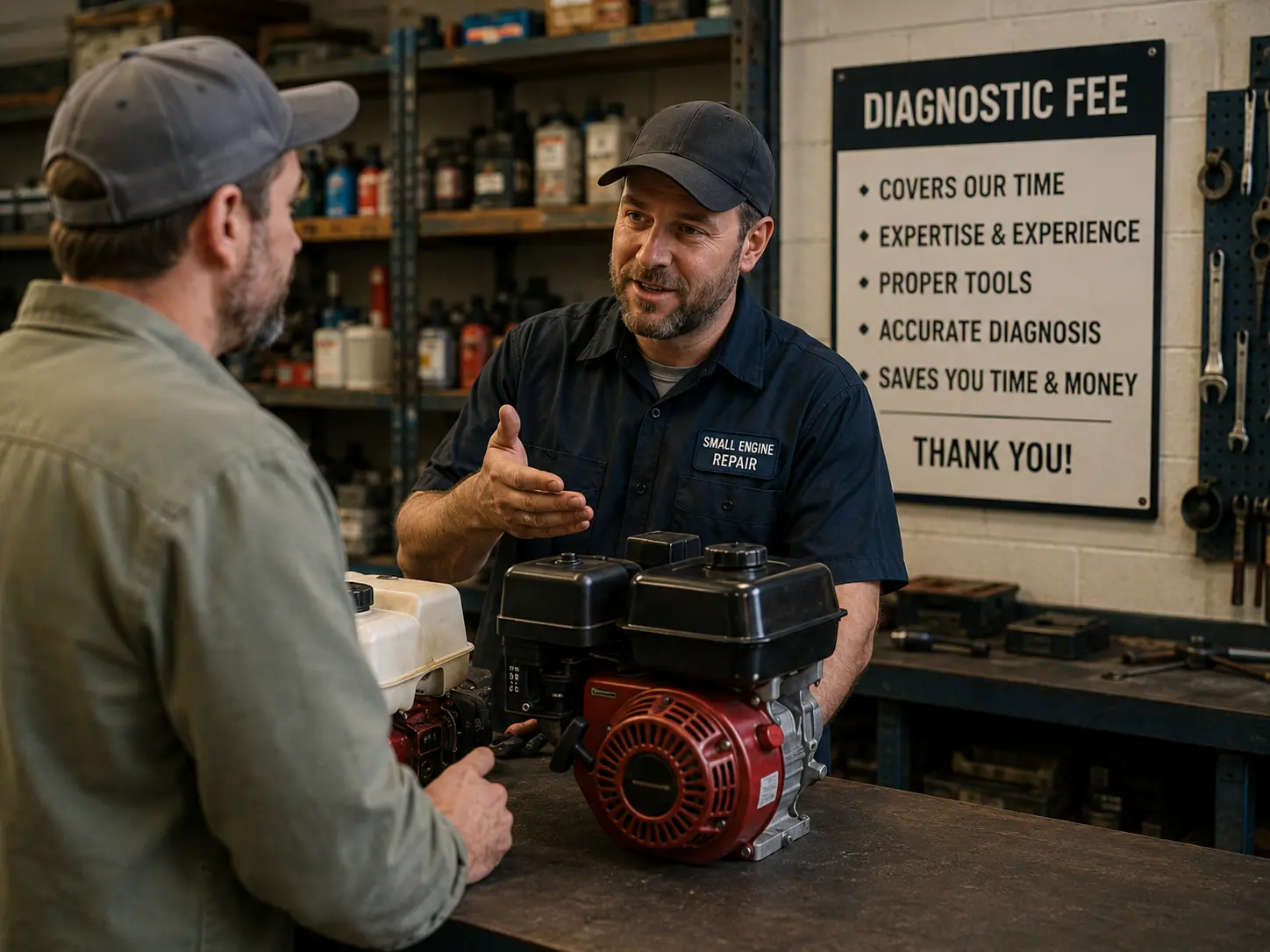
Before dropping off:
- Ask whether the shop charges a diagnostic fee and what it covers.
- Ask whether the fee is applied to the repair if you authorize.
- Get the policy verbally confirmed — most reputable shops are straightforward about this.
At dropoff:
- Describe the symptom clearly: when did the problem start, what changed, what you have already tried.
- More context means faster diagnosis, which means lower labor time.
After diagnosis:
- You are not obligated to authorize the repair. If the quote is too high or you want a second opinion, you pay the diagnostic fee and take the equipment.
- If you decline and take it to another shop, that shop will likely charge their own diagnostic fee — so factor this into whether a second opinion is worth it.
Typical diagnostic fee ranges by equipment
| Equipment | Typical diagnostic fee |
|---|---|
| Push mower | $20–$40 |
| Riding mower / zero-turn | $35–$65 |
| Chainsaw | $20–$40 |
| Generator (portable) | $30–$60 |
| Snowblower | $25–$50 |
| Pressure washer | $25–$50 |
These ranges reflect typical independent shop rates. Authorized dealers for Stihl, Husqvarna, and Generac may charge at the higher end of the range or higher, reflecting higher labor rates and brand-specific diagnostic tools.
Finding shops that are upfront about fees
Before dropping off equipment, a quick phone call asking "do you charge a diagnostic fee?" tells you a lot about how the shop communicates. A shop that is straightforward about fees is typically straightforward about everything else.
smallengine.directory is an independent repair-shop directory. Pricing and fee policies vary by shop and region. Always confirm fee structure directly with the shop before dropping off equipment.