Small Engine Repair Minimum Charge: What to Expect
You bring in a chainsaw with a bad spark plug. Total parts cost: $6. But the invoice comes back at $55. What happened?
You hit the shop minimum. Most small engine shops have a minimum charge — often $40–$80 — that applies regardless of how simple or fast the job is. Understanding why this exists will help you decide when a shop visit makes sense and when to handle small repairs yourself.
Why minimum charges exist
A shop's cost structure is not just parts and wrenches. Every ticket that comes through the door involves:
- Administrative time: Writing up the work order, logging the equipment, calling the customer, preparing the invoice.
- Handling time: Moving the equipment from dropoff to the work bay, staging parts, cleaning up afterward.
- Liability: The shop is accountable for the equipment while it is in their possession. That requires insurance, tracking, and careful handling.
- Overhead per ticket: Rent, utilities, tools, and insurance are costs spread across every job. A shop running 10 jobs per day spreads those differently than one running 50.
Even if the technician spends 15 minutes on a spark plug swap, the shop has invested 45 minutes of total business time to process that ticket. At $45–$95/hour labor, the minimum charge reflects the true cost floor of completing any job.
Typical minimum charges by shop type
| Shop type | Typical minimum charge |
|---|---|
| Independent small engine shop | $40–$80 |
| Authorized Stihl / Husqvarna dealer | $55–$120 |
| Authorized Generac dealer | $65–$150 |
| Big-box repair service (Lowe's, Home Depot) | $60–$100 |
| Farm supply stores with service departments | $35–$75 |
Authorized brand dealers tend to run higher minimums, reflecting higher labor rates and brand-specific overhead (factory-required tooling, technician certification, warranty documentation).
What the minimum typically covers
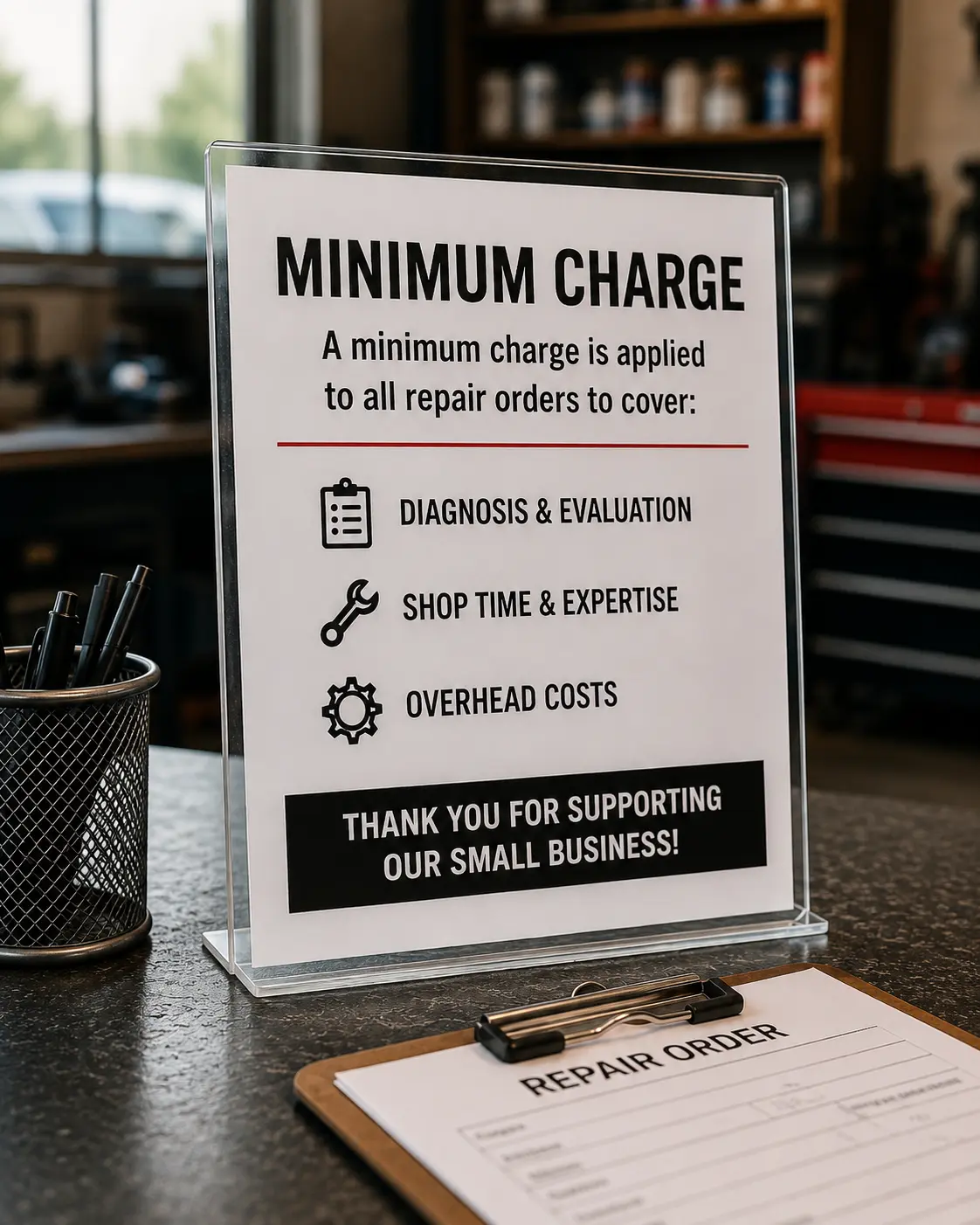
The minimum charge usually includes:
- Inspection and diagnosis of the stated problem
- One billed unit of labor (typically 0.5–1.0 hours)
- Basic safety inspection while the equipment is on the bench
It does not include parts. If the repair requires a part — a spark plug, a primer bulb, a belt — that cost is added on top of the minimum.
Some shops quote the minimum as diagnostic only, and then provide a separate labor charge for the actual repair. Others roll the diagnostic into the minimum, meaning if you authorize the repair, no additional charge is added for the diagnosis time.
Always ask: "Does your minimum include diagnosis, or is diagnosis charged separately?"
When the minimum is worth paying
The minimum is worth it when:
- You genuinely do not know what is wrong. A proper diagnosis from a technician is worth $40–$80 if it correctly identifies the problem and prevents you from buying parts you don't need.
- The equipment is valuable. A $50 minimum on a $2,000 riding mower is a trivial cost.
- You have already tried the obvious fixes. If you have put in fresh fuel, new plug, and clean air filter and it still won't run — the problem is likely internal, and a shop's diagnostic equipment and experience adds real value.
The minimum is not worth it when:
- The repair is straightforward and you can do it yourself. A spark plug swap, air filter replacement, oil change, and blade sharpening are all homeowner-serviceable tasks with YouTube tutorials and parts available at any hardware store. Paying a shop minimum for a $6 plug makes no economic sense.
- The equipment's replacement cost is close to the minimum. A push mower worth $80 that needs an unknown repair probably should not go to a shop charging a $65 minimum plus parts.
How to reduce what you pay at a shop
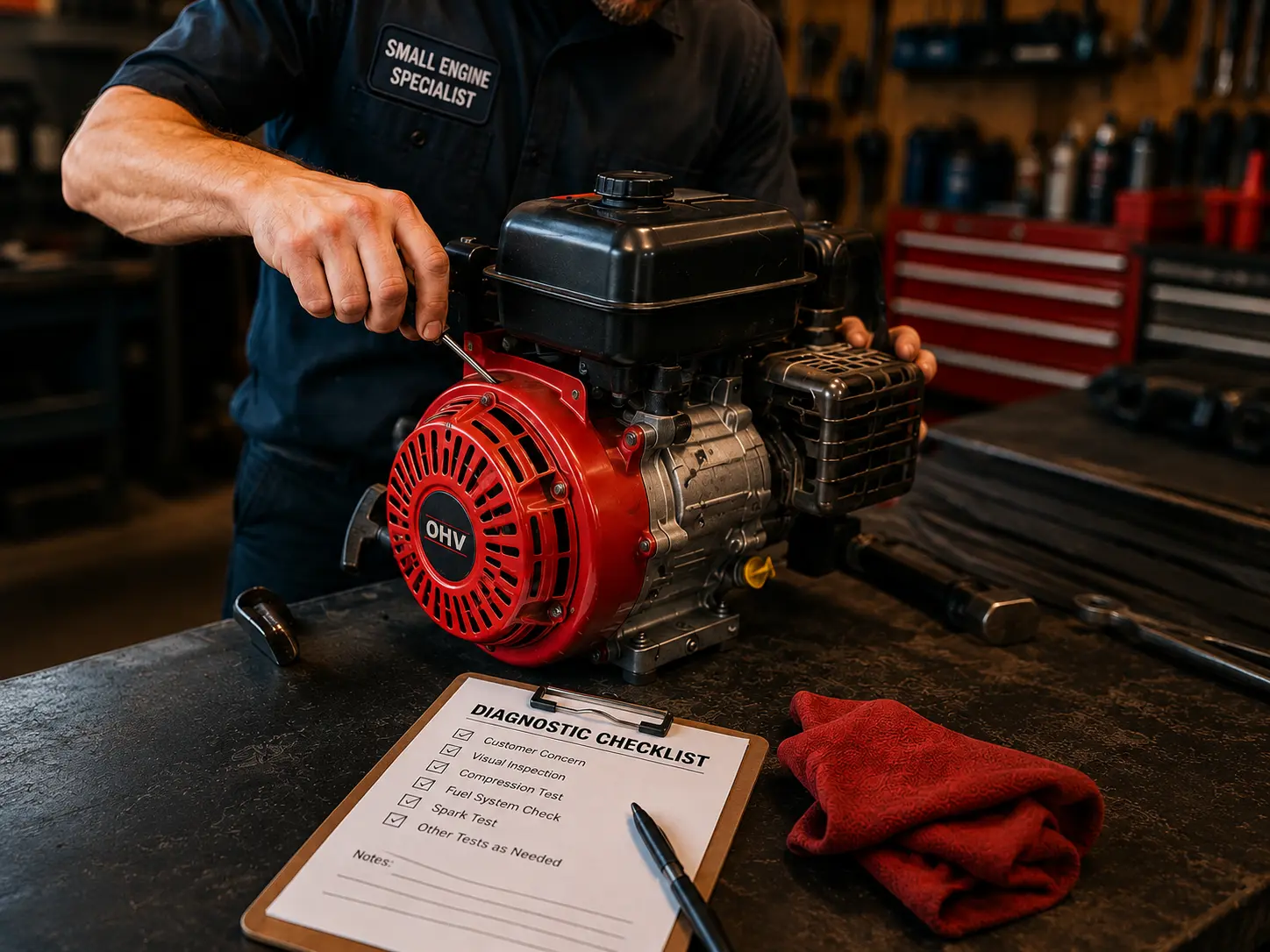
1. Diagnose before you drop off. If you can describe the specific failure — "carburetor bowl has varnish, float is stuck" — the shop skips part of the diagnostic step. Some shops reduce the labor estimate when the problem is pre-identified.
2. Bring it in during off-season. Many small engine shops have faster turnaround and are more flexible on pricing in the off-season (late fall for mowers, summer for snowblowers). Shops running at 30% capacity have more room to work with on ticket minimums than shops managing a two-week backlog in spring.
3. Ask about bundling. If you have two machines that need work, some shops will reduce the per-ticket overhead when both come in at once.
4. Do the simple stuff first. Fresh fuel, new spark plug, clean air filter — these fix the majority of no-start problems and cost under $20 in parts. Confirm these are not the issue before paying a shop minimum.
Minimum charge vs flat-rate pricing
Some shops publish flat-rate pricing for common jobs:
| Common flat-rate jobs | Typical range |
|---|---|
| Spark plug replacement | $20–$40 (labor only) |
| Air filter replacement | $15–$30 (labor only) |
| Carburetor cleaning | $60–$120 |
| Full tune-up (push mower) | $80–$150 |
| Blade sharpen | $15–$35 |
Flat-rate shops sometimes eliminate the minimum by folding it into the flat rate. If the plug swap is quoted at $35 flat, you know exactly what you are paying.
Ask shops upfront whether they charge flat rates for common jobs or time-and-materials. For simple work, flat-rate is usually predictable and fair.
smallengine.directory is an independent repair-shop directory. Pricing policies vary significantly by shop and region. Always confirm fee structure directly with the shop before authorizing work.