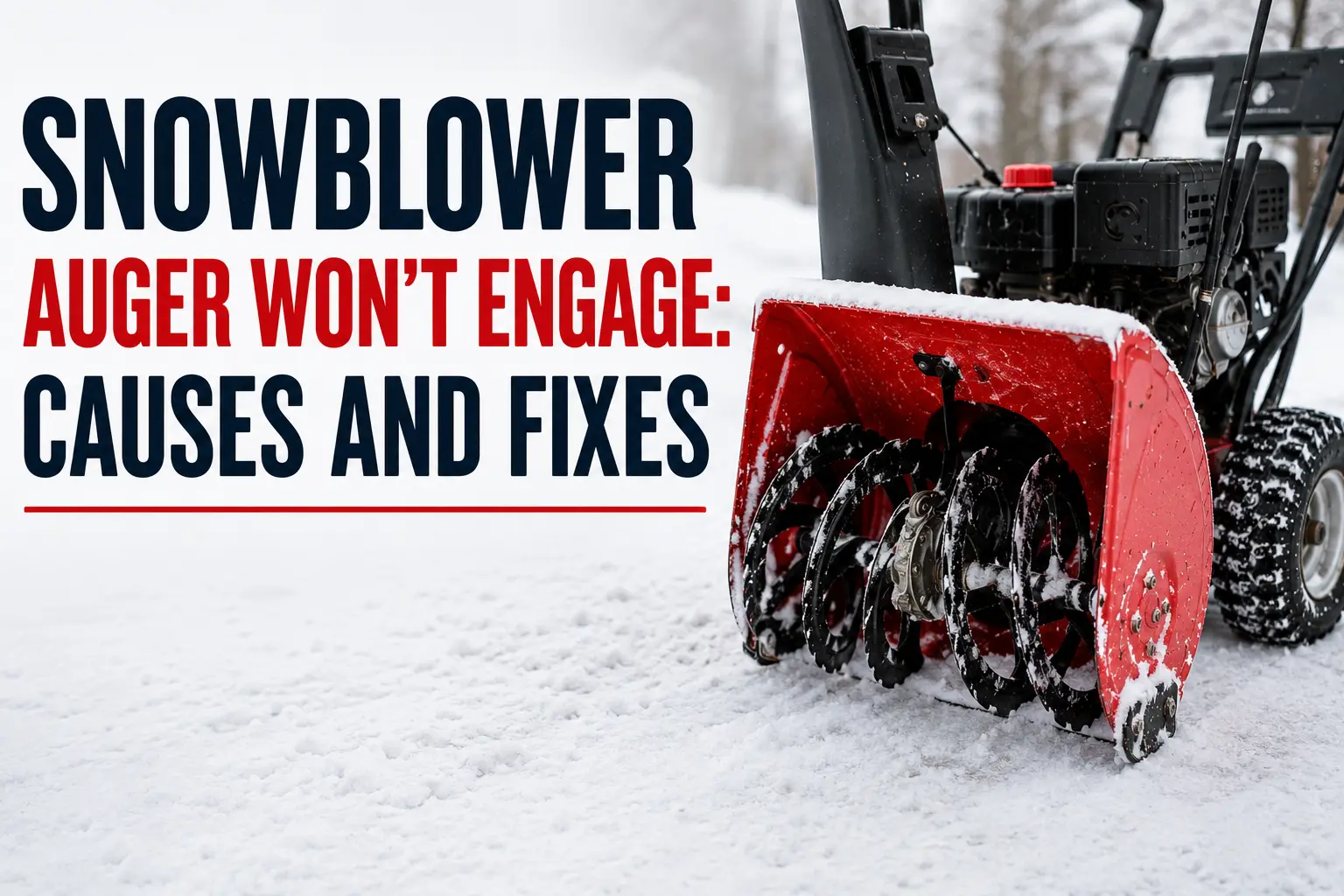
Snowblower Auger Won't Engage: Causes and Fixes
The engine starts and runs fine. You squeeze the auger engagement lever, and nothing happens. The auger sits motionless while snow piles up in front of the machine.
This is one of the more common snowblower problems, and unlike an engine that won't start, it has a relatively short list of causes. Most of them are diagnosable without any special tools, and some are fixable in under 10 minutes in the driveway. Here's how to work through them.
Use the interactive snowblower auger diagnostic to narrow the likely failure from what moves, what does not, and what happened before the auger stopped.
How the auger drive system works
Before diagnosing the problem, it helps to understand how power gets from the engine to the auger. The basic path in a two-stage snowblower:
Engine crankshaft → drive belt → auger gearbox → auger shaft → shear bolts → auger flights
Single-stage snowblowers are simpler — the auger is typically driven directly by the engine through a belt, without a separate gearbox.
A failure anywhere in this chain stops the auger. The location of the failure determines what you'll find and how difficult the fix is.
Cause 1: Broken shear bolts (most common, easiest fix)
Shear bolts are the sacrificial weak point in the system by design. They connect the auger flights to the auger shaft, and they're engineered to snap if the auger hits a rock, a chunk of ice, or anything too hard to pass through. When a shear bolt breaks, the auger shaft spins freely inside the auger housing — the flights don't turn.
This is the first thing to check because it's the most common cause and takes five minutes to confirm.
How to check:
Look at the auger from the front of the machine. You'll see one or two bolts on each auger flight where the flight meets the shaft. On most machines, broken shear bolts are obvious — the bolt is visibly snapped, sheared off flush, or missing entirely, sometimes with the remains still in the hole.
Try to rotate each auger flight by hand. If a flight spins freely on the shaft with no resistance, the shear bolt for that flight is gone.
The fix:
Replace the shear bolts with the correct grade. This is critical: shear bolts are intentionally softer than standard hardware bolts so they break before the gearbox does. Using a regular grade-5 or grade-8 bolt instead of the specified shear bolt defeats the purpose and risks gearbox damage the next time you hit something hard.
The correct shear bolt specifications are in your owner's manual and usually printed on a label near the auger housing. They're sold at most hardware stores and any small engine dealer. Ariens, Toro, and most major brands use 5/16-18 shear bolts, but confirm yours before buying.
Keep a pack of spares in the snow blower's storage compartment or garage. A broken shear bolt mid-storm is a two-minute fix if you have the parts. Without them, you're done for the night.
Cause 2: Worn or broken auger belt
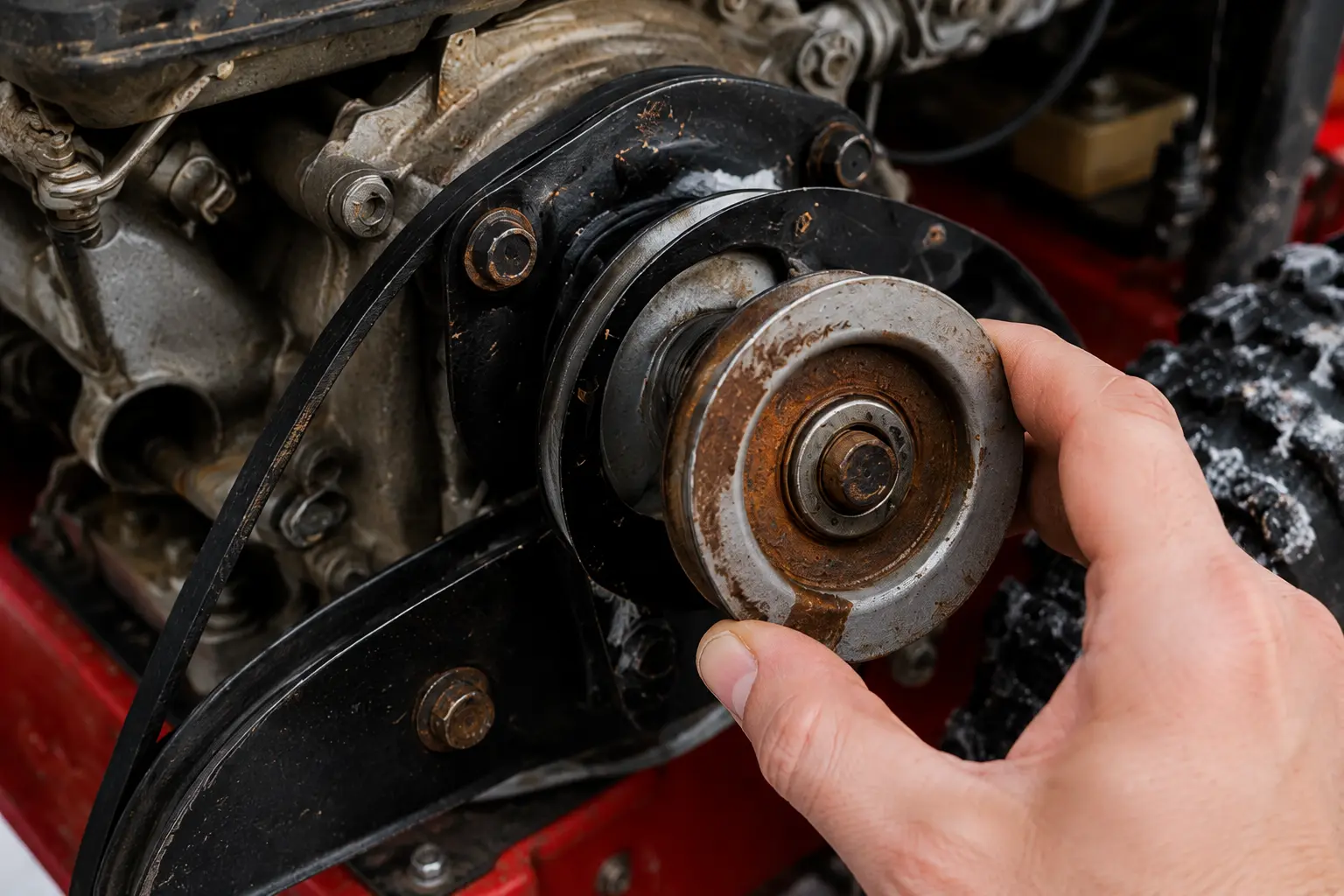
The belt that drives the auger stretches, glazes, and eventually cracks or breaks with use. A belt that's slipping won't transfer full power to the auger — the auger may spin weakly or only under light load. A broken belt means no auger movement at all.
How to check:
On most two-stage snowblowers, the auger belt is accessible by removing a panel on the back or side of the machine (usually 3-6 screws). With the panel off, you can see the belt directly. Look for:
- Visible cracking or fraying on the belt surface
- Glazed or hardened appearance — a healthy belt is slightly flexible and matte; a worn belt looks shiny and feels stiff
- The belt lying slack in the drive path — if it's broken, one end will have fallen off the pulleys
- Proper tension — with the auger lever disengaged, the belt should have some slack. With the lever engaged, the belt should tighten. If it stays slack when engaged, the engagement mechanism isn't pulling the belt tight
The fix:
Belt replacement is a moderate DIY repair. The procedure varies significantly by brand and model — on some machines it's straightforward, on others it requires removing the auger housing. Look up the specific procedure for your model before starting.
Replacement belts are available from small engine dealers and online suppliers. Use the OEM belt number from your owner's manual — aftermarket belts may be close in size but slightly different in profile, which affects how they grip the pulleys.
If you're not comfortable with belt replacement, this is a reasonable shop job. Most independent shops can replace a snowblower auger belt in under an hour.
Cause 3: Auger engagement cable stretched or disconnected
The auger engagement lever on the handlebar connects to the auger clutch via a cable. When you squeeze the lever, the cable pulls a tensioner pulley that tightens the belt against the drive pulley. If the cable is stretched, broken, or disconnected from one of its attachment points, squeezing the lever doesn't actually engage the belt.
How to check:
Squeeze the auger engagement lever and watch what happens at the engine end. On most machines, you can see the cable pull a pivot arm or tensioner pulley. If squeezing the lever produces no visible movement at the engagement mechanism, the cable isn't transmitting force.
Check both ends of the cable: the lever attachment at the handlebar and the tensioner attachment near the engine. Cables sometimes pop off their attachment hooks, especially after the machine has been jostled in transport or storage.
Also check cable tension. Most auger engagement cables have an adjustment barrel near the lever or near the engine that lets you take up slack. If the cable has stretched significantly, the lever may feel like it's pulling but not actually reaching full engagement travel.
The fix:
A disconnected cable end is a 5-minute fix — pop it back into the attachment point and test. A stretched cable can often be corrected with the adjustment barrel. A frayed or broken cable needs replacement, which is similar in difficulty to belt replacement.
Cause 4: Auger engagement lever not reaching full travel
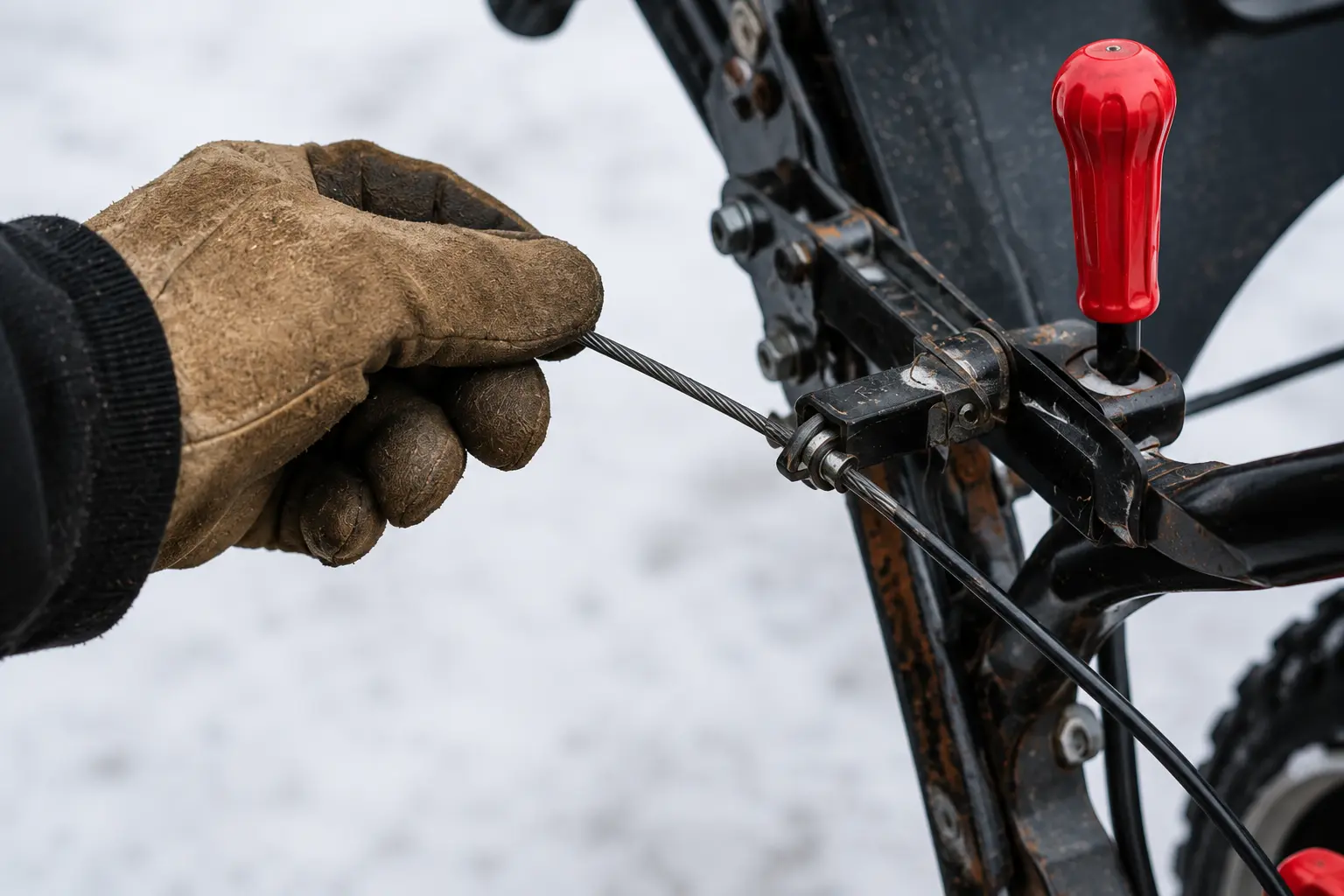
This is a variant of the cable problem, but caused by the lever mechanism itself rather than the cable. If the lever pivot is frozen with rust or dirt, or if the lever stop is bent, the lever may not travel far enough to fully engage the belt.
How to check:
Squeeze the auger lever and confirm it travels all the way to the handlebar and locks in position (on machines with a lock-out feature). If it stops short or requires unusual force, the lever pivot needs lubrication or inspection.
The fix:
Spray penetrating oil (WD-40, PB Blaster) on the lever pivot and work it back and forth. In most cases, this frees a stuck pivot quickly. If the lever stop is physically bent, straighten it carefully with pliers.
Cause 5: Gearbox failure (least common, most expensive)
The auger gearbox is the assembly that transfers power from the belt to the auger shaft and changes the rotational direction. Gearbox failures are relatively uncommon — the shear bolt system exists specifically to protect the gearbox from damage — but they do occur, especially on older machines or after a major impact.
Signs of gearbox trouble: the belt is intact and properly tensioned, the engagement cable is working, but the auger still doesn't turn, or turns with a grinding sound and then stops.
How to check:
With everything else ruled out, have a shop check the gearbox directly. Internal gearbox failure requires disassembly to confirm. Don't try to diagnose it by forcing the auger to turn — if the gearbox is damaged, forcing it makes it worse.
The fix:
Gearbox repair or replacement is the most expensive auger-related fix. A replacement gearbox runs $80-200 depending on the brand and model. Labor adds to that. On an older machine or a low-end consumer unit, gearbox failure can make the repair vs. replace question worth revisiting — see the overall snowblower repair vs. replace analysis in snowblower repair vs replace for the framework.
Diagnostic order summary
Work through these in order — you're going from simplest to most complex:
- Check shear bolts first — visible, instant confirmation, $5 fix if that's the problem
- Inspect the belt — remove the access panel, look for wear, breakage, or improper tension
- Trace the engagement cable — confirm both ends are attached and cable has correct tension
- Check lever travel — confirm the lever reaches full engagement position
- If all of the above check out, have a shop inspect the gearbox
Most auger problems are shear bolts or belts. If you find a broken shear bolt and replace it, test before assuming the job is done — sometimes a hard impact that broke the shear bolt also damaged the belt. Check both.
When to call a shop
Any of the above can be repaired at home if you're comfortable with basic mechanical work. Take the machine to a shop if:
- You've replaced the shear bolts and they keep breaking (indicates something in the auger path is causing repeated impacts, or the replacement bolts are too hard)
- The belt replacement requires auger housing removal on your specific model and you're not comfortable with that level of disassembly
- You've ruled out shear bolts, belt, and cable and suspect gearbox damage
To find a snowblower repair shop near you, use the search below. If the season is approaching, call ahead — shops get backed up quickly once snow starts falling.
This guide covers two-stage and single-stage gas-powered snowblowers. Electric snowblowers have different drive systems and aren't covered here. Always disconnect the spark plug wire before working near the auger.