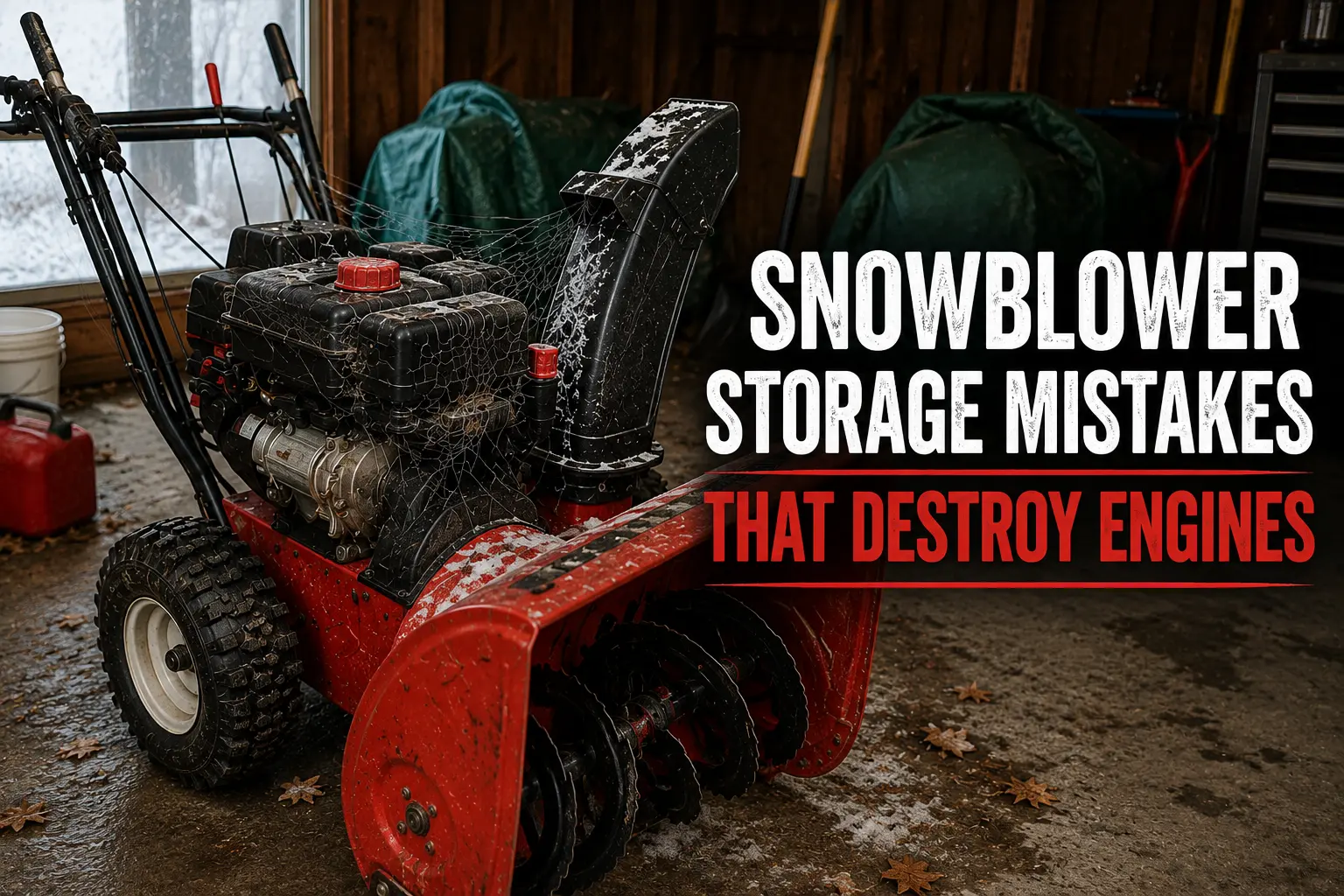
Snowblower Storage Mistakes That Destroy Engines
The most common reason snowblowers end up in a repair shop has nothing to do with how hard they were used during the winter. It has to do with how they were stored during the eight months they sat in the garage.
Fuel goes bad. Gaskets dry out. Mice find their way in. A machine that ran perfectly in February can be completely non-functional by October if it was put away wrong. The repairs that result — gummed carburetors, cracked fuel lines, fouled cylinders — are almost entirely preventable.
Here are the mistakes that cause the most damage, and what to do instead.
Mistake 1: Leaving fuel in the tank
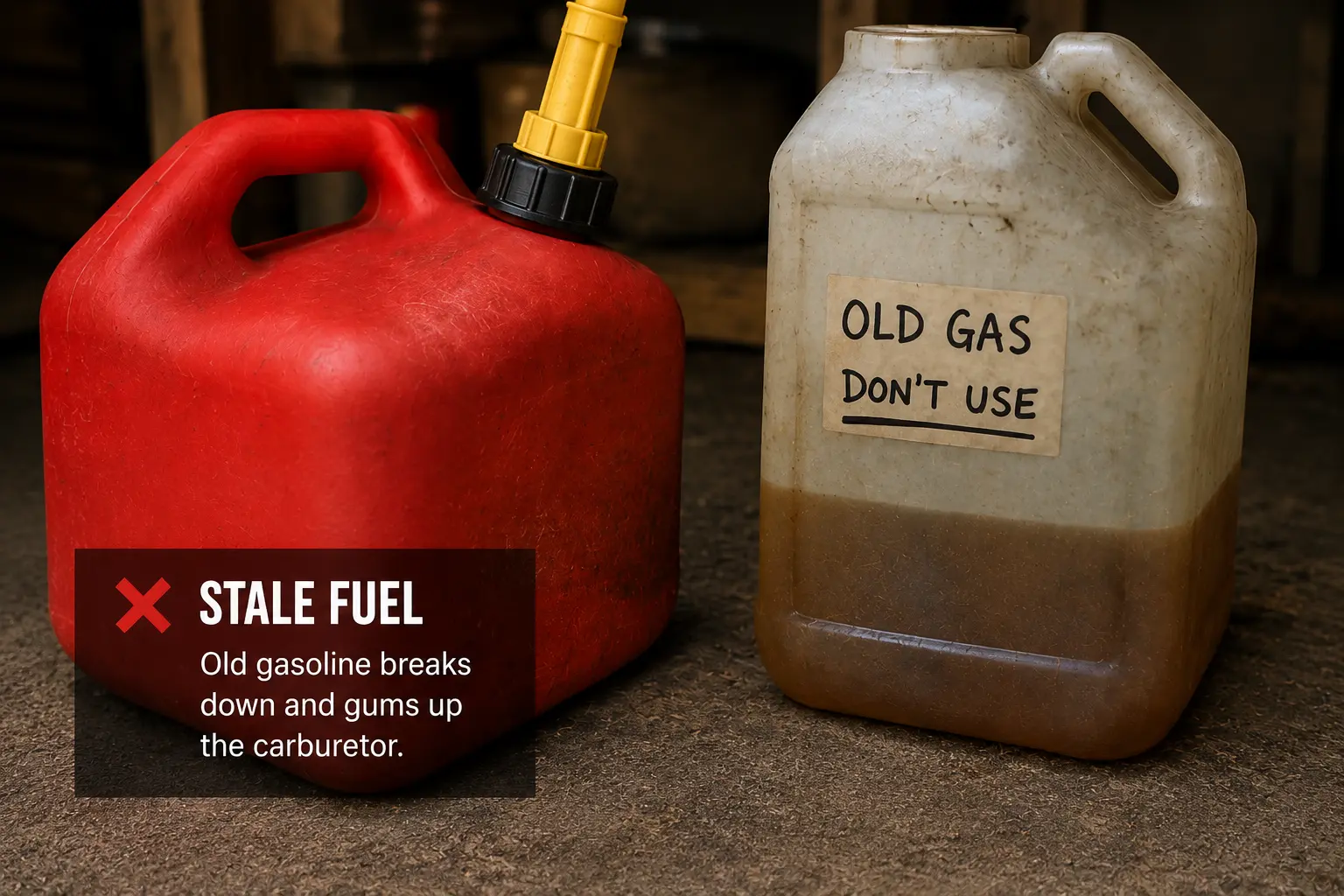
This is the single most common cause of snowblower engine failure. Gasoline begins to degrade within 30 days. The lighter, more volatile compounds that make fuel ignite easily evaporate first, leaving behind a heavier residue that thickens and eventually turns into a sticky varnish. By the time you go to start the snowblower in October, that varnish is coating the inside of the carburetor, blocking the tiny passages that meter fuel into the engine.
The result: the engine cranks but won't start, or starts briefly and dies, or runs roughly and surges. Cleaning a carburetor that's been varnished costs $100-200 at most shops. Replacing one that's beyond cleaning costs more.
What to do instead:
You have two options, and both work.
Option 1: Run the fuel out completely at the end of the season. With the fuel valve turned off, let the engine run until it stalls from fuel starvation. This drains the carburetor bowl and the fuel lines. Then drain the tank with a hand pump or by tipping the unit if it's small enough.
Option 2: Add a fuel stabilizer to a full tank and run the engine for 10 minutes to distribute it through the fuel system. Products like Sta-Bil or Sea Foam extend fuel life to 12-24 months when used at the correct dose. This is the better option if you want a ready-to-start machine at the beginning of next season — you don't have to add fresh fuel, just pull the cord.
Do not do neither. Leaving untreated fuel in the tank from March to October is the single fastest way to guarantee a repair bill.
Mistake 2: Using ethanol-blended fuel without stabilizer
Most pump gasoline in the United States contains up to 10% ethanol (E10). Ethanol absorbs moisture from the air, and over time, that moisture separates from the fuel and sinks to the bottom of the tank — a process called phase separation. The water-ethanol layer at the bottom can corrode metal components, damage rubber fuel lines and gaskets, and cause the carburetor to rust from the inside.
Small engines are particularly vulnerable because they sit for long periods. A car burns through fuel fast enough that phase separation rarely has time to occur. A snowblower sitting for eight months is a different story.
What to do instead:
Use ethanol-free gasoline (often labeled as recreational fuel or E0) when available. Many marina and small engine dealers carry it. It costs more per gallon but can sit in the tank significantly longer without degrading.
If ethanol-free fuel isn't available, use a fuel stabilizer with ethanol treatment (Sta-Bil 360 is formulated for this) and don't let the fuel sit beyond 90 days without either running the engine or draining the tank.
Mistake 3: Skipping the oil change before storage
Used engine oil is acidic. Over a season of operation, combustion byproducts — including carbon, acids, and moisture — accumulate in the oil. If you store the engine for eight months with used oil in the crankcase, those acids sit in contact with internal metal surfaces the entire time, slowly corroding bearings, cylinder walls, and other components.
This damage is cumulative and invisible until it isn't. A snowblower that's had its oil changed every season before storage will outlast one that hasn't by years.
What to do instead:
Change the oil at the end of the season, not the beginning. Fresh oil has full additive protection and no accumulated acids. Run the engine briefly after the change so fresh oil circulates through all internal surfaces before storage.
Check your owner's manual for the correct oil grade. Most four-cycle snowblower engines call for SAE 5W-30 in cold weather conditions, though some manufacturers specify 10W-30. Running the wrong viscosity doesn't cause immediate damage but isn't ideal.
Note: two-cycle engines (less common in snowblowers, more common in older units and some string trimmers) don't have a separate oil reservoir — oil is mixed directly with the fuel. There's no oil change to do, but the fuel mixture still needs to be managed at storage time.
Mistake 4: Not fogging the cylinder
Even with fresh oil in the crankcase, the cylinder walls above the piston aren't bathed in oil during storage. Over months, that bare metal can develop surface rust — especially in humid climates or if the snowblower is stored in an unheated space where temperature swings cause condensation.
Cylinder wall rust isn't always catastrophic. Light surface rust often wipes away on the first start. But it accelerates ring wear and increases blow-by over time.
What to do instead:
Before storage, remove the spark plug. Spray a shot of fogging oil (or a few drops of fresh engine oil) directly into the spark plug hole. Pull the recoil cord two or three times slowly to distribute the oil over the cylinder walls. Reinstall the plug. This takes two minutes and provides a protective oil film on the cylinder for the entire storage period.
Mistake 5: Storing it with the parking brake off (or belts engaged)
Some two-stage snowblowers have drive belts that can take a set — a permanent curve or flat spot — if stored under tension for months. A belt that's been sitting compressed in one position can slip, squeal, or fail prematurely when put back under load.
What to do instead:
Consult your owner's manual for storage-specific recommendations. Many manufacturers suggest releasing belt tension for long-term storage. On Ariens units, for example, there's a specific belt disengagement procedure for storage. If your manual doesn't address it, storing the unit in neutral with no tension on the drive engagement is the safe default.
Mistake 6: Leaving it outdoors or in a damp space
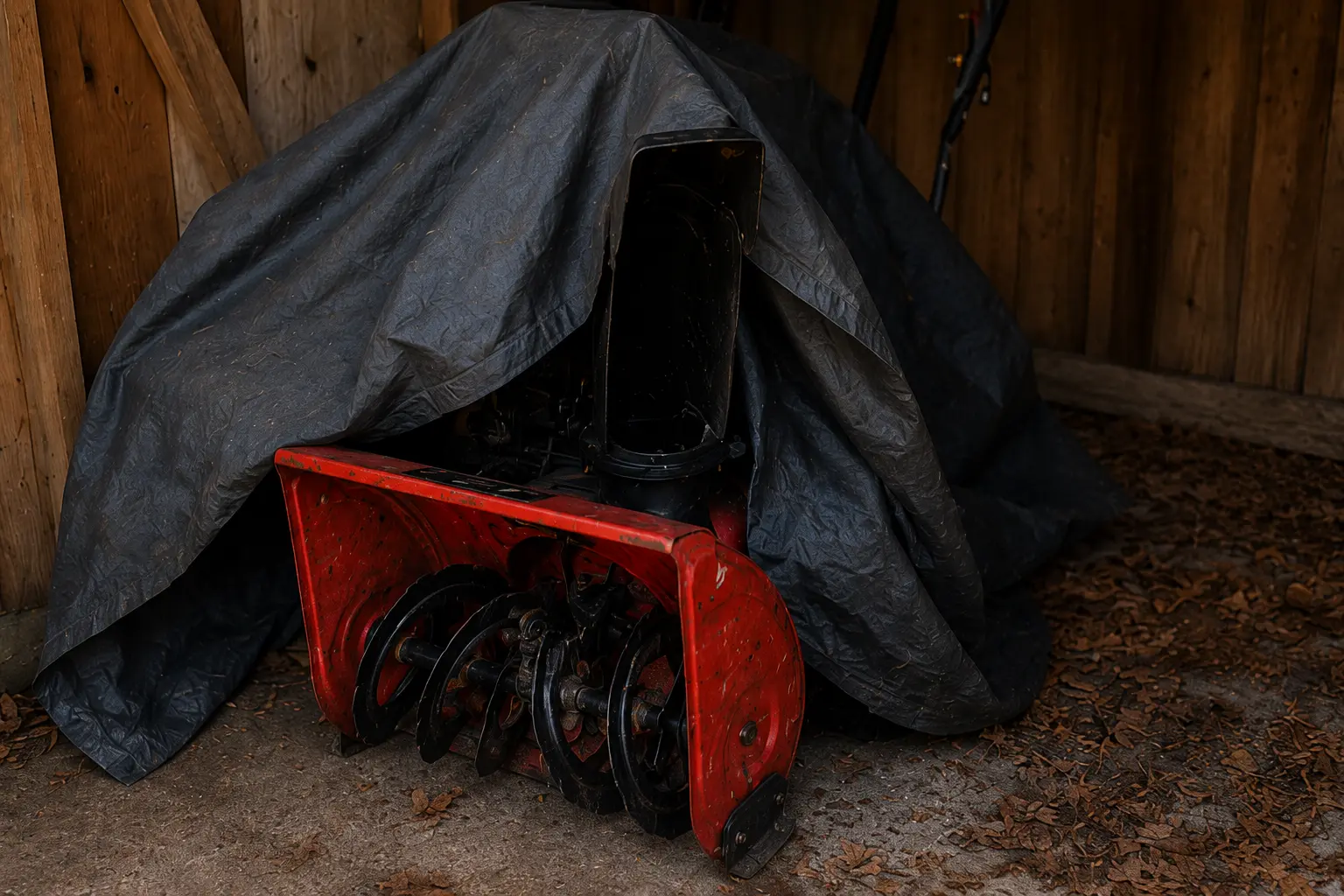
Moisture is the enemy of small engines in storage. Rust forms on exposed metal surfaces, rubber components dry and crack, and fuel systems absorb atmospheric moisture. A snowblower stored outdoors under a tarp gets wet every rain, and tarps concentrate moisture underneath through condensation.
What to do instead:
Store the snowblower indoors — in a garage, shed, or basement — with at least some protection from direct moisture. If indoor storage isn't possible, use a breathable cover (not plastic) and elevate the unit off concrete if possible. Concrete wicks moisture.
If you're storing in a garage or shed that gets very cold, this is actually fine for the engine — cold doesn't damage a properly prepared engine. What damages it is temperature cycling (warm days, cold nights) combined with moisture.
Mistake 7: Not checking for mice
This one is specific to snowblowers and other equipment stored for long periods. Mice find small engines extremely attractive for nesting. The air filter housing, the engine shroud, and the carburetor area are warm, protected spaces that provide excellent nesting material from the foam air filter and any insulation they can find.
Mouse nests inside an engine shroud are a fire hazard. Chewed wiring causes hard-to-diagnose electrical problems. Nesting material packed around the carburetor can prevent the choke from closing.
What to do instead:
Before storing, place mouse traps or a rodent deterrent near the snowblower. Steel wool stuffed into the exhaust pipe (remove it before starting next season) prevents mice from entering that way. Dryer sheets placed near (not inside) the engine compartment are a commonly used deterrent, though their effectiveness is debated.
Before starting the snowblower for the first time each season, lift the engine shroud and look inside. If you find a nest, remove it completely before starting. Running the engine with a nest inside is a genuine fire risk.
Mistake 8: Ignoring the shear bolts
Shear bolts are the sacrificial bolts that connect the auger to the auger shaft. They're designed to break if the auger hits something hard, protecting the more expensive gearbox and transmission from damage. Most snowblowers come with spare shear bolts in the tool kit, but many owners never check whether spares are on hand.
Going into storage with broken or missing shear bolts means you'll find out you need them mid-storm, when hardware stores may be closed.
What to do instead:
At end of season, check the shear bolts. They should be intact and properly torqued. Buy a package of replacements and store them with the snowblower — the correct bolt size is in the owner's manual or on the manufacturer's website.
The end-of-season checklist
Done properly, storing a snowblower for the season takes about 30-45 minutes:
- Drain the fuel or add stabilizer and run the engine 10 minutes
- Change the engine oil while the engine is warm
- Remove the spark plug, add fogging oil, reinstall the plug
- Inspect and replace the air filter if dirty
- Check shear bolts and confirm spares are on hand
- Inspect belts and cables for visible wear or fraying
- Clean off snow residue, mud, and salt from the housing
- Lubricate all pivot points, cable ends, and wheel axles per the owner's manual
- Release belt tension if your manual specifies it
- Store indoors or under a breathable cover, elevated off concrete
A snowblower that gets this treatment will start on the second or third pull next October. One that doesn't will give you a Monday morning in November, a foot of snow on the driveway, and a repair shop's phone number.
This guide applies to four-cycle single-stage and two-stage snowblowers. Two-cycle engine models have different fuel and oil requirements — consult your owner's manual. For a related guide on timing your service work, see best time to service your snowblower.