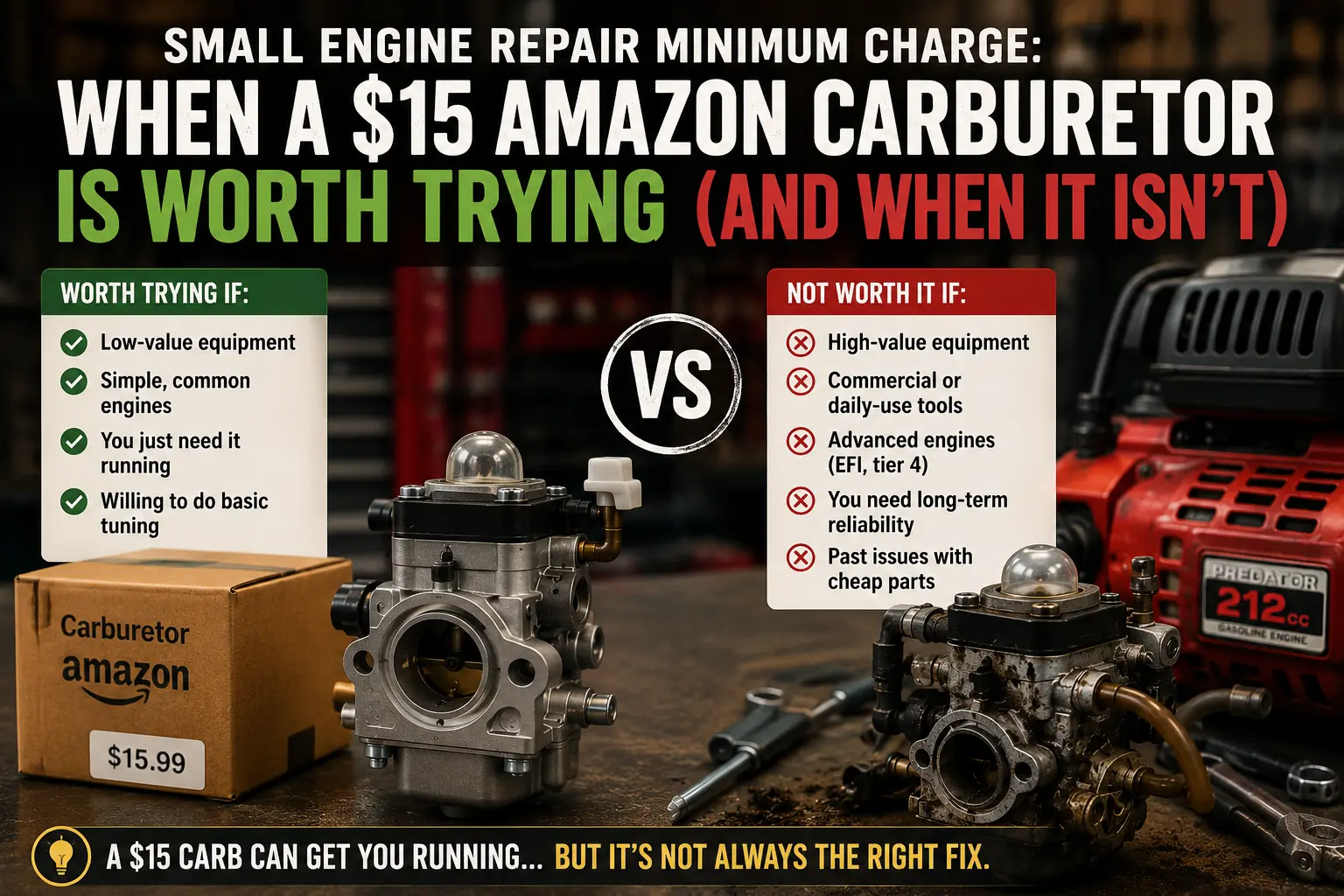
When a $15 Amazon Carburetor Is Worth Trying (And When It Isn't)
Search Amazon for "Honda GCV160 carburetor" and you will find options ranging from $14 to $120. The $14 one and the $120 one both claim to fit the same engine. What is actually different between them, and when does the cheap one make sense?
This is a genuine question that small engine shops get asked regularly — and the honest answer is: it depends on the engine and what you are trying to accomplish.
This guide includes some Amazon Associate links. We earn a small commission on qualifying purchases at no extra cost to you, and we only link products we'd recommend to a neighbor.
What aftermarket carburetors are (and aren't)
An aftermarket carburetor is manufactured to the same external dimensions as the OEM part but by a third-party supplier — typically in China. The body fits the engine. The jets are sized to approximately the OEM specification. The float, needle, and seat are present.
What varies: jet accuracy, materials quality, machining tolerances on internal passages, and finish quality of the needle seat. These differences rarely matter on a low-demand homeowner engine run 50 hours per season. They matter more on commercial engines run 500–1,000+ hours per season, and on precision-tuned engines where fuel metering tolerances are tight.
The $15 aftermarket carb is not a fraud. It is a cost-appropriate part for certain applications — and a poor choice for others.
Worth-trying product box
When it is worth trying
1. The engine is old and low-value
If you have a 12-year-old push mower worth $100–$150 and the carburetor needs replacement, spending $120 on an OEM carb makes no economic sense. A $15–$25 aftermarket carb gets the engine running again for another few seasons at a fraction of the engine's value.
This is the clearest case. The repair is economically proportionate to the machine's remaining useful life.
2. You have already confirmed the carb body needs replacement
Before buying any carburetor, cleaning should be the first step. A dirty carb that just needs cleaning is not a carb that needs replacing. See the guide on carburetor clean vs replace for the decision framework.
If you have cleaned the carb thoroughly — spray cleaner, soak, compressed air through every passage — and the engine still runs poorly, and you have inspected the carb body and found it damaged (cracked, corroded, worn throttle shaft), then replacement is appropriate. An aftermarket carb at $15–$25 is a reasonable choice in this situation.
3. The engine is a Honda GCV or common Briggs Quantum
Honda GCV160 and GCV190 engines are the most-used small engines in the world and are installed on hundreds of mower, pressure washer, and rototiller models. Aftermarket carbs for these engines are well-established — many suppliers have shipped millions of units, and the designs have been refined over many iterations.
For a GCV160 engine, a rebuild kit (like this Honda GCV160/GCV190 carburetor kit) is often the better option before committing to a full carb replacement — the kit replaces the internal wear parts (needle, seat, gaskets) for $10–$20 and fixes most failure modes without needing a new carb body. But if the body itself is compromised, a full replacement carb is a reasonable next step.
4. You are comfortable doing the installation yourself
An aftermarket carb that needs adjustment to run correctly — enriching the pilot jet slightly, adjusting the float level — requires some mechanical comfort. If you have never rebuilt a carburetor and are not comfortable adjusting a mixture screw or float height, an aftermarket carb that arrives slightly out of spec can be more frustrating than it is worth. A shop (or a more experienced DIYer) can make those adjustments, but add that variable to your decision.
When to avoid the aftermarket carb
1. Commercial or professional equipment
If the equipment runs daily — landscaping company mowers, generator sets in regular use, commercial chainsaws — the precision and durability difference between OEM and aftermarket carbs matters. Commercial equipment earns revenue. Downtime is expensive. Use OEM.
2. Stihl or Husqvarna chainsaws and outdoor equipment
Stihl and Husqvarna use proprietary carburetor designs (typically Walbro or Zama brand) where the jet sizes are tuned to the specific engine's performance. Aftermarket copies are available but the quality and tunability vary more than on simpler Honda/Briggs engines. For in-warranty equipment, an OEM carb is required. For out-of-warranty Stihl or Husqvarna, an OEM or genuine Walbro/Zama carb is worth the price premium over generic alternatives.
3. You haven't tried cleaning first
Buying a new carb before cleaning is almost always premature. Cleaning costs $5–$10 in supplies and an hour of time. It fixes the majority of no-start and runs-rough problems caused by stale fuel. Replacement carbs — even at $15 — are unnecessary if the existing carb just needs cleaning.
Spray carburetor cleaner through the jets and passages, soak the bowl in cleaner for 10 minutes, blow everything out with compressed air, and reassemble before concluding that replacement is needed.
4. The engine is under warranty
Any manufacturer warranty is void if non-OEM parts are installed and a failure is traced to those parts. If the equipment is under warranty, use OEM — both for the repair and for the peace of mind.
5. The engine has precision fuel mapping (EFI)
Carbureted engines with electronic fuel injection have sensors and mapping that assume precise jet sizing. Aftermarket carbs on these systems can cause rich or lean conditions that trigger fault codes. This is more relevant to newer equipment (riding mowers with EFI, some Kawasaki and Kohler applications). If your engine has an EFI badge or throttle-body injection, this is not a carb issue in the traditional sense.
A realistic walk-through
Here is a common scenario: a 2012 Troy-Bilt push mower with a Honda GCV160 engine. It ran fine last season. This spring, it won't start. You pull the carb, find varnish in the bowl and a clogged main jet.
Step 1: Clean the carb thoroughly. If it starts and runs, done.
Step 2: If cleaning didn't fix it — pull the needle and seat. If the seat is worn, order a rebuild kit. If the body is cracked or corroded, move to step 3.
Step 3: Replace the carb. For a 12-year-old mower worth $150–$200 in trade, an OEM carb at $80–$120 is hard to justify. An aftermarket carb at $15–$25 is proportionate. Order one that is specifically listed for the GCV160, check the jet sizes match (usually 35 for the main jet on these engines), and install.
In this scenario, the $15 aftermarket carb is a reasonable and practical choice.
Bottom line
Aftermarket carbs are a legitimate repair option for older, lower-value engines where the cost of OEM parts exceeds the machine's economic value. They are not the right choice for commercial equipment, Stihl/Husqvarna precision engines, or warranty situations.
The sequence matters: clean first, rebuild if needed, replace only when the body is confirmed damaged. And when you replace, the choice of OEM vs aftermarket should be proportionate to the engine's age, value, and use case.
Manufacturer note: Use of non-OEM parts may affect warranty coverage. Always verify part compatibility with your engine's model number. smallengine.directory is an independent repair-shop directory and is not affiliated with Honda, Briggs & Stratton, Amazon, or any other manufacturer or retailer.