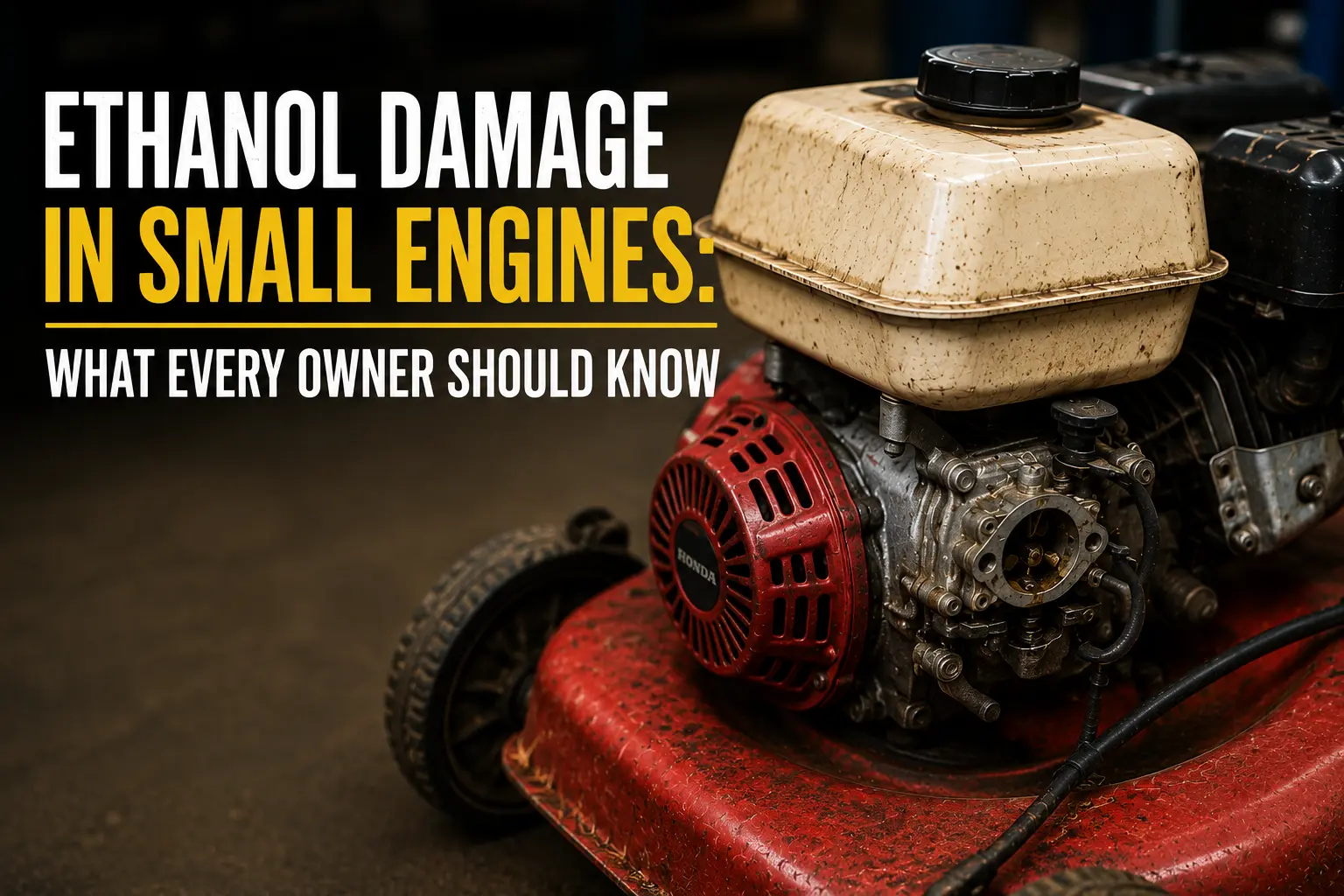
Ethanol Damage in Small Engines: What Every Owner Should Know
The most common cause of small engine carburetor failures isn't age or wear. It's the fuel. Specifically, it's the ethanol blended into virtually all pump gasoline in the United States — and the way that ethanol interacts with small engines that sit unused for weeks or months at a time.
This isn't a niche concern or something that only affects old equipment. Ethanol damage is the single leading cause of preventable small engine repairs, and it affects lawn mowers, snowblowers, generators, chainsaws, and pressure washers across all ages and brands.
What ethanol is and why it's in the fuel
The United States Renewable Fuel Standard requires ethanol to be blended into motor gasoline. The most common blend is E10 — 10% ethanol, 90% gasoline — which is the standard fuel available at most gas stations. Some stations now offer E15 (15% ethanol) and a growing number of flex-fuel stations offer E85 (85% ethanol).
Ethanol is an alcohol derived from corn. It burns cleanly and has a higher octane rating than gasoline, which is why it's used as an additive. For car engines that run continuously and turn over their fuel supply frequently, it's largely benign. For small engines that sit unused for extended periods, it's a significant problem.
How ethanol damages small engines
The damage happens through three mechanisms, each compounding the others.
Phase separation
Ethanol is hygroscopic — it absorbs water from the surrounding atmosphere. In a sealed fuel tank, this happens slowly. In a vented tank (which most small engines have, to prevent pressure buildup), it happens continuously.
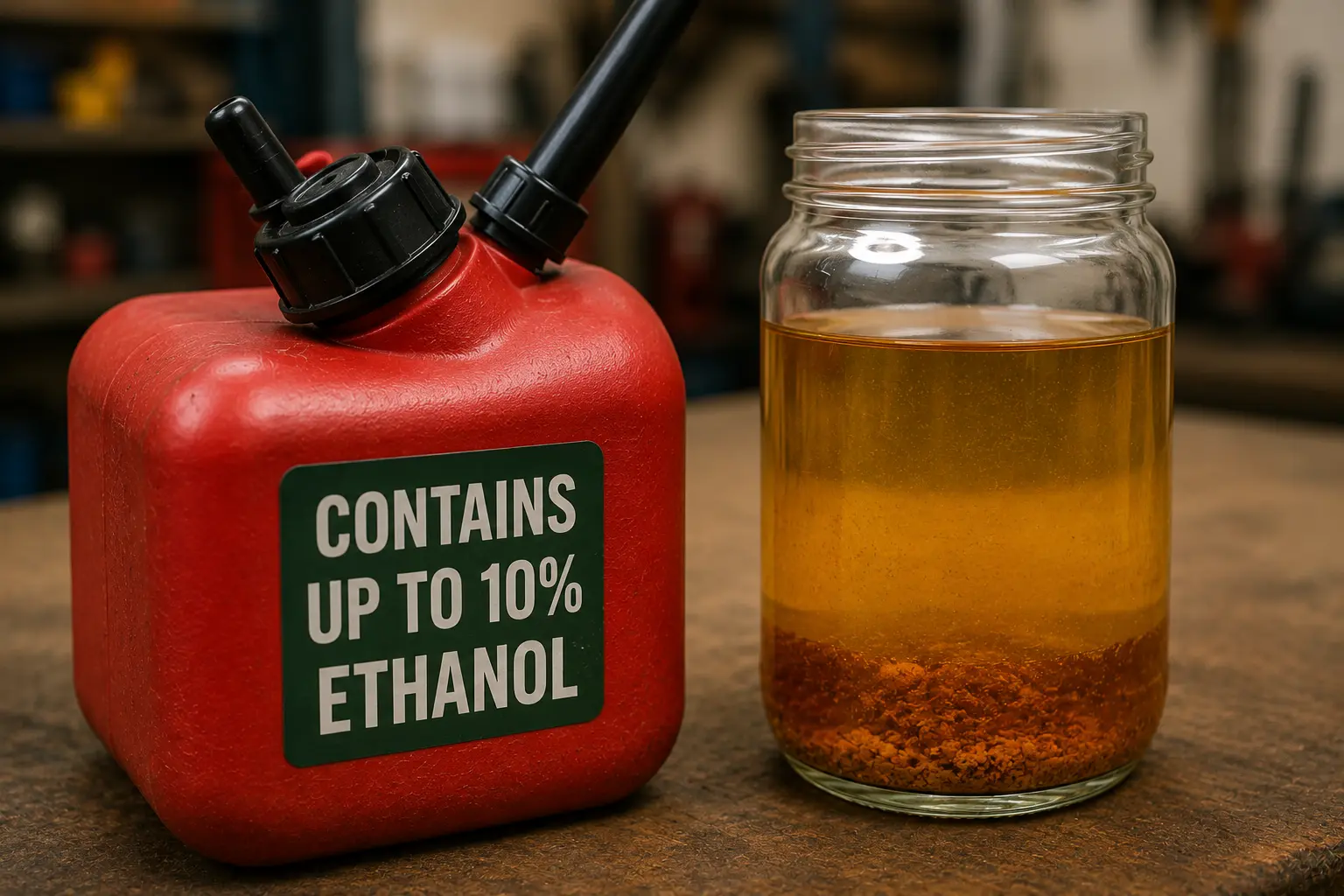
Over time, the ethanol in the fuel absorbs enough water that it can no longer stay in solution with the gasoline. At that point, the ethanol and water separate from the gasoline and sink to the bottom of the tank — a process called phase separation.
The layer of ethanol-water mixture at the bottom is corrosive. It attacks the metal surfaces inside the tank, the fuel lines, and most aggressively, the carburetor. Carburetors have small brass and aluminum components, rubber gaskets, and tiny fuel passages that are particularly vulnerable to the acidic ethanol-water mixture.
Phase separation can occur in as little as 30 days in humid conditions. A small engine stored over winter with E10 fuel in the tank is almost certain to have phase-separated fuel by the time it's needed in spring.
Varnish and gum deposits
Even without phase separation, ethanol-blended fuel leaves behind sticky deposits when it evaporates. The lighter compounds in gasoline evaporate first, leaving a progressively heavier, stickier residue. Ethanol accelerates this process compared to ethanol-free fuel.
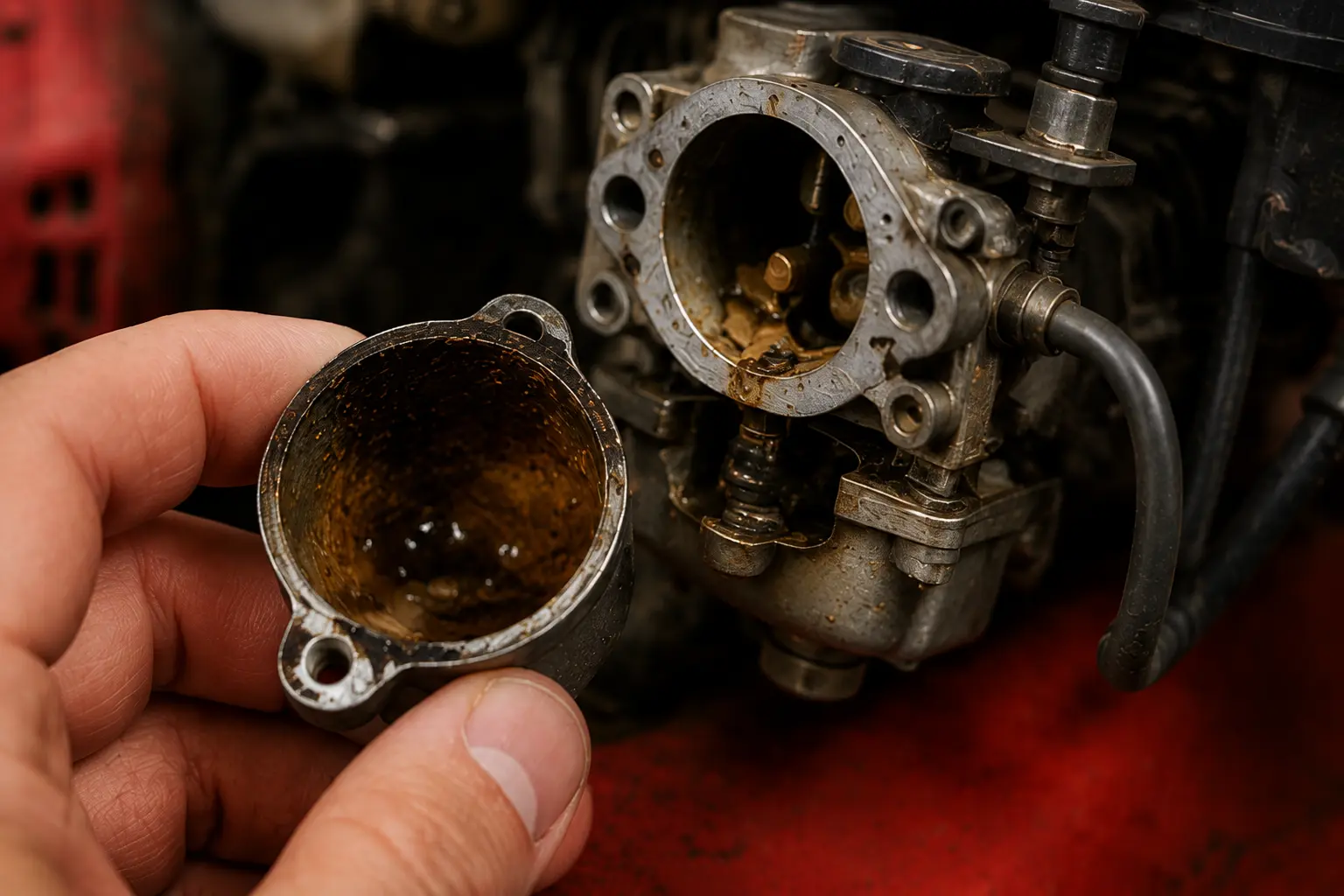
These deposits — technically called varnish and gum — accumulate inside the carburetor. They coat the fuel passages, clog the main jet and idle jet, and can freeze the float needle in the closed position, starving the engine of fuel entirely.
The result is an engine that won't start, runs rough, surges at idle, or dies when you try to rev it. In many cases, the fix is a carburetor cleaning. In worse cases, the carburetor needs to be rebuilt or replaced entirely.
Material degradation
Ethanol is a solvent. It degrades certain rubber and plastic compounds over time, including some types of fuel lines, primer bulbs, diaphragms, and gaskets.
Older equipment is more vulnerable because the materials used in fuel system components manufactured before ethanol blending became standard weren't formulated to resist it. A carbureted engine from the early 2000s or earlier is particularly at risk. Many small engine manufacturers have updated their fuel system materials in recent years to improve ethanol tolerance, but older equipment in the field hasn't been upgraded.
Degraded fuel lines become brittle, crack, and develop pinhole leaks. Deteriorated diaphragms — a critical component in the carburetors used on many two-cycle engines — cause lean-running conditions and hard starting. Swollen or softened gaskets allow air leaks that throw off the fuel-air mixture.
Which engines are most vulnerable
Two-cycle engines (chainsaws, string trimmers, backpack blowers) are particularly vulnerable. These engines rely on a diaphragm carburetor with small rubber components that are more sensitive to ethanol than the float-bowl carburetors used in most four-cycle engines. They also run on a fuel-oil mixture that's often premixed and stored, extending the fuel's exposure time.
Small four-cycle engines used seasonally (lawn mowers, snowblowers, generators) are vulnerable primarily because of the storage issue. A lawn mower that sits from October to April with fuel in the tank has six months for phase separation and varnish to develop. By contrast, a car that sits for two weeks is fine because the engine turns over fuel quickly.
Generators are especially high-risk because they're often called on after months or years of inactivity — exactly when fuel problems are most severe. The generator needed most during a power outage is the one least likely to start if ethanol damage has occurred.
Pressure washers have the same seasonal storage problem as lawn mowers, with the additional complication that the pump system (which uses separate oil) can mask carburetor symptoms until the engine completely fails to start.
How to protect your equipment
Use ethanol-free fuel when possible
Ethanol-free gasoline (E0) is the best fuel for small engines. It doesn't phase-separate, doesn't degrade rubber components, and has a significantly longer storage life. Many marinas, small engine dealers, and some gas stations sell ethanol-free recreational fuel.
Search for ethanol-free fuel near you at pure-gas.org, which maintains a user-updated database of stations that carry it. Expect to pay a premium — typically $1-2 more per gallon than pump premium. For a small engine that uses 1-3 gallons per season, the cost difference is negligible compared to a carburetor repair.
Add fuel stabilizer to every tank
If you use pump gasoline, add a quality fuel stabilizer to every tank — not just before storage. Stabilizers like Sta-Bil 360 Protection (formulated specifically for ethanol blends) or Sea Foam contain additives that slow oxidation, inhibit corrosion, and help prevent phase separation.
Follow the dosage on the bottle. More is not better — overdosing stabilizer can itself cause deposits.
After adding stabilizer, run the engine for 5-10 minutes to distribute the treated fuel through the entire fuel system including the carburetor. A stabilizer sitting in the tank but not in the carburetor doesn't protect the carburetor.
Don't store fuel for more than 30-60 days without stabilizer
Fresh fuel is meaningfully better than fuel that's been sitting. If you buy gasoline in cans, date the can when you fill it and use it within 30 days. After 30 days, treat it with stabilizer or discard it.
This applies to the fuel in the equipment itself. If you fill a lawn mower's tank and then don't use it for a month, the fuel has already started to degrade.
Drain the fuel system before long storage
For equipment going into storage for more than 60 days, the most reliable protection is removing all fuel from the system. Turn off the fuel valve, run the engine until it stalls from fuel starvation, and then tip the unit (safely) to drain any remaining fuel from the tank.
This leaves the carburetor dry — no fuel, no residue. A dry carburetor is a clean carburetor.
The tradeoff is that a fully drained system needs fresh fuel before starting, and the rubber components inside a dry carburetor can dry out over years of storage. For most seasonal storage (3-8 months), draining is fine. For long-term storage of several years, a small amount of fresh stabilized fuel left in the system is actually better to prevent gasket dry-out.
Use fuel quickly after mixing (two-cycle engines)
For two-cycle engines that use a premixed fuel-oil ratio, mix only what you'll use within 30 days. Don't mix a gallon and store the rest in a gas can. The ethanol in the mix will begin degrading the rubber components and separating from the oil within weeks.
Pre-mixed fuel products (TruFuel, Husqvarna XP+) are available in sealed cans with ethanol-free gasoline and pre-mixed oil at the correct ratio. They're expensive per gallon — roughly $7-10 for a half-liter — but they have a 2-year unopened shelf life and are ideal for occasional-use equipment like chainsaws that might sit between uses.
What ethanol damage looks like in the shop
When a small engine comes in with ethanol damage, this is what a technician typically finds:
Gummed carburetor: Sticky brown or tan residue in the fuel passages, a float needle that's stuck open or closed, a main jet that's partially or fully blocked. Cleaning fixes mild cases; rebuild or replacement handles severe ones.
Cracked fuel lines: Hairline cracks or brittleness in the rubber fuel line, particularly at bends and fittings. Often the line looks intact until it's flexed. Fuel line replacement is inexpensive but easy to overlook.
Deteriorated primer bulb: The clear or red rubber primer bulb is cracked, stiff, or fails to draw fuel. Replacement is a 10-minute job.
Phase-separated fuel in tank: Brown or discolored fuel with visible separation layers. The tank needs to be completely drained and flushed before fresh fuel is added.
Corroded carburetor body: In severe cases, the carburetor itself has pitting or corrosion on internal surfaces that cleaning won't address. A replacement carburetor is needed.
The cost of ignoring it
A fuel line replacement and carburetor cleaning runs $80-150 at most shops. A carburetor rebuild runs $120-200. A carburetor replacement, if cleaning isn't viable, runs $150-300 depending on the engine.
For a $200 string trimmer or a $300 consumer lawn mower, a carburetor replacement means you're spending half the cost of the equipment on a repair that could have been prevented with a $10 bottle of stabilizer and 10 minutes of end-of-season prep.
For a generator that costs $500-2,000, the math strongly favors prevention.
This guide covers ethanol-related damage in gasoline-powered small engines. Diesel engines and propane-powered equipment have different fuel system concerns and aren't covered here. For related reading, see why won't my snowblower start and why won't my generator start.