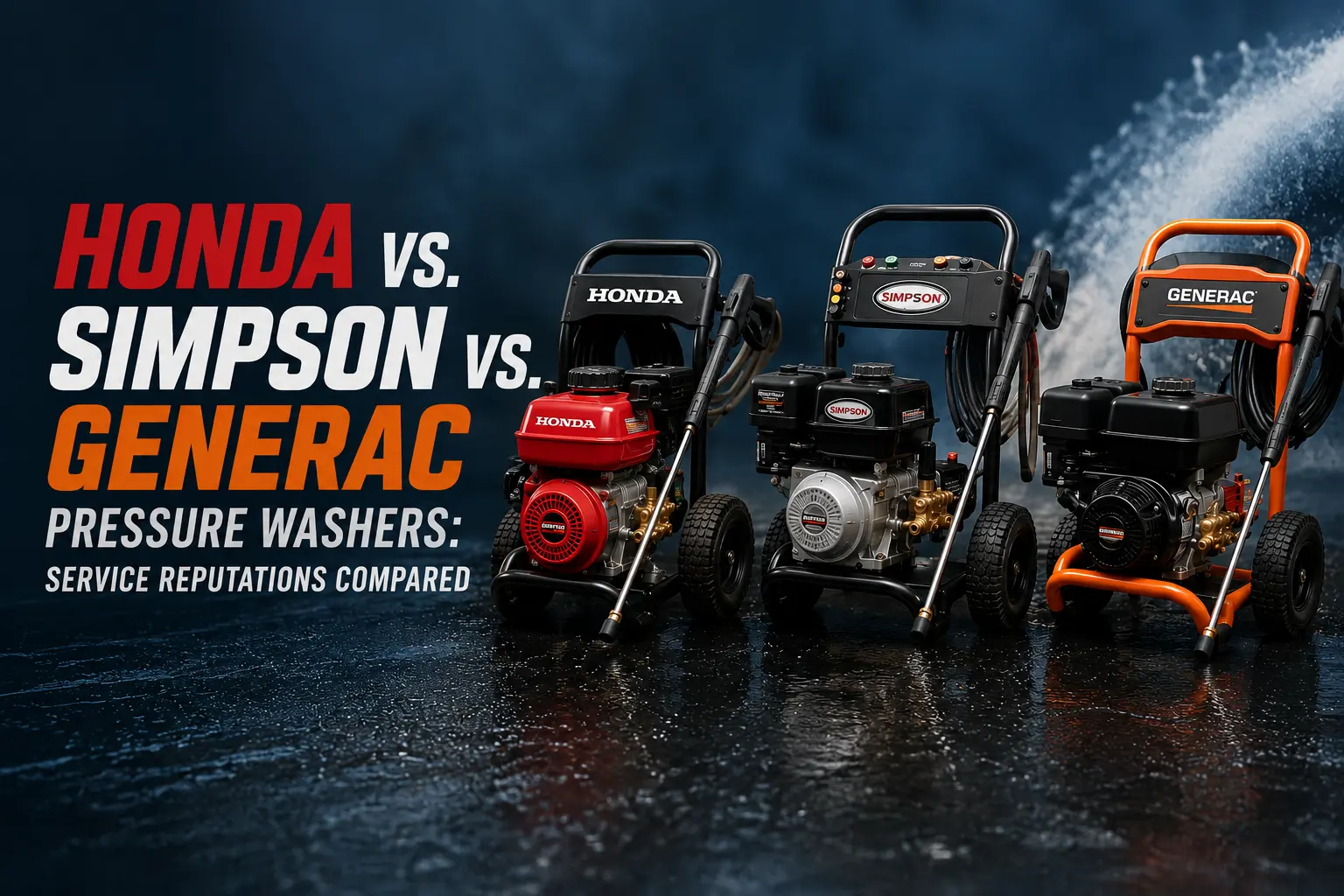
Honda vs. Simpson vs. Generac Pressure Washers: Service Reputations Compared
Three brands dominate the U.S. consumer and prosumer pressure washer market: Honda (Honda Power Equipment-branded units), Simpson, and Generac. Each has loyal owners and reasonable arguments for being the best buy. But "best pressure washer" misses the more useful question for someone planning to use a unit for 5-10 years of seasonal cleaning: which one is easiest to service in the place you actually live?
Service support — meaning how easy it is to find competent repair, how readily parts are available, and what those repairs actually cost — varies meaningfully between these three brands. This guide breaks each brand down from the perspective of repair-shop accessibility and long-term cost of ownership, drawn from feedback across the small engine repair shop network.
For specific troubleshooting and repair, see the pressure washer won't start guide, the pump rebuild guide, and the carburetor cleaning guide. This article assumes you're at the buying-decision or long-term-ownership stage.
At a glance
| Honda | Simpson | Generac | |
|---|---|---|---|
| U.S. service network density | Lower (specialized) | Highest (broad) | High (dealer network) |
| Engine source | Honda GC/GX OEM | Honda GC/Briggs/Simpson-branded | Generac OHV |
| Pump source | Honda-engineered | AR Annovi Reverberi (common) | AR (consumer), OEM (commercial) |
| Parts availability | Good at dealers, sparse at independents | Excellent (mix of Honda + AR) | Good across both networks |
| DIY-friendliness | Medium-High | High | High |
| Average repair cost | $$$ | $$ | $$ |
| Common service issues | Carb varnish, fuel valve | Pump seals, carb varnish | Carb varnish, voltage regulator |
| Reputation for longevity | 10-15 years typical | 7-12 years typical | 6-10 years typical |
| Warranty | 2-3 years standard | 1-5 years (varies by series) | 1-3 years |
| Best fit | Owners prioritizing longevity | Most owners — best value/service balance | Owners with established Generac dealer relationships |
Each section below unpacks why these distinctions matter when something breaks.
Honda Power Equipment: premium positioning, sparser network
Honda Power Equipment-branded pressure washers — not the much more common pressure washers that simply use Honda engines on the powerplant — are Honda-designed end-to-end. Honda makes both the engine and the pump assembly.
The distinction matters when you're shopping. A "Simpson with a Honda engine" is a Simpson pressure washer; service goes through Simpson's network and uses Simpson-spec parts for everything except the engine. A "Honda Power Equipment" pressure washer is a fully Honda-designed unit — different service network, different parts ecosystem.
What Honda does well:
- Premium build quality — heavier-gauge components, tighter tolerances
- Industry-best engine longevity (Honda GX engines routinely hit 3,000+ hours)
- Quiet operation across the line
- Consistent finish quality and ergonomics
The service tradeoff:
- Honda-branded pressure washers are less common in U.S. distribution than Simpson or Generac. In rural areas, finding a parts source can mean ordering through Honda Power Equipment online rather than picking up at a local shop.
- Independent shops can work on Honda Power Equipment units, but parts often need ordering rather than coming from local stock.
- Premium parts pricing — Honda OEM parts run 25-40% higher than Simpson or Generac equivalents on the same component.
Common Honda service issues:
- Carburetor varnish (universal across all gas pressure washers, no brand exception)
- Fuel valve corrosion on units stored with old fuel for years
- Float bowl gasket wear on older units
- Pump seal wear after 200+ hours of use
Repair cost reality:
- Carburetor service: $130-180 at independent, $180-250 at authorized dealer
- Pump rebuild (Honda-engineered): $180-280 total including parts
- Annual tune-up: $90-130
Where Honda makes sense: owners who want premium build quality, plan to keep the unit 10+ years, and live within reasonable distance of a Honda Power Equipment dealer. The repair cost premium is rational only when you're collecting the longevity dividend in return.
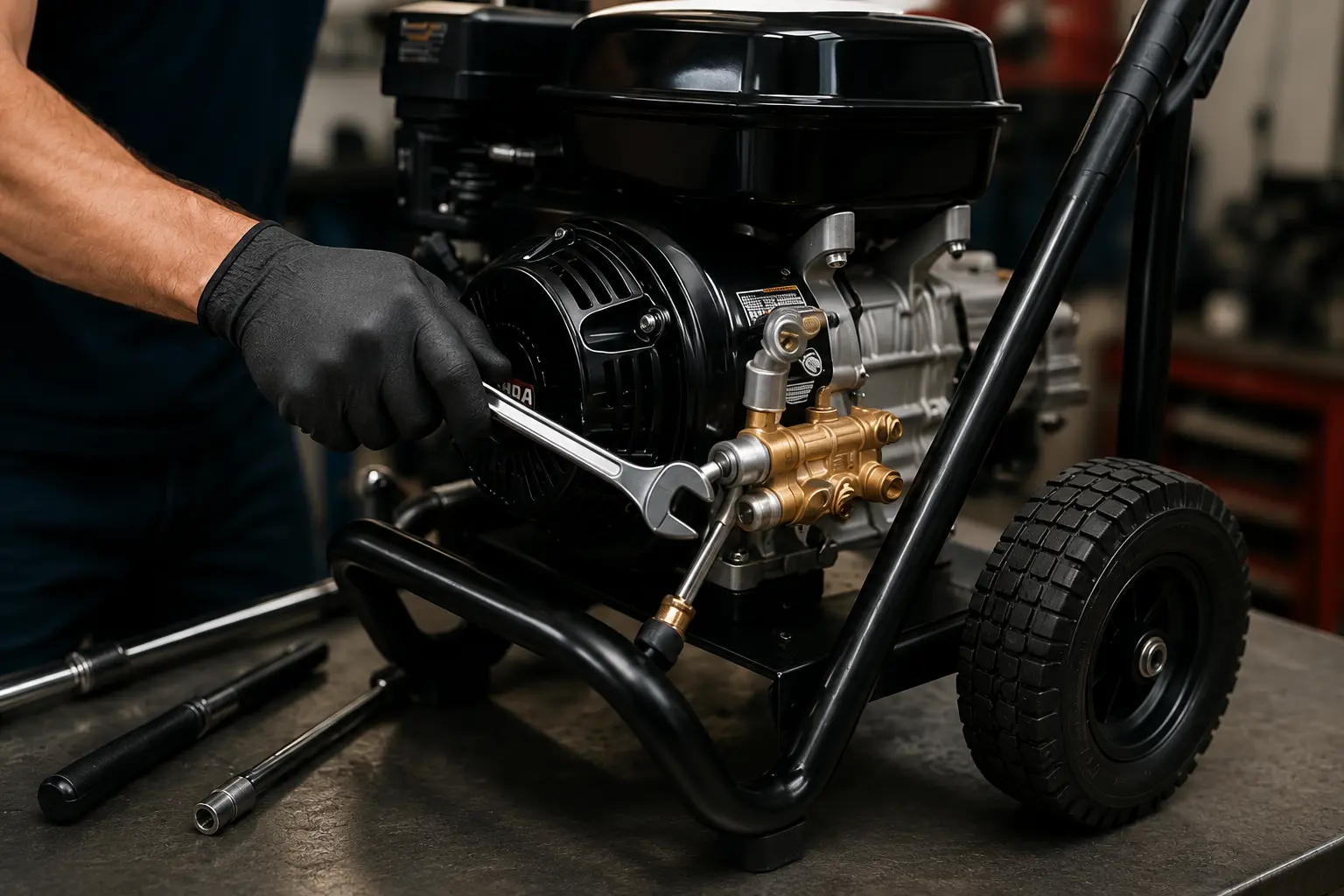
Simpson: deepest service network, mid-tier longevity
Simpson is the most popular pressure washer brand in the U.S., with the widest distribution and the deepest dealer network. Most prosumer pressure washers under $700 are Simpson-branded, even when the engine is Honda or Briggs. This translates to several service-side advantages.
Service network strengths:
- Found at most independent power equipment shops — any decent shop can work on a Simpson
- Wide parts availability through both Simpson's network and aftermarket (AR pump parts especially)
- Strong warranty support (5-year on Aluminum series, 3-year on most others)
What complicates service:
- Quality varies between Simpson model lines — the Mega Shot consumer line uses different pump and engine combinations than the PowerShot prosumer line
- Some Simpson models use Simpson-branded engines (lower reliability than the Honda-engined versions); check the engine before assuming the same model performs the same as a friend's
- After 5+ years of use, the pump (often AR Annovi Reverberi) typically needs rebuild before any other component fails
Common Simpson service issues:
- Pump seal wear on AR pumps — most common service item, $30-60 in parts to rebuild
- Carburetor varnish (universal)
- Fuel line cracking on units 3+ years old
- Spray gun trigger valve failure on heavy-use units
Repair cost reality:
- Carburetor service (Honda GC-engined model): $80-150 at independent
- Carburetor service (Simpson-branded engine): $100-180 at independent
- Pump rebuild: $100-180 total including parts
- Annual tune-up: $60-100
If you've decided to replace rather than rebuild a worn pump, the AR SRMW22G26-EZ pump is a common drop-in axial cam replacement that fits many Simpson and Simpson-style prosumer units in the 2,400-3,000 PSI range.
Where Simpson makes sense: most owners. Simpson is the right default unless you have a specific reason to choose Honda (premium positioning) or Generac (existing dealer relationship). The combination of broad service availability, reasonable parts cost, and decent reliability is hard to beat at the price points Simpson plays in.
Generac: dealer-driven service, broad availability
Generac entered the pressure washer market leveraging the dealer relationships built around its generator business. This produces a particular service profile: strong support inside the Generac dealer network, less consistent at independents.
Service network characteristics:
- Most authorized Generac dealers (the same shops that service Generac standby generators) can service Generac pressure washers
- Parts availability is solid through the Generac network
- Independent shops have variable familiarity with Generac OHV engines — some shops specialize, others avoid them
What sets Generac apart:
- Lower price points than Simpson on comparable spec models (often $50-100 less for similar PSI/GPM)
- Strong warranty for the price point (3 years on most models)
- SpeedWash, Pro Series, and OneWash lines cover budget through prosumer use cases
What complicates service:
- Generac OHV engines have a mixed reliability reputation — they've improved meaningfully since 2018 but consumer reports still show higher failure rates than Honda-engined alternatives at the same age
- Aftermarket parts ecosystem is thinner than Honda or Briggs — most parts go through Generac dealers
- Electric-start models on some commercial Generac units add a voltage regulator that can fail after 3-5 years
Common Generac service issues:
- Carburetor varnish (universal)
- Voltage regulator failure on electric-start models
- Fuel valve corrosion
- Engine bearing wear at high-hour mark on consumer models
Repair cost reality:
- Carburetor service: $100-180 at Generac dealer, $80-150 at independent (varies by shop familiarity)
- Voltage regulator replacement (electric-start models): $80-180 total
- Pump rebuild: $100-180 total
Where Generac makes sense: owners who already have a working relationship with a Generac dealer (often through a standby generator), or those prioritizing initial price over absolute longevity. The lower upfront cost makes sense for occasional users; daily users get better lifetime value from Simpson or Honda.
What this means for your buying decision
If you'll use the pressure washer 5-10 times a year for residential cleaning, all three brands will serve adequately. The differentiator becomes service network access in your specific area. Two things worth checking before buying:
Call 2-3 local shops. Ask which brand they actually service most often. The brand with the most local service experience usually delivers the best repair turnaround when you need it.
Confirm the engine on the model you're considering. Many pressure washers labeled as one brand use another company's engine. A Simpson with a Honda GC engine has different service characteristics than the same Simpson with a Simpson-branded engine. Get the engine model number from the manufacturer's spec sheet before deciding.
For daily users (200+ hours per year), Honda's longevity premium increasingly justifies the higher upfront and service costs. For seasonal users, Simpson's service network density usually beats the alternatives.
Common ground across all three brands
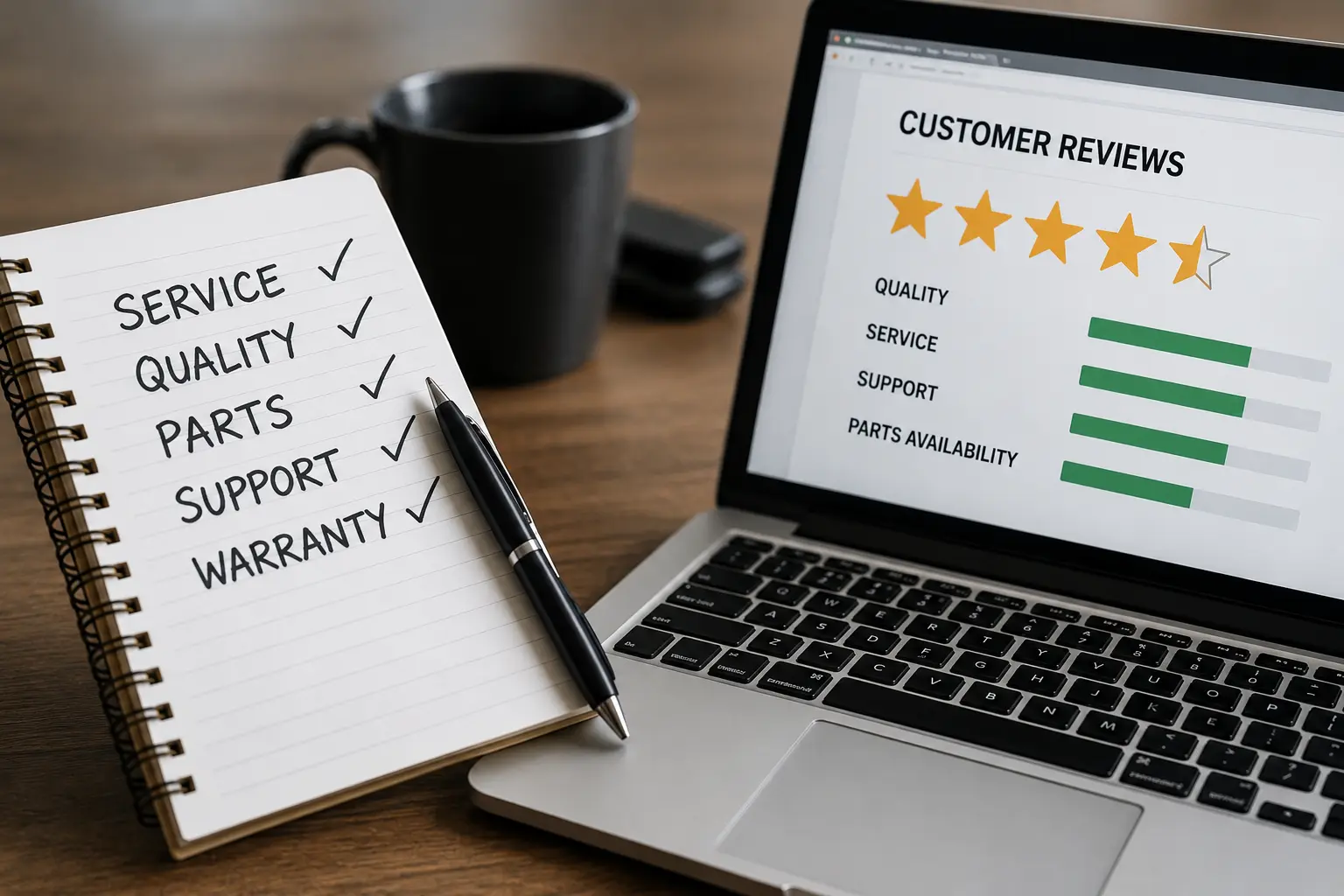
Three things matter more than brand choice for keeping a pressure washer running:
Fresh fuel. Drain old fuel before storage, use stabilized fresh fuel for any unit that sits between projects, and replace fuel that's been in the tank more than 60 days. This single practice prevents 70-80% of all pressure washer service issues regardless of brand.
Winterize the pump. Water left in the pump during freezing weather expands and cracks pump internals. Always blow water out of the pump before winter storage in cold climates, or run pump antifreeze through the system. Pump failure from freeze damage is the #1 reason consumer pressure washers get replaced rather than repaired.
Annual tune-ups in season. Cheap insurance — $60-100 catches most problems before they become $200+ repairs.
When to bring it to a shop regardless of brand
Some problems aren't worth DIY fixing on any brand:
- Compression issues, cylinder rebuilds — engine work that requires specialized tools
- Inverter or AVR failures on electric-start models — diagnostic readout needed
- Cracked pump body — replacement only, not rebuildable
- Hydrolocked engine after freeze damage
- Anything still under warranty
Independent shops typically charge $80-120 per hour. Authorized dealers run 20-40% higher. Pre-season service in early-to-mid spring is the best time to book — wait times stretch to 2-3 weeks once spring cleaning season hits.
If you need to find a shop for diagnosis or service, use the directory below — most can give a phone estimate and brand-familiarity check before you bring the unit in.
This guide compares Honda Power Equipment-branded, Simpson, and Generac gas pressure washers. Electric pressure washers (Karcher, Sun Joe, AR Blue Clean) have entirely different service profiles dominated by motor and pump-controller issues, not covered here. Service network observations are drawn from independent shop feedback across the small engine repair network and may vary by region.