8 Signs Your Generator Needs Professional Service (And Which DIY Fixes to Try First)
Most generator owners wait too long to call a repair shop. The pattern is predictable: a symptom shows up, the owner tries a few DIY fixes, those don't work, the problem gets worse, and by the time the generator goes to a shop the repair scope has grown beyond what would have been needed if it went in early.
This guide covers the eight symptoms that demand professional service, what DIY steps are worth trying first for each, and what to do before bringing your generator in. If your generator just won't start at all, the generator won't start guide covers basic troubleshooting first. This article is for symptoms beyond that initial diagnosis.
A quick triage rule
For each symptom below, there's usually a 15-minute DIY check that either fixes it or definitively confirms shop work is needed. The check is worth doing — both to save money on the obvious fixes and to give the shop better information when you do bring the unit in.
Generally, you should call a shop when:
- You've worked through the DIY check and the symptom persists
- The symptom involves the electrical side (voltage, output, the alternator) rather than the engine side
- The symptom shows a hard mechanical fault (knocking, smoke, oil leaks)
- The unit is under warranty and DIY voids coverage
1. No spark after replacing the spark plug
The symptom: Engine cranks normally but won't fire. You've replaced the plug with a fresh one, gapped to spec, and tested it grounded against the cylinder fins while pulling the starter — no blue spark, or only a weak orange spark.
DIY check (5 minutes):
- Confirm the kill switch is in the "run" position
- Verify the plug wire is firmly seated on the new plug
- Inspect the wire for visible damage or oil contamination
Why this is shop work: No spark after a confirmed-good plug usually means the ignition coil has failed, or the kill-switch wiring is shorting to ground. Coil replacement requires removing the cylinder shroud, gapping the new coil to the flywheel (typically 0.012" or 0.3mm), and reassembling — possible for an experienced DIYer but easier and more reliable at a shop. Expected cost: $80-180 total.
2. Engine cranks freely but never fires (even with fresh fuel and a new plug)
The symptom: You've drained old fuel, refilled with fresh, replaced the plug, sprayed carburetor cleaner through the air intake, and the engine still won't catch.
DIY check (10 minutes):
- Pull the plug and check for fuel wetness on the tip — if completely dry, fuel isn't reaching the cylinder (carburetor blockage or fuel valve closed)
- If wet, dry the plug and try again with the choke closed
- Confirm the air filter isn't completely blocked (try starting without the filter for diagnostic purposes only)
Why this is shop work: When fresh fuel and a fresh plug don't fix the no-start, the issue is usually compression-related (worn rings, leaking head gasket) or the carburetor needs full disassembly rather than just spray cleaning. Both require shop tools and time. Compression test alone runs $25-50; full diagnosis and repair scope typically $150-400.
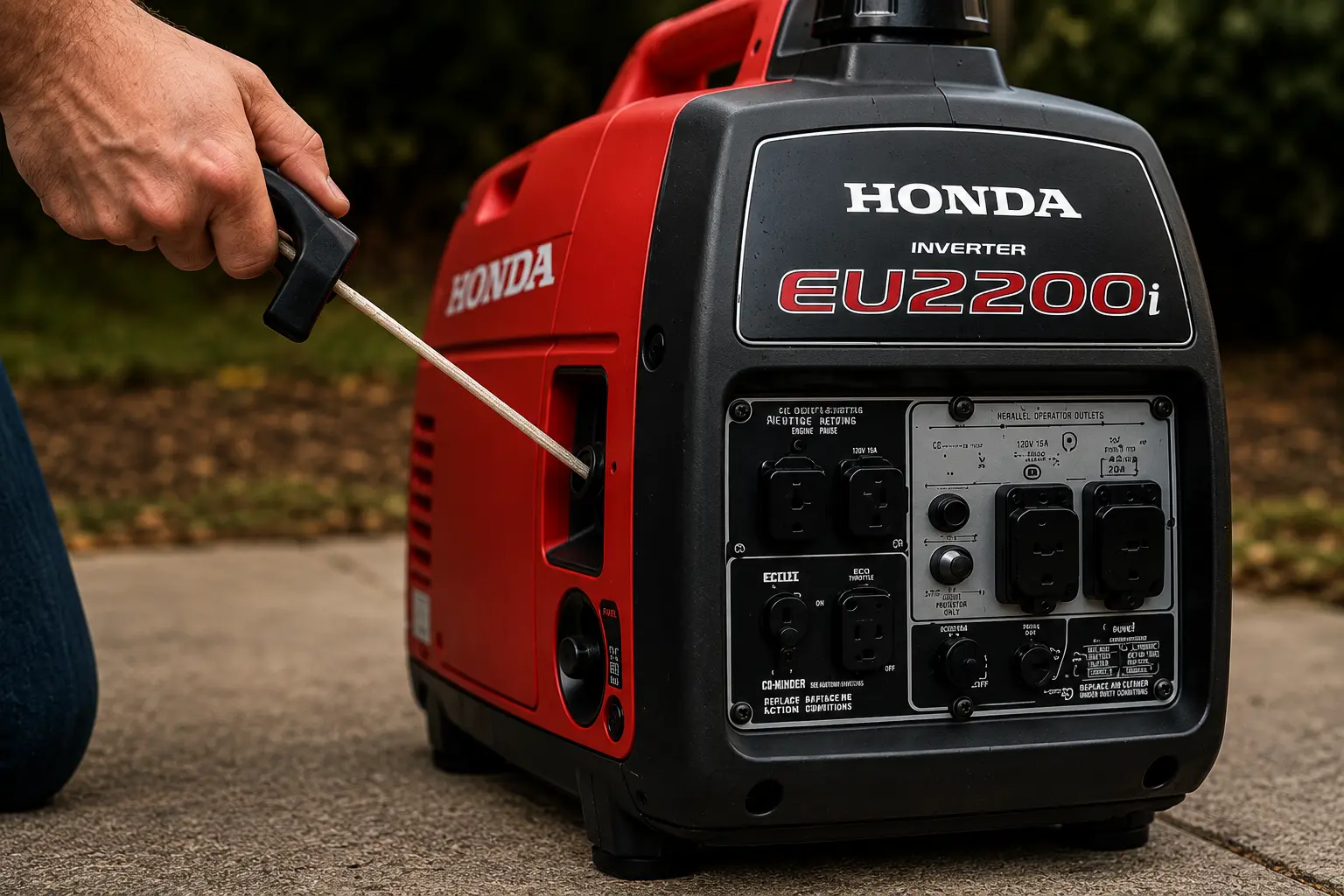
3. Visible smoke from the exhaust
The symptom: Smoke pours from the exhaust during operation. Not just the initial puff at startup (normal), but sustained smoke after the engine warms up.
Smoke color tells you something:
- Blue/grey smoke: Burning oil. Worn piston rings, valve seals, or oil leak into the cylinder.
- White smoke: Water in the combustion chamber. Head gasket failure or coolant intrusion (rare on air-cooled generators).
- Black smoke: Running rich. Excess fuel, clogged air filter, or carburetor adjustment problem.
DIY check (5 minutes):
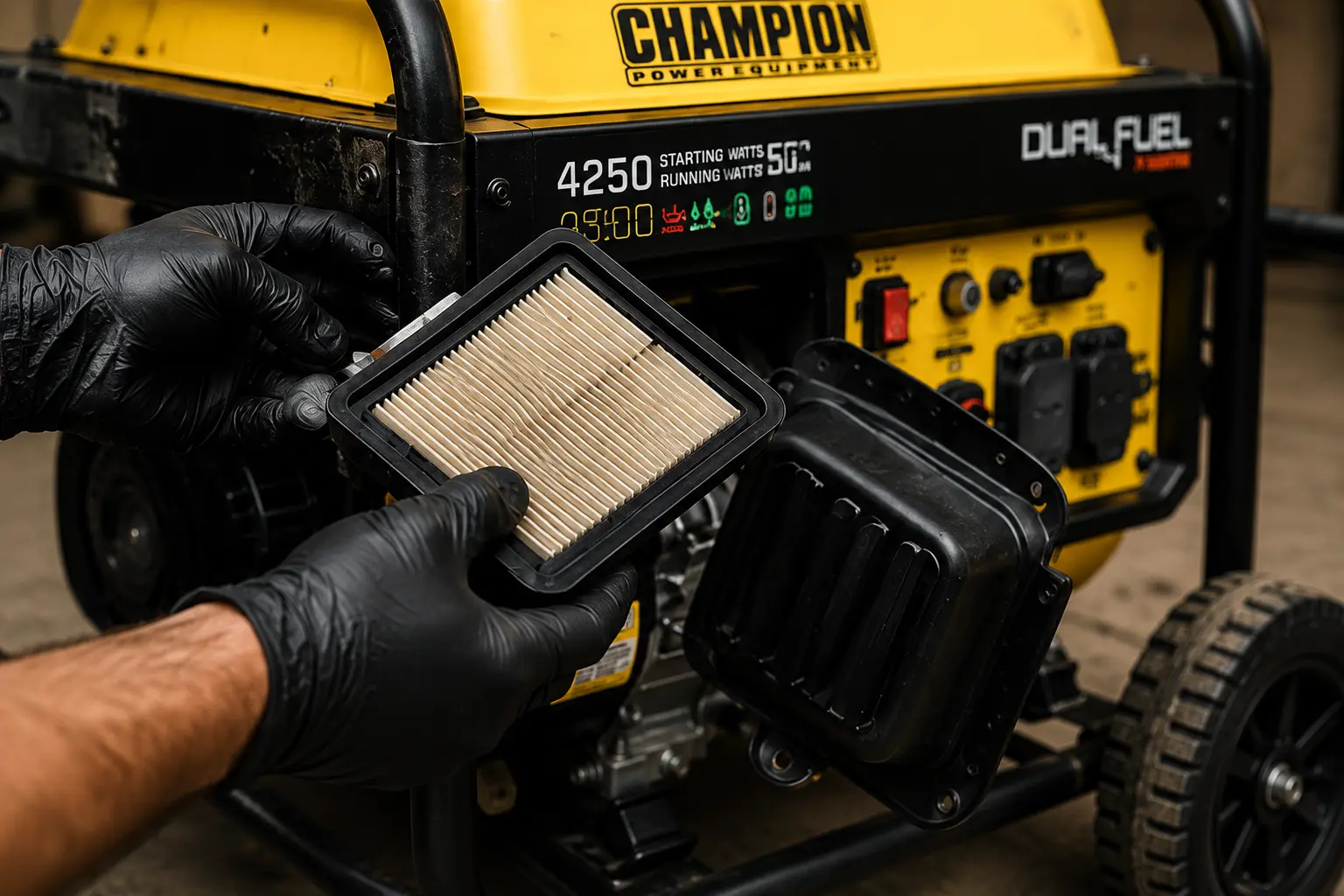
- For black smoke: replace or clean the air filter, verify the choke is fully open during operation
- For blue or white smoke: stop running the generator immediately — continued operation accelerates damage
Why this is shop work: Blue and white smoke indicate internal engine wear or damage that requires teardown to diagnose accurately. Black smoke that doesn't resolve with a clean filter and proper choke setting usually means a carburetor adjustment issue beyond DIY. Cost varies widely: $80-150 for a carb adjustment, $300-700+ for ring replacement or head gasket work.
4. Visible oil leaks from gaskets or seals
The symptom: Oil pooling under the generator after a run, or visible oil seeping from the engine block, valve cover, or crankshaft seals.
DIY check (5 minutes):
- Clean the engine surface with a rag
- Run the generator for 10 minutes
- Identify exactly where the oil is appearing from
Why this is shop work: Identifying the exact leak source is half the repair. Valve cover gasket leaks are cheap to fix ($30-80). Crankshaft seal leaks require pulling the flywheel ($150-300). Head gasket leaks usually warrant a compression test first to determine whether the leak is the only issue or a symptom of broader head problems ($200-500+). A shop can diagnose accurately and price the repair before you commit.
5. Voltage output abnormal at the receptacles
The symptom: Generator runs at normal RPM, but a multimeter reading at the receptacles shows voltage outside the 110-130 VAC range (for 120V circuits) or significantly fluctuating.
DIY check (15 minutes, if you have a multimeter):
- Measure voltage with no load — should read 118-130V on a healthy generator
- Measure with a small load (a lamp or fan) — should hold steady within 5V of no-load reading
- If voltage swings wildly: that's the alternator or voltage regulator
- If voltage reads zero or low across all receptacles: that's a winding or rotor issue
Why this is shop work: Electrical-side issues require multimeter diagnostics, knowledge of the specific generator's electrical schematic, and often replacement of the AVR (automatic voltage regulator) or capacitor pack. The engine can be perfectly fine while the electrical side has failed entirely. Diagnosis runs $30-80; AVR replacement $100-250; rotor or stator rebuild $400-800+.
6. Surging that doesn't clear with fresh fuel + carburetor cleaner
The symptom: Engine RPM cycles up and down (surges or hunts) and the cycling continues even after fresh fuel, stabilizer, and spray-cleaning the carburetor.
DIY check: Already done if you've worked through the generator surging troubleshooting guide.
Why this is shop work: Persistent surging after fuel-system DIY usually means one of three things: (1) the carburetor needs full disassembly and rebuild rather than spray cleaning, (2) there's a vacuum leak after the carburetor that's harder to identify without diagnostic tools, or (3) the governor system is failing internally. Cost typically $130-250 for full carb service; $150-300+ for governor work.
7. Hard mechanical noise from the engine
The symptom: Knocking, grinding, screeching, or rattling that wasn't there before. Different from normal engine noise.
DIY check (2 minutes): Stop running the generator immediately. Continued operation with mechanical noise accelerates damage and can convert a $200 repair into a $800 rebuild.
Why this is shop work: Mechanical noise indicates bearing wear, valve train issues, rod knock, or other internal problems that require teardown to diagnose. Diagnosis $80-150; repair scope depends entirely on what's found. On consumer generators under $1,000 retail, sometimes the right answer is replacement rather than repair.
8. Engine starts but dies under any load
The symptom: Engine starts and runs at idle, but the moment you connect a meaningful load (refrigerator, well pump, lights), the engine bogs down and stalls.
DIY check (10 minutes):
- Confirm fuel valve fully open
- Check air filter (clogged filter starves engine under load)
- Replace fuel filter if equipped (partial clog passes idle fuel but starves under load)
- Try with fresh fuel
Why this is shop work: Persistent stall-under-load after DIY checks means either the carburetor's main jet is partially clogged (full clean required), the fuel pickup tube has restrictions, or the engine has compression issues that only show up under load. Diagnosis is straightforward at a shop with diagnostic tools; trying to diagnose at home without a vacuum gauge or compression tester turns into guess-and-check.
What to do before bringing your generator in
For best shop turnaround and accurate diagnosis:
Write down the symptoms. Specifically: what does the generator do, what does it sound like, what changed, and what you've already tried. A clear symptom description saves the tech 20-30 minutes of diagnostic time and often $30-50 in labor.
Note the engine hours. Many generators have an hour meter. The number tells the shop a lot about expected wear and helps calibrate expectations for repair vs replacement.
Drain old fuel before transport. Slosh-around fuel in a leaky tank during transport is messy and dangerous. Drain into a separate container, transport empty.
Bring the owner's manual if you have it. Has the engine model number and serial number, which speeds up parts ordering.
Ask about warranty before any work. Even if you bought the generator used, original warranty coverage may still apply on younger units. Some authorized dealers honor partial warranty even on second-hand units.
When the math says replace instead of repair
For consumer generators under $1,000 retail, the cost-benefit equation gets thin fast on major repairs. Quick reference:
- Replacement value under $500: Repair budget cap of $150. Above that, consider replacement.
- Replacement value $500-$1,200: Repair budget cap of $400. Above that, weigh against age.
- Replacement value $1,200+: Repair almost always cheaper than replacement on portable units.
- Standby generators (any replacement value): Almost always repair — the installation cost of a replacement standby ($3,000+) typically exceeds any repair.
For deeper guidance on this decision, see DIY vs professional generator repair.
If the diagnosis says replacement makes more sense and you still need emergency backup power right away, a battery station from EcoFlow or BLUETTI US can bridge the gap for essentials while you plan a longer-term fix.
Emergency backup power boxes
When you call a shop
Independent generator shops typically charge $80-120 per hour. Authorized dealers run 20-40% higher. Diagnostic fees are typically $30-80, credited toward the repair if you proceed. For storm-season service, book pre-season (April-May) — wait times stretch dramatically after major weather events.
If you need to find a verified generator repair shop near you, the directory below filters shops by brand expertise. Most will give a phone diagnosis based on your symptom description before you commit to bringing the unit in.
This guide covers gas-powered portable and standby generators (Generac, Honda, Champion, Briggs & Stratton, Kohler, and similar brands). Diesel generators have different service requirements and aren't covered here. If your generator is under warranty, follow the manufacturer's authorized service requirements before any DIY work to preserve coverage.