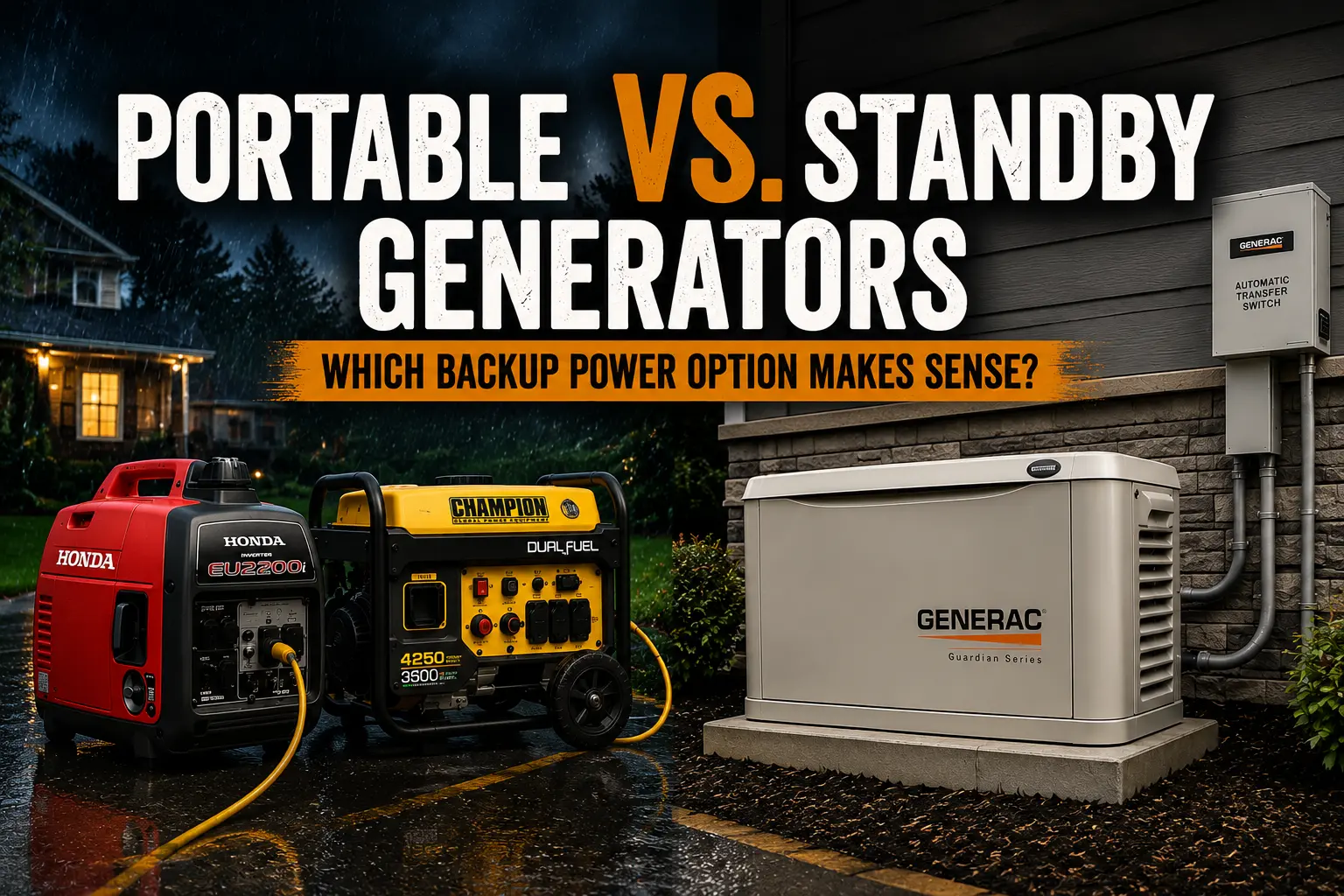
Portable vs. Standby Generators: Service Differences You Should Know Before Buying
The buying decision between a portable and a standby generator is usually framed around price — portable units start around $400, standby units start around $3,000 installed. But the price difference at purchase is a small fraction of the actual long-term cost difference, and most of the gap comes down to service requirements that buyers don't think about until they're locked in.
This guide covers the service profile of each generator type, who can work on what, what annual service actually costs, and how to decide which one fits your situation. If you already own a generator and want troubleshooting help, see the generator won't start guide and generator surging guide.
At a glance
| Portable | Standby | |
|---|---|---|
| Typical purchase price | $400-1,500 | $3,000-10,000 installed |
| Installation | None (plug-and-play) | Professional electrician required |
| Fuel | Gasoline or dual-fuel | Natural gas or propane (permanent supply) |
| Transfer switch | Manual (extension cords or interlock kit) | Automatic transfer switch (ATS) |
| Startup | Manual (pull cord or button) | Automatic when power fails |
| Service network | Any small engine repair shop | Authorized dealers + licensed electricians only |
| Annual service cost | $80-150 (DIY-friendly) | $200-400 (professional required) |
| Warranty service | Per brand network | Mandatory authorized dealer service to preserve coverage |
| Useful life | 1,000-3,000 hours | 10-20 years typical |
| Best fit | Occasional outages, mobility needed | Long outages, whole-home backup, frequent storms |
Each section below unpacks why these distinctions matter when something breaks.
Portable generators: owner-serviceable, broad service network
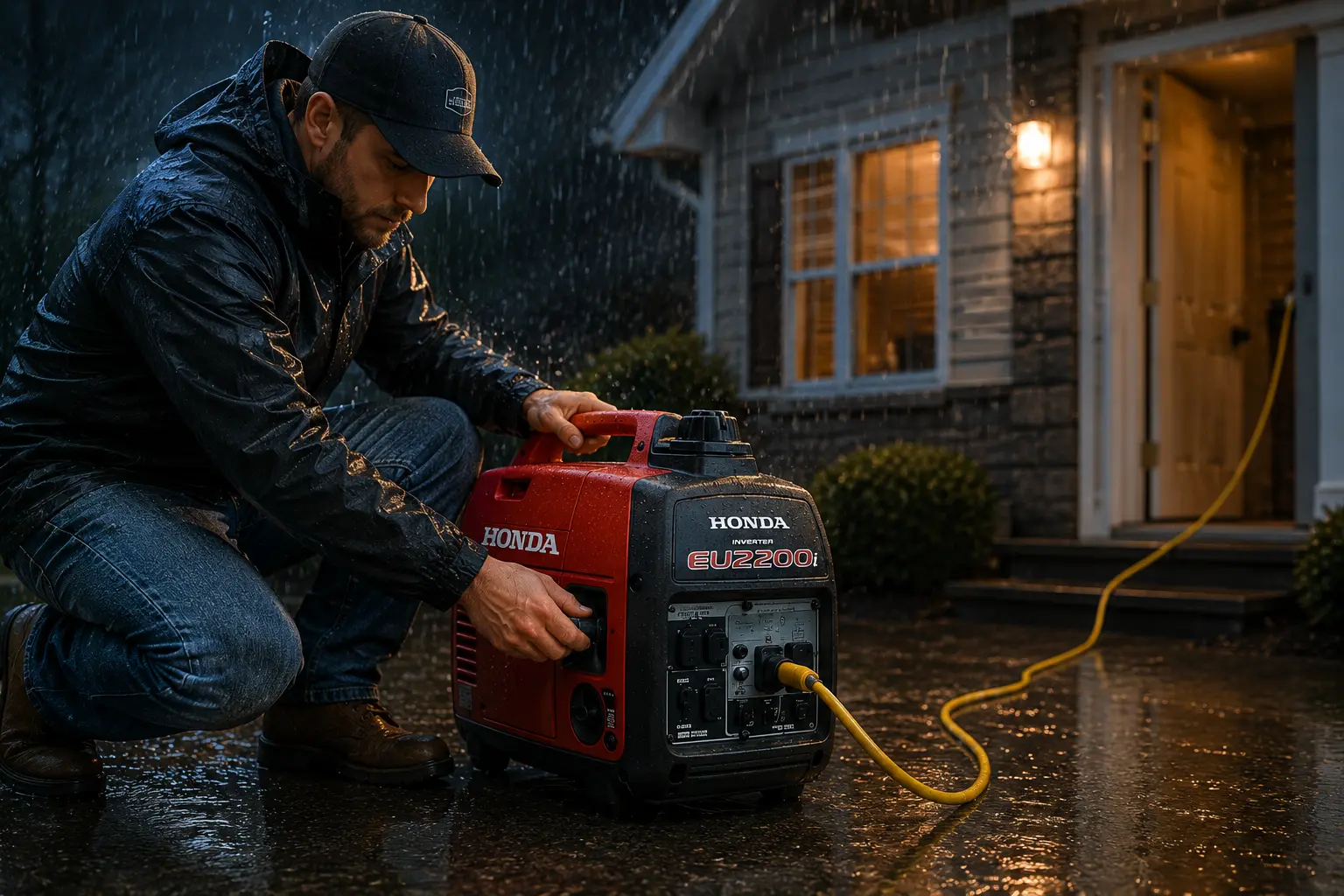
Portable generators are designed to be moved and used as needed. A 4,000-7,500 watt portable runs a refrigerator, well pump, microwave, and a few lights through most outages, and connects to your house via extension cords or an interlock kit on the main panel.
Service profile:
- Who can service it: Any small engine repair shop that works on lawn mowers, snowblowers, and chainsaws can also work on a portable generator. The engines (Briggs & Stratton, Honda GX, Generac OHV, Champion) are mechanically similar to other small engines.
- Owner-serviceable maintenance: Oil changes, spark plug replacement, air filter, fuel system service, basic carburetor work are all DIY-friendly with standard hand tools.
- What requires a shop: Ignition coil replacement, compression issues, voltage regulator failure on inverter models, electronic-control diagnostics on newer units.
- Average annual maintenance cost: $80-150 if you bring it in for annual service. $30-50 in parts if you DIY.
Where portable generators struggle:
- Sustained use is hard on consumer-grade portables. Run a 5,000W portable at 80% load for 8 hours a day during a 3-day outage and you'll burn through more service life than 6 months of weekend lawn work.
- Fuel storage is the #1 long-term problem. Gasoline degrades in 30-60 days; a portable that sits between outages with stale fuel develops carburetor varnish, fuel valve corrosion, and ignition issues. Adding a fuel stabilizer like STA-BIL to fresh fuel extends usable storage to 6-12 months and prevents most of the common no-start issues.
- Manual startup means someone has to be home, awake, and able to operate the unit. Useful for predictable storms; less useful at 3 AM during an unexpected outage.
Standby generators: dealer-locked, professional-only service
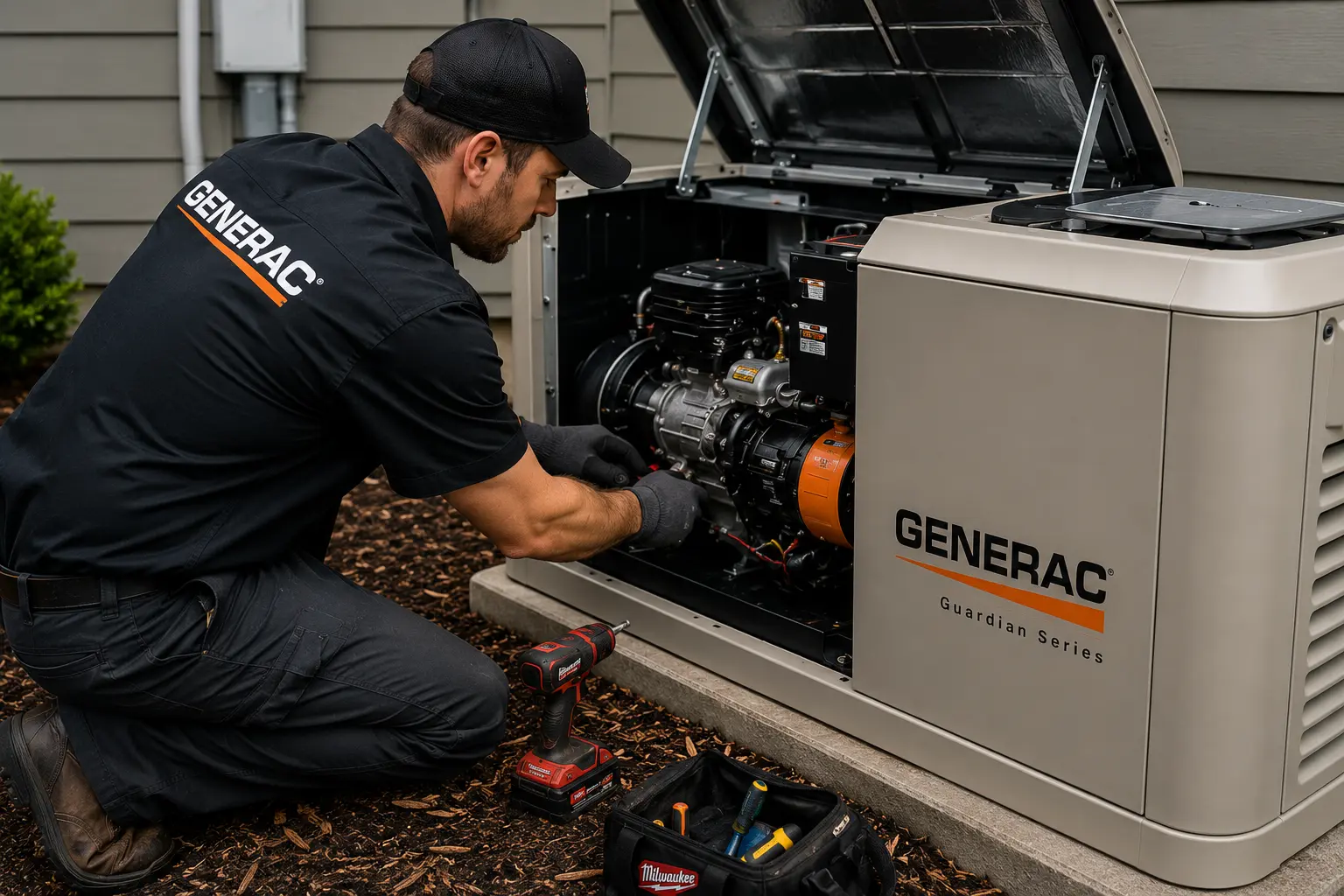
Standby generators are permanently installed outside the home, connected to a fixed fuel supply (natural gas, propane), and wired through an automatic transfer switch that detects utility power loss and starts the generator within 10-30 seconds. The most common consumer brands are Generac Guardian, Briggs & Stratton, and Kohler residential.
Service profile:
- Who can service it: Authorized dealers and licensed electricians only. Standby generators involve high-voltage connections to the main electrical panel, integration with natural gas or propane fuel systems, and warranty terms that require manufacturer-trained technicians.
- Owner-serviceable maintenance: Limited. Most owners can check oil level and battery voltage, but most service requires a professional.
- What requires authorized service: Annual service inspection, ATS diagnostics, fuel system work, exercise cycle programming, firmware updates on newer units, any warranty claim.
- Average annual maintenance cost: $200-400 for a professional annual service. Most authorized dealers offer service contracts in the $300-600 per year range that cover annual service plus discounted emergency repairs.
Where standby generators excel:
- Designed for sustained operation — 10,000 to 50,000 hours of useful life depending on model and maintenance.
- Automatic startup means the generator runs whether you're home or not. Refrigerated food stays cold; well pumps stay running; sump pumps keep basements dry.
- Natural gas supply (where available) means no fuel storage problems. The generator pulls fuel from the same gas line that supplies the furnace and water heater.
Where standby generators frustrate owners:
- Service network is narrower. A homeowner who buys a Generac standby in a small metro area may have one or two authorized service options within 50 miles.
- Warranty terms are strict. Skip an annual service or use an unauthorized shop and the warranty often voids entirely — even if the failure has nothing to do with the missed service.
- Repair costs are higher. A control board replacement on a Generac Guardian runs $400-900 in parts and labor. The equivalent diagnostic on a portable would be $150-300 because the parts are simpler.
Total cost of ownership: a realistic comparison
Comparing a $1,000 portable to a $5,000 standby over 10 years:
Portable (10 years):
- Purchase: $1,000
- Annual service: $100 × 10 = $1,000 (DIY: $300-500)
- Major repair at ~year 5 (carb rebuild + plug/filter): $200
- Replacement at year 8-10: $1,000 (most consumer portables don't last 10 years of regular use)
- Fuel: $200/year in gasoline + stabilizer = $2,000
- Total 10-year cost: ~$5,000-5,500 (or $3,500 with DIY service)
Standby (10 years):
- Purchase + installation: $5,000-7,000
- Annual service: $300 × 10 = $3,000
- Major repair at year 6-8 (control board or starter): $500-800
- Fuel: $0 incremental (natural gas already in home) OR $300/year propane = $3,000
- Total 10-year cost: ~$8,500-13,000
The standby is 1.6-2.5x more expensive over a decade. The question becomes: is the automation and capacity worth the difference?
For homes that lose power 0-2 times per year for less than 8 hours each time: portable is the right answer. The standby's automation is wasted on infrequent short outages.
For homes that lose power 4+ times per year, or live through extended (3+ day) outages, or have specific needs that require automatic startup (medical equipment, well pumps, sump pumps in flood-prone basements): the standby's automation and capacity often justify the premium.
Which one is right for your situation
Three honest questions to answer:
1. How often does your power actually go out, and for how long? Check the last 5 years of outage history (most utilities publish this on their websites, or you can call the outage line). Frequent short outages favor portable; infrequent long outages favor standby; frequent long outages strongly favor standby.
2. Are you typically home when outages happen? Standby starts automatically; portable requires someone present to operate. For commuters, vacation homes, or households where everyone works during the day, this is decisive.
3. What's your physical setup? Standby requires a permanent outdoor location, a fuel connection, and an electrical permit/inspection process that varies by jurisdiction. Portable just needs storage space.
A common third option many owners overlook: portable + interlock kit on the main panel ($150-400 for the kit + electrician install). This adds whole-home transfer capability to a portable generator without the standby's permanent installation cost. Manual startup but no extension cord routing.
If your outage plan is more about keeping essentials alive for a few hours than powering the whole house, a battery station from EcoFlow or BLUETTI US can be a better fit than buying a larger generator. That is especially true for renters, apartment owners, and anyone who only needs temporary backup power while a repair is pending.
Short-term backup power boxes
When to bring it to a shop (portable)
Most portable generator service is DIY-friendly. Bring it to a shop when:
- Engine cranks but won't fire after fresh fuel and a new plug
- No spark even after replacing the plug
- Visible oil leaks or smoke from the exhaust
- Voltage output reads abnormal at the receptacle (multimeter test)
- Unit is still under warranty (DIY voids it)
For deeper DIY guidance, the DIY vs professional generator repair guide covers the decision framework. For symptom-specific help, see signs your generator needs professional service.
When to bring it to a shop (standby)
For standby generators, the answer is almost always "call the authorized dealer." Specifically:
- Any time the ATS doesn't transfer correctly
- Any time the generator fails to start during an outage
- Any time the exercise cycle fails or produces unusual codes
- Annual service (required for warranty preservation)
- Anything involving the high-voltage side or fuel supply
The exception: simple visual checks (oil level, battery voltage, fuel pressure gauge reading) you can do yourself. Anything that requires opening the cabinet should be authorized service.
For both types, hurricane and storm season service should be booked in spring or early summer — wait times stretch dramatically after major weather events. See how to prepare your generator for hurricane season for pre-season checklists.
Finding the right service
For portable generators, any verified small engine repair shop will do. For standby generators, you need an authorized dealer for the specific brand. The directory below filters shops by brand expertise and authorization tier — most provide a phone consultation before you bring the unit in.
If you're shopping for a new standby install, see our local installer + cost breakdowns for Norman, OK and Cincinnati, OH.
This guide covers gas-powered portable generators and natural-gas/propane standby generators (Generac, Briggs & Stratton, Kohler residential, Honda Power Equipment, Champion). Diesel generators (commercial and large standby) have different service requirements and aren't covered here. Standby installation costs and service contract pricing vary by region; consult local authorized dealers for accurate quotes.